
Ductless Heat Pump vs. Traditional Heat Pump: What's the Difference for Follansbee, WV Homes?
June 27th, 2026
4 min read
Quick Answer
A traditional heat pump conditions air through ducts connected to a central air handler. Ductless sends refrigerant directly to wall-mounted heads -- no ductwork at all. In Follansbee, duct availability, home age, and the legacy coke works particulate environment are what separate them.
Follansbee sits on the Ohio River at roughly 660 feet, with housing stock built largely for steel and coke workers. Most homes here have never had forced-air equipment.
That context shapes the heat pump conversation here more than almost anywhere else we work.
What's the Actual Difference Between Ductless and Traditional?
Quick Answer:
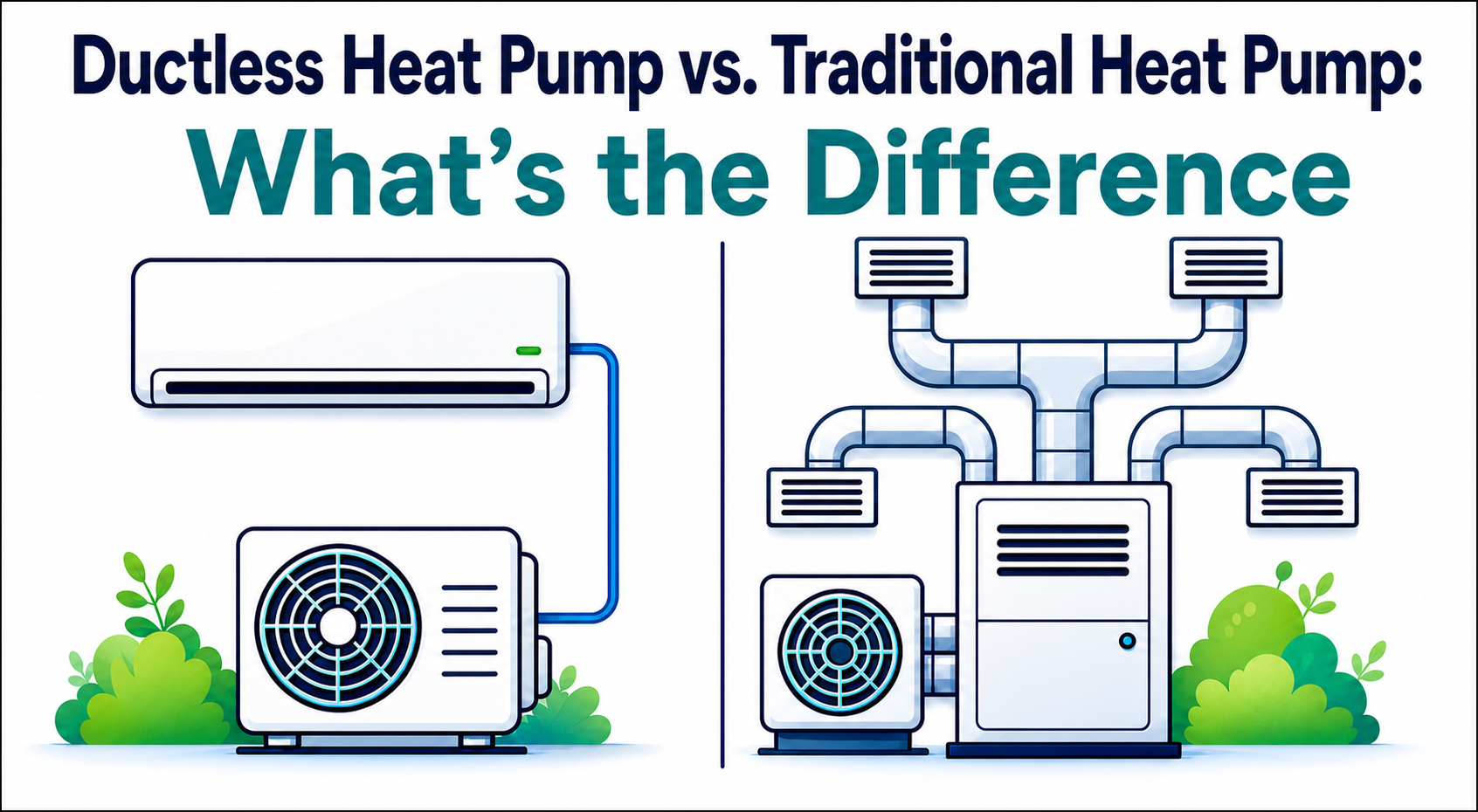
A traditional heat pump conditions air through a duct network connected to a central air handler. A ductless system delivers refrigerant directly to wall-mounted heads with no ductwork at all. Both heat and cool using the same refrigerant cycle, no combustion.
For a traditional heat pump to work, three things need to exist:
- An indoor air handler to move and condition the air
- A supply duct network sized to reach every room
- Return ducts large enough to pull air back without starving the system
When all three exist and are in good shape, a traditional heat pump is usually the simpler swap.
A ductless system bypasses all of that. The outdoor unit connects to each wall-mounted head through a small refrigerant line set. One outdoor unit can run two to five heads depending on the system. Each head operates independently.
My Follansbee Home Has No Ductwork. What Are My Options?
Quick Answer:
Most Follansbee homes were built before World War II and never had forced-air ductwork. Adding ducts to these homes means dropping ceilings or cutting into walls for trunk lines. Ductless skips that entirely, going in through a 3-inch hole in the wall.
Follansbee's pre-WWII housing stock was built for radiators, window units, or nothing at all. The floor plans are typically two stories with plaster walls and minimal chase space for duct runs.
When a homeowner here asks about adding central forced air, the options are:
- Full duct addition: $6,000 to $10,000 or more, requires dropped ceilings or soffits in most rooms
- Mini-duct high-velocity system: less invasive but still requires small-diameter runs through walls and floors
- Ductless: a 3-inch wall penetration per zone, no ceiling or wall modification required beyond that
For a pre-WWII Follansbee home, ductless is almost always what we recommend. Faster install, minimal disruption, finished result looks intentional.
Does the Old Coke Plant Affect Which System Is Better?
Quick Answer:
Follansbee sits downwind of one of the Upper Ohio Valley's heaviest former industrial corridors. Particulate loads run higher than most towns we serve. Both ductless and traditional systems need more frequent filter cleaning here than anywhere else in this batch.
The former Wheeling-Pittsburgh coke works is gone, but particulate levels remain elevated from ongoing industrial activity in the corridor.
What that means for each system:
- Ductless: washable mesh filters in each indoor head need cleaning every 3 to 4 weeks in Follansbee, versus 4 to 6 weeks in cleaner-air towns
- Traditional: central filter replacements every 30 days at MERV 8 or higher; lower-MERV filters plug faster than the rating suggests in this area
- Both: annual professional coil cleaning matters more here than in rural or suburban locations
Neither system has an air quality advantage over the other. The difference is maintenance frequency. Ductless head filters are washable. Central filters are disposable.
8-Factor Head-to-Head: Ductless vs. Traditional Heat Pump
|
Factor |
Ductless Heat Pump |
Traditional Heat Pump |
|
Ductwork required |
No |
Yes |
|
Fits pre-WWII homes with no ducts |
Yes; purpose-built for it |
Needs $6K-$10K+ duct addition |
|
Install disruption in older homes |
Minimal; 3-inch wall penetration per zone |
High; ceilings and walls opened for duct runs |
|
Zone control |
Yes; each head runs independently |
No; whole-home thermostat |
|
Filter maintenance in industrial area |
Washable; every 3-4 weeks |
Disposable; every 30 days at MERV 8+ |
|
High-humidity performance |
Inverter modulates continuously |
Single-stage cycles fully on/off |
|
Cooling efficiency |
SEER2 rated; varies by model |
SEER2 rated; varies by model |
|
Heating efficiency |
HSPF2 rated; varies by model |
HSPF2 rated; varies by model |
7-Scenario Decision Guide for Follansbee Homes
|
Your situation |
Better fit |
|
Pre-WWII home with no existing ductwork |
Ductless |
|
Home with a working forced-air duct system already in place |
Traditional heat pump |
|
Want to control temperatures room by room |
Ductless |
|
Replacing an old furnace and AC; ducts are solid |
Traditional heat pump |
|
Adding comfort to one room or a basement that was never conditioned |
Ductless (single-zone) |
|
Concerned about filter costs near the industrial corridor |
Ductless (washable filters) |
|
Tight budget; existing ductwork is in good shape |
Traditional heat pump |
Frequently Asked Questions
Can ductless heat my whole house through a Follansbee winter?
Yes, with proper sizing. Modern inverter ductless systems hold full output down to 5 degrees Fahrenheit. Follansbee winters are cold but rarely sustain temperatures that low for long. A multi-zone system with heads in the main living areas handles whole-home heating.
How often do I need to clean my filters living near the old plant?
Plan on every 3 to 4 weeks for ductless head filters in Follansbee, versus every 4 to 6 weeks in a cleaner-air town. It takes about 10 minutes per head. Traditional central filters run every 30 days at MERV 8 or better.
Will ductless actually fit in my 1940s row house?
Yes. The outdoor unit sits on a ground pad or wall bracket beside the house. Each indoor head mounts high on the wall and connects through a 3-inch hole to the refrigerant line outside. No dropped ceilings, no soffits, no major wall work.
Which system costs less to run in Follansbee?
Ductless is typically lower operating cost in Follansbee because homes here rarely have existing ductwork. Ducts added to a pre-WWII house are almost always leaky at the connections, which bleeds conditioned air and raises the monthly bill.
If your Follansbee home has never had forced air and you are trying to figure out how to add heating and cooling without gutting the place, ductless is almost always the right starting point. Call (740) 825-9408 or schedule a free quote at honestfix.com.
Scott Merritt is a co-founder of Honest Fix Heating, Cooling and Plumbing and brings more than 30 years of experience across HVAC, leadership, and industry education. He serves in a senior leadership and oversight role, providing licensed guidance, reviewing HVAC educational content, and supporting technician training and documentation standards. Prior to co-founding Honest Fix, Scott founded and owned Fire & Ice Heating & Air Conditioning in Columbus, Ohio, which he operated for more than two decades before selling the company in 2025. During that time, he led programs and partnerships including Carrier Factory Authorized Dealer, Trane Comfort Specialist, and Rheem Pro Partner, helping establish high technical and training standards. Scott is the Ohio State HVAC license holder for Honest Fix and provides licensed oversight to help ensure work meets applicable codes and manufacturer requirements. Learn more about Scott’s background and role at Honest Fix by viewing his full leadership bio.
