
Ductless Heat Pump vs. Traditional Heat Pump: What's the Difference for Weirton, WV Homes?
June 27th, 2026
4 min read
Quick Answer
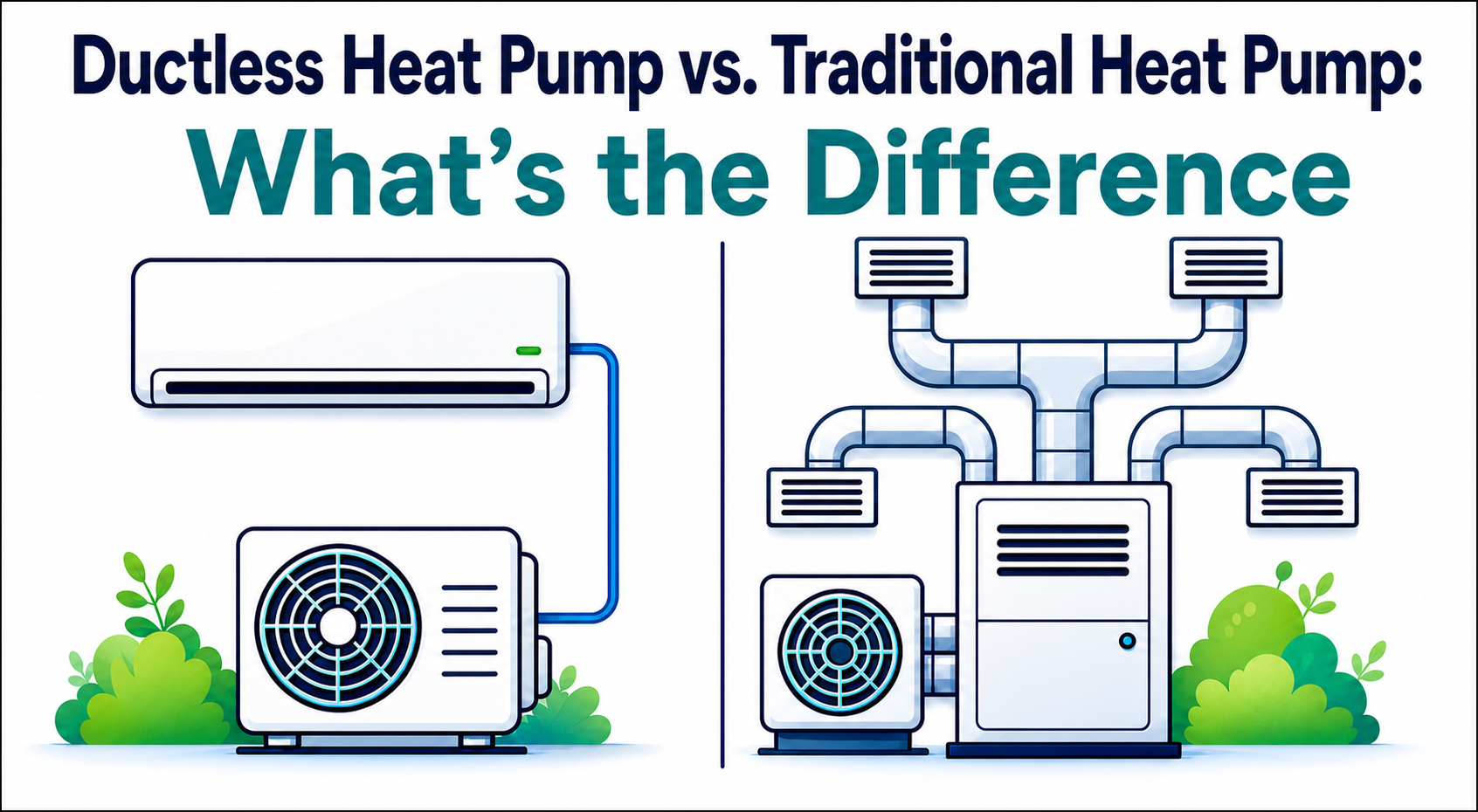
A traditional heat pump conditions air through ducts connected to a central air handler. Ductless sends refrigerant directly to wall-mounted heads -- no ductwork required. In Weirton, duct condition, elevation, and whether the home is in the river-flat or hillside zone are what separate them.
Weirton stretches from the Ohio River at roughly 660 feet up to hillside neighborhoods above 900 feet. That elevation split creates genuinely different conditions for home comfort equipment, and it is one reason we size and specify differently depending on your address.
We have worked in Weirton homes from the original mill-worker blocks near the river to the 1970s-1990s subdivisions up the hill. The answer here is not one-size-fits-all.
What Is the Core Difference Between These Two Systems?
Quick Answer:
A traditional heat pump moves conditioned air through ducts from a central air handler. A ductless heat pump delivers refrigerant directly to wall-mounted heads, one per zone, through a 3-inch wall penetration. No ductwork required, and each head operates independently.
Traditional heat pumps require three things to work correctly:
- An indoor air handler connected to the outdoor unit
- A supply duct network sized and routed to reach every room
- Return ducts large enough to pull air back to the handler without restriction
If your home already has ductwork in good condition, a traditional heat pump replaces your old furnace-and-AC combination directly. It is the lower-disruption path when ducts already exist.
Ductless systems skip the air handler and all duct runs. Each wall-mounted head connects to the outdoor unit via a refrigerant line set through a small wall opening. A single outdoor unit can power two to five indoor heads depending on the unit.
How Does Weirton's Housing Stock Factor In?
Quick Answer:
Pre-1950 mill housing in Weirton's river-flat neighborhoods was built without ductwork. Retrofitting ducts into these homes costs $6,000 to $10,000 or more and often compromises ceiling height and room layout. Ductless installs without touching existing structure.
Weirton's housing breaks into two broad categories, and the right system often follows that line:
- River-flat and downtown areas: pre-1940 to 1960s mill housing, two-story frame homes, row-style construction, typically no original ductwork. Ductless is usually the cleaner fit.
- Hillside neighborhoods: 1960s to 1990s ranches, split-levels, and colonials, most built with forced-air systems. Traditional heat pump replacement is often straightforward here.
Homes in the middle, say, a 1950s cape cod that had a boiler added later but no duct system, are the ones where a site visit and duct feasibility check matters most before you commit.
How Do River Humidity and Industrial Air Quality Affect the Choice?
Quick Answer:
Weirton's river-flat elevation, roughly 660 to 690 feet, puts those homes inside the Ohio River humidity corridor. Ductless inverter systems modulate output to match actual load, which helps on high-humidity summer nights. Steel mill particulates also load filters faster than in non-industrial towns.
Weirton Steel operated one of the largest integrated steel plants in North America. The facility footprint has changed, but particulates from continuing industrial operations affect filter loading throughout the city, especially in downwind neighborhoods.
What that means practically for either system:
- Ductless: clean the indoor head filters every 4 to 6 weeks (takes 10 minutes)
- Traditional: central filter changes every 30 to 60 days depending on MERV rating and location
- Both systems benefit from an annual professional coil cleaning in an industrial environment
On humidity: ductless inverter compressors run at variable speed, cycling down rather than off when demand drops. That continuous low-level operation removes more moisture than a single-stage traditional system that switches fully on and off.
8-Factor Head-to-Head: Ductless vs. Traditional Heat Pump
|
Factor |
Ductless Heat Pump |
Traditional Heat Pump |
|
Ductwork required |
No |
Yes |
|
Fits river-flat mill housing (no ducts) |
Yes; purpose-built for it |
Needs $6K-$10K+ duct addition |
|
Fits hillside homes with existing ducts |
Yes; can supplement or replace |
Yes; direct replacement |
|
Zone control |
Yes; each head is independent |
No; whole-home thermostat |
|
High-humidity performance |
Strong; inverter modulates continuously |
Single-stage cycles fully on/off |
|
Filter maintenance in industrial area |
Every 4-6 weeks; easy to clean |
30-60 day replacements |
|
Cooling efficiency |
SEER2 rated; varies by model |
SEER2 rated; varies by model |
|
Heating efficiency |
HSPF2 rated; varies by model |
HSPF2 rated; varies by model |
7-Scenario Decision Guide for Weirton Homes
|
Your situation |
Better fit |
|
River-flat home built before 1960, no ductwork |
Ductless |
|
Hillside home with good existing forced-air ductwork |
Traditional heat pump |
|
Any home where you want room-by-room temperature control |
Ductless |
|
Replacing existing central system; ducts are sound |
Traditional heat pump |
|
Adding comfort to one problem room or addition |
Ductless (single-zone) |
|
Concerned about high-humidity summer performance |
Ductless (inverter advantage) |
|
Budget is the primary constraint and ducts already exist |
Traditional heat pump |
Frequently Asked Questions
Can a ductless system heat a whole house in Weirton, WV winters?
Yes, with proper sizing. Modern inverter ductless systems maintain full output to 5 degrees Fahrenheit. Weirton winters get cold but rarely sustain temperatures below that threshold. A multi-zone system with heads in each main living area handles whole-home heating.
What if my Weirton home has a boiler with radiators instead of ducts?
Ductless is the standard answer. Adding forced-air ductwork to a radiator home is expensive and disruptive. A multi-zone ductless system works alongside the boiler or replaces it entirely, without opening walls or ceilings for duct runs.
Does the steel mill location matter for which system I choose?
It matters for maintenance frequency, not for the system choice itself. Both systems need more frequent filter cleaning in Weirton than in a rural setting. Ductless head filters are washable and faster to clean than central system cartridge replacements.
Is ductless more efficient than a traditional heat pump in Weirton?
In most cases, yes. Ductless eliminates duct losses and runs at variable speed rather than cycling on and off. For river-flat homes where existing ductwork would need to be installed new, the efficiency advantage of ductless is clearest.
Whether you are in the river-flat blocks or up on the hill, we do a free exact quote on ductless and traditional heat pump installations in Weirton. Call (740) 825-9408 or schedule at honestfix.com. We will tell you what fits your actual house, not a category.
Scott Merritt is a co-founder of Honest Fix Heating, Cooling and Plumbing and brings more than 30 years of experience across HVAC, leadership, and industry education. He serves in a senior leadership and oversight role, providing licensed guidance, reviewing HVAC educational content, and supporting technician training and documentation standards. Prior to co-founding Honest Fix, Scott founded and owned Fire & Ice Heating & Air Conditioning in Columbus, Ohio, which he operated for more than two decades before selling the company in 2025. During that time, he led programs and partnerships including Carrier Factory Authorized Dealer, Trane Comfort Specialist, and Rheem Pro Partner, helping establish high technical and training standards. Scott is the Ohio State HVAC license holder for Honest Fix and provides licensed oversight to help ensure work meets applicable codes and manufacturer requirements. Learn more about Scott’s background and role at Honest Fix by viewing his full leadership bio.
