What Is the $5,000 Rule for HVAC — And Why It’s No Longer Valid
January 19th, 2026
3 min read
By Alex Largent

Quick Answer
The $5,000 Rule for HVAC says that if the age of your system multiplied by the cost of a repair exceeds $5,000, replacement is usually the better financial choice. While the logic still applies, the $5,000 threshold is outdated due to higher equipment costs, refrigerant phase-outs, and newer efficiency standards. Today, homeowners need to consider total ownership cost, not a fixed dollar rule.
If your furnace or air conditioner just failed, you’re likely facing a hard decision—repair it or replace it—and you need an answer fast. That’s why homeowners across the Upper Ohio Valley, including Steubenville, Weirton, Toronto, Wintersville, Mingo Junction, Follansbee, Wellsburg, Hooverson Heights, New Cumberland, Colliers, Brilliant, and Richmond, search for the $5,000 Rule when their system breaks down.
At Honest Fix, we work through this decision with homeowners every week. The rule can still help—but only if you understand where it no longer reflects today’s HVAC realities.
What Is the $5,000 Rule for HVAC?
The $5,000 Rule is a repair-versus-replacement guideline, not a requirement.
How the Formula Works
System Age (years) × Repair Cost ($) = Decision Number
- Below $5,000: Repair usually makes sense
- Above $5,000: Replacement is usually the safer long-term choice
Simple Examples
- 6-year-old AC + $600 repair
→ 6 × 600 = $3,600 → Repair - 14-year-old furnace + $700 repair
→ 14 × 700 = $9,800 → Replace
The original intent of the rule was to prevent homeowners from putting significant money into systems near the end of their usable life.
Why the $5,000 Rule Originally Made Sense
When the rule became popular:
- Full HVAC replacements were far less expensive
- Refrigerants were stable and widely available
- Efficiency standards changed slowly
- Major repairs carried less long-term risk
At the time, $5,000 represented a meaningful tipping point between repairing an aging system and starting over.
Why the $5,000 Rule Breaks Down in Today’s Market
The logic behind the rule still works.
The fixed $5,000 number does not.
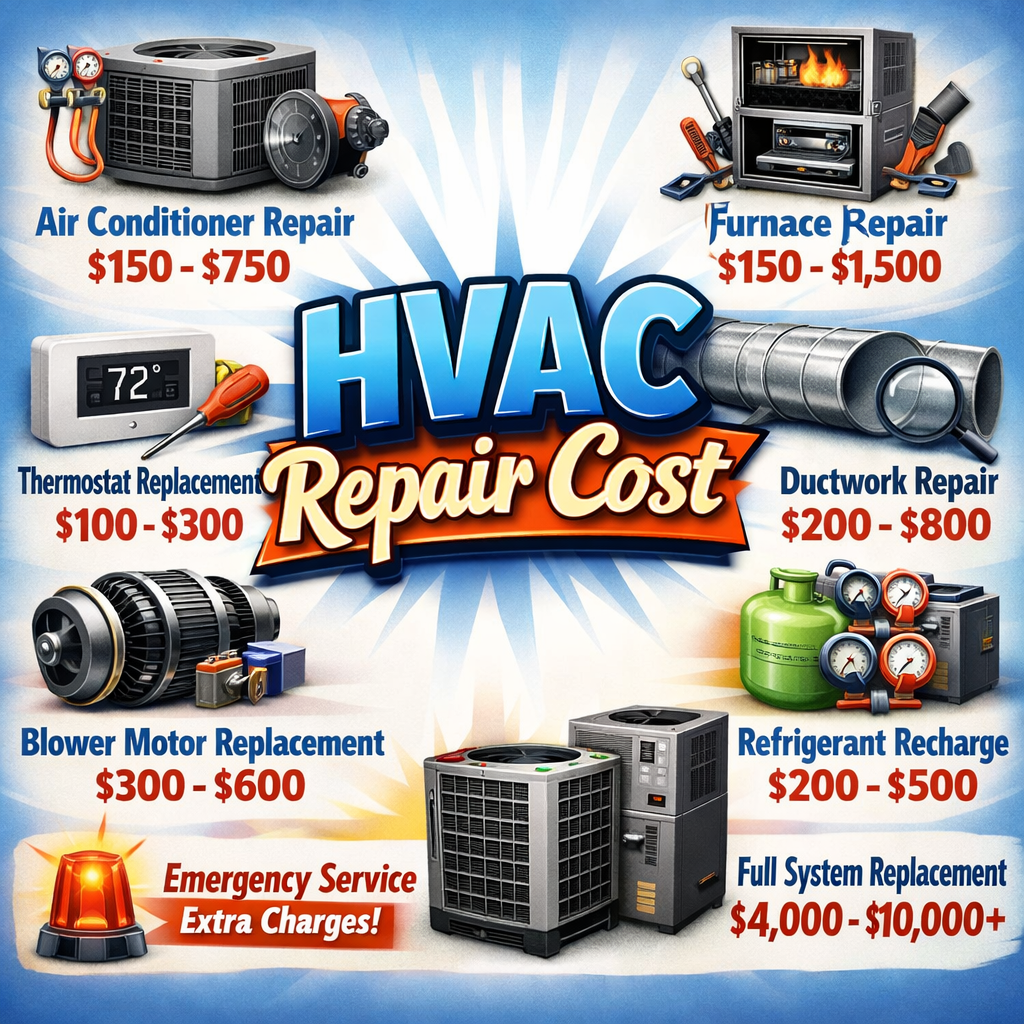
HVAC Replacement Costs Are Much Higher Today
One of the biggest reasons the $5,000 Rule no longer works is simple: replacement costs are dramatically higher than when the rule was created.
Below are Honest Fix’s current installed pricing ranges, taken directly from our website and reflective of real projects in the Upper Ohio Valley.
Air Conditioner Installation
Most homes fall between:
$6,460 – $14,970 installed
Furnace Installation
Most homes fall between:
$4,200 – $7,175 installed
Heat Pump + Air Handler Installation
Most homes fall between:
$11,880 – $24,225 installed
Full System Replacement (Heating + Cooling)
When both heating and cooling are replaced together:
- Furnace + Air Conditioner Full System:
$10,660 – $22,145 installed - Heat Pump + Air Handler Full System:
$11,880 – $24,225 installed
These are real installed ranges, including equipment, labor, permits, inspections, and Honest Fix guarantees—not stripped-down pricing.
Why These Pricing Ranges Are Wide
HVAC pricing varies because homes are not interchangeable. The biggest factors include:
- Home size and layout
- Condition and design of existing ductwork
- Efficiency level and comfort features
- Electrical or gas upgrades
- Installation complexity and access
- What’s included in the job
Honest Fix pricing includes proper sizing, code compliance, system testing, and long-term guarantees. Lower advertised prices often exclude these steps—and the cost shows up later.
How This Relates Back to the $5,000 Rule
When a full system replacement can realistically range from $10,000 to well over $20,000, using a fixed $5,000 repair rule without context can lead to bad decisions.
- A $600 repair on a system that would cost $11,000 to replace
- A $600 repair on a system that would cost $22,000 to replace
That’s why the rule should be treated as a starting point, not a final answer.
Refrigerant Phase-Outs Add New Risk
Most systems installed over the last decade use R-410A refrigerant.
- New equipment is moving away from it
- Supply is tightening over time
- Service costs can rise unpredictably
Any repair involving refrigerant carries added long-term risk, which the $5,000 Rule does not account for.
The Biggest Limitation of the $5,000 Rule
It treats all repairs as equal.
They are not.
A simple electrical repair is very different from:
- A compressor failure
- A leaking evaporator coil
- A cracked heat exchanger
The rule ignores safety concerns, refrigerant exposure, warranty coverage, and repeat breakdown patterns.
When the $5,000 Rule Still Helps
The rule can still guide decisions when:
- The system is under 10 years old
- The repair does not involve refrigerant
- The failed part is under warranty
- The system has been reliable overall
When the $5,000 Rule Gives the Wrong Answer
- Major component failures on older systems
- Refrigerant-related repairs
- Repeated breakdowns in a short time span
- Safety-related failures, such as cracked heat exchangers
In these cases, replacement often makes more sense even if the math looks close.
What Guarantees Do You Offer?
Repairs — Service Trust Guardian
- 5-Year Labor Warranty
- 60-Day Money-Back Satisfaction Guarantee
- No Overtime Charges
- On-Time Arrival and Clean Work Guarantees
Replacements — Lifetime Trust Shield
- 15-Year Labor Warranty
- No-Lemon Guarantee
- Energy Savings Guarantee
- Full Money-Back Satisfaction Guarantee
Final Takeaway
The $5,000 Rule isn’t wrong—it’s incomplete.
It was built for a different HVAC market.
Today’s decisions require clearer pricing context and long-term thinking.
Use the $5,000 Rule as a guide, not a verdict.
Your Next Step
If your system is failing and you’re weighing repair versus replacement, call Honest Fix today for a free exact quote.
We’ll walk you through the numbers clearly so you can make the right decision for your home.
No upsells. No games. Just Honest Fixes.
Alex Largent is the Owner and Senior HVAC Efficiency Analyst at Honest Fix Heating, Cooling & Plumbing. With more than 20 years of field experience, NATE and EPA certifications, and a hands-on leadership style, Alex teaches his team to fix systems right the first time — with transparency, precision, and no upsells. He writes about HVAC diagnostics, home energy efficiency, and practical maintenance advice for homeowners across the Upper Ohio Valley. Read Alex Largent’s full bio to learn more about his expertise in the HVAC and Plumbing industry. Updated October 2025.