Variable-Speed vs Fixed-Speed AC: What’s the Difference in Steubenville, OH & Weirton, WV?
February 14th, 2026
3 min read
Quick Answer
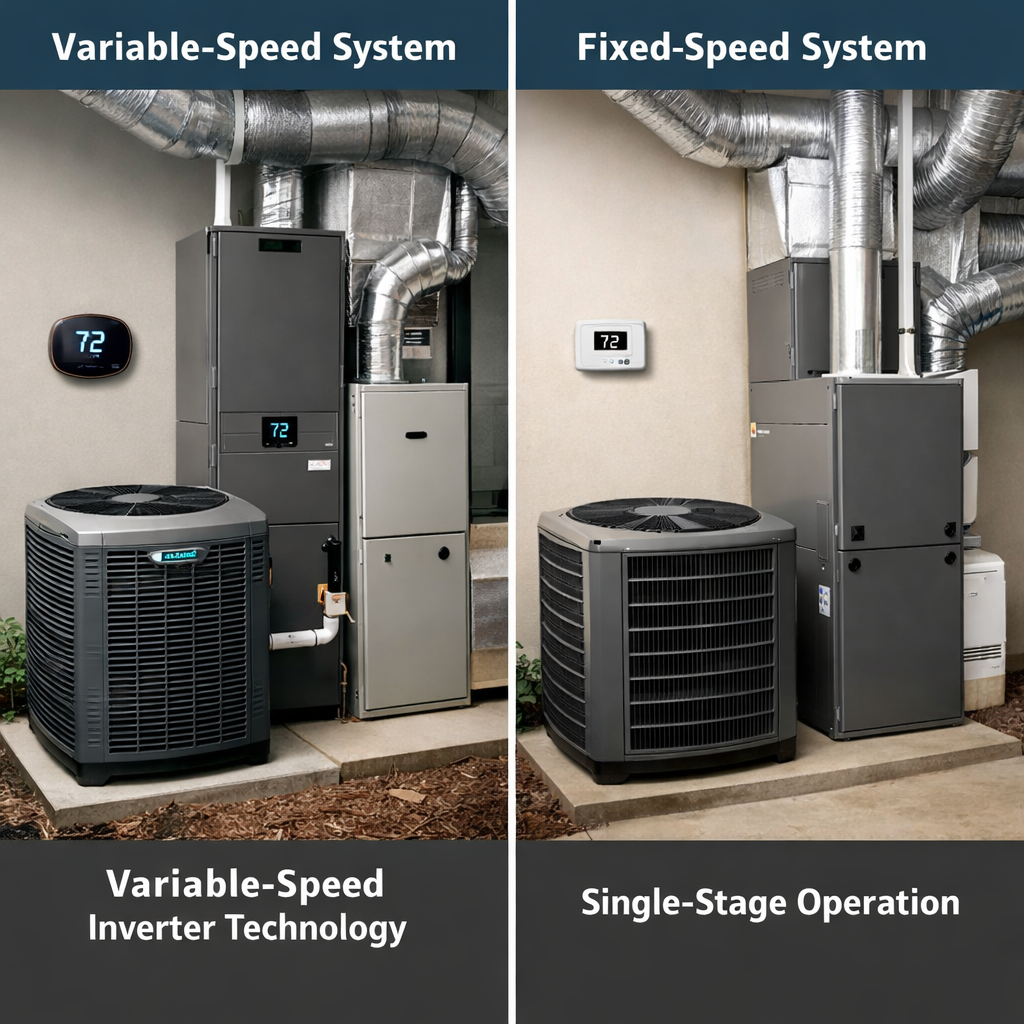
A fixed-speed AC runs at full power whenever it turns on. A variable-speed AC adjusts output continuously based on demand. In humid Ohio River valley climates like Steubenville and Weirton, variable-speed systems provide steadier temperatures, better humidity control, and smoother operation during long summer runtime periods.
Homes near the Ohio River in Steubenville, hillside properties in Weirton, ranch homes in Wintersville, and older homes in Toronto, Mingo Junction, Follansbee, Wellsburg, Brilliant, New Cumberland, Colliers, and Hooverson Heights often deal with extended cooling cycles and uneven airflow. Valley humidity and mixed insulation levels make how a system runs more important than simply how large it is.
How a Fixed-Speed AC Works
A fixed-speed (single-stage) AC system:
- Runs at 100% capacity
- Shuts off completely once the set temperature is reached
- Repeats that cycle throughout the day
On a typical July afternoon in Steubenville — 88°F with high humidity — a fixed-speed system may run hard for 10–15 minutes, shut off, then restart shortly after.
This creates:
- Noticeable temperature swings
- Frequent on/off cycling
- Shorter moisture removal windows
Fixed-speed systems are mechanically simpler and generally involve fewer electronic components.
How Variable-Speed AC Works
A variable-speed system:
- Uses an inverter-driven compressor
- Adjusts output gradually
- Runs at lower capacity for longer periods
Instead of cycling fully on and off, it may operate at 30–60% capacity for extended periods.
In Weirton’s humid hillside neighborhoods, that longer runtime allows the indoor coil to stay cold longer, improving moisture removal without overcooling.
In Upper Ohio Valley installations, properly matched variable-speed systems often improve comfort stability in multi-level homes when duct design is balanced.
Side-by-Side Comparison
| Category | Fixed-Speed | Variable-Speed |
|---|---|---|
| Operation Style | Full output or off | Modulates continuously |
| Temperature Stability | Wider swings | Consistent indoor conditions |
| Humidity Control | Limited during short cycles | Improved during extended runtime |
| System Complexity | Simpler design | Inverter compressor, advanced control boards, ECM blower motor |
| Investment Structure | Lower upfront cost | Higher due to inverter technology and calibration requirements |
Why Cost Differences Exist
Variable-speed systems include:
- Inverter-driven compressor technology
- Variable-speed ECM blower motor
- Advanced control boards
- More detailed setup and airflow calibration
That added technology increases upfront investment and long-term electronic complexity. Fixed-speed systems remain more mechanically straightforward.
Payback & Runtime Logic
Efficiency gains depend on runtime.
If your system runs long hours due to humidity — common in Steubenville river-adjacent homes and Toronto or Wellsburg properties with valley moisture — efficiency improvements compound over time.
If your home:
- Is smaller
- Has balanced airflow
- Maintains stable temperature
- Rarely experiences long cooling cycles
The financial return may be modest.
Variable-speed systems often deliver stronger comfort benefits than pure energy savings.
Electrical & Installation Considerations
Variable-speed systems use inverter boards that are more sensitive to:
- Voltage fluctuations
- Improper grounding
- Aging electrical panels
In older homes throughout Mingo Junction, Follansbee, and Brilliant, electrical evaluation is important before installation.
Static pressure and duct airflow must also be verified. Restricted return air can reduce performance and stress components regardless of technology level.
Installation quality determines outcome.
When Variable Speed Makes Sense
Variable-speed systems are typically beneficial if:
- Humidity control is a priority
- Temperature swings are noticeable
- The home has multiple levels
- You plan long-term occupancy
- Ductwork is properly sized and balanced
They may not be necessary if:
- The home is under 1,500 sq ft
- Layout is open and single-level
- Insulation is consistent
- Budget simplicity is a priority
In newer New Cumberland and Colliers homes with tight construction, fixed-speed systems often perform adequately.
Repair & Ownership Considerations
Fixed-speed systems:
- Simpler component layout
- Fewer advanced electronics
Variable-speed systems:
- Inverter boards
- Communicating controls
- More electronic service points
Outside of warranty, advanced electronic components may involve higher replacement cost.
For systems installed by Honest Fix:
Trust Shield Warranty
- 5-year parts coverage
- 5-year labor coverage
Trust Guardian Warranty
- 15-year extended protection
Warranty strength becomes more important as system technology increases.
Frequently Asked Questions
Is variable-speed always more efficient?
Not automatically. Efficiency improvements depend on runtime, airflow, and installation quality.
Does variable-speed eliminate humidity problems?
It improves moisture control but does not replace dedicated dehumidification in high-moisture homes.
Are repairs more complex?
Variable-speed systems involve more electronic components, which can increase repair complexity compared to fixed-speed systems.
Is fixed-speed outdated?
No. Fixed-speed systems remain reliable and practical for certain layouts and budgets.
Fixed-speed AC systems provide straightforward, reliable cooling. Variable-speed systems deliver steadier comfort and improved humidity control in humid river valley climates. In Steubenville, Weirton, and surrounding Upper Ohio Valley communities, variable-speed technology often improves comfort — when airflow and installation are done correctly.
Scott Merritt is a co-founder of Honest Fix Heating, Cooling and Plumbing and brings more than 30 years of experience across HVAC, leadership, and industry education. He serves in a senior leadership and oversight role, providing licensed guidance, reviewing HVAC educational content, and supporting technician training and documentation standards. Prior to co-founding Honest Fix, Scott founded and owned Fire & Ice Heating & Air Conditioning in Columbus, Ohio, which he operated for more than two decades before selling the company in 2025. During that time, he led programs and partnerships including Carrier Factory Authorized Dealer, Trane Comfort Specialist, and Rheem Pro Partner, helping establish high technical and training standards. Scott is the Ohio State HVAC license holder for Honest Fix and provides licensed oversight to help ensure work meets applicable codes and manufacturer requirements. Learn more about Scott’s background and role at Honest Fix by viewing his full leadership bio.