Zoned vs Non-Zoned AC Systems: What’s the Difference in Steubenville, OH & Weirton, WV?
February 15th, 2026
3 min read
Quick Answer
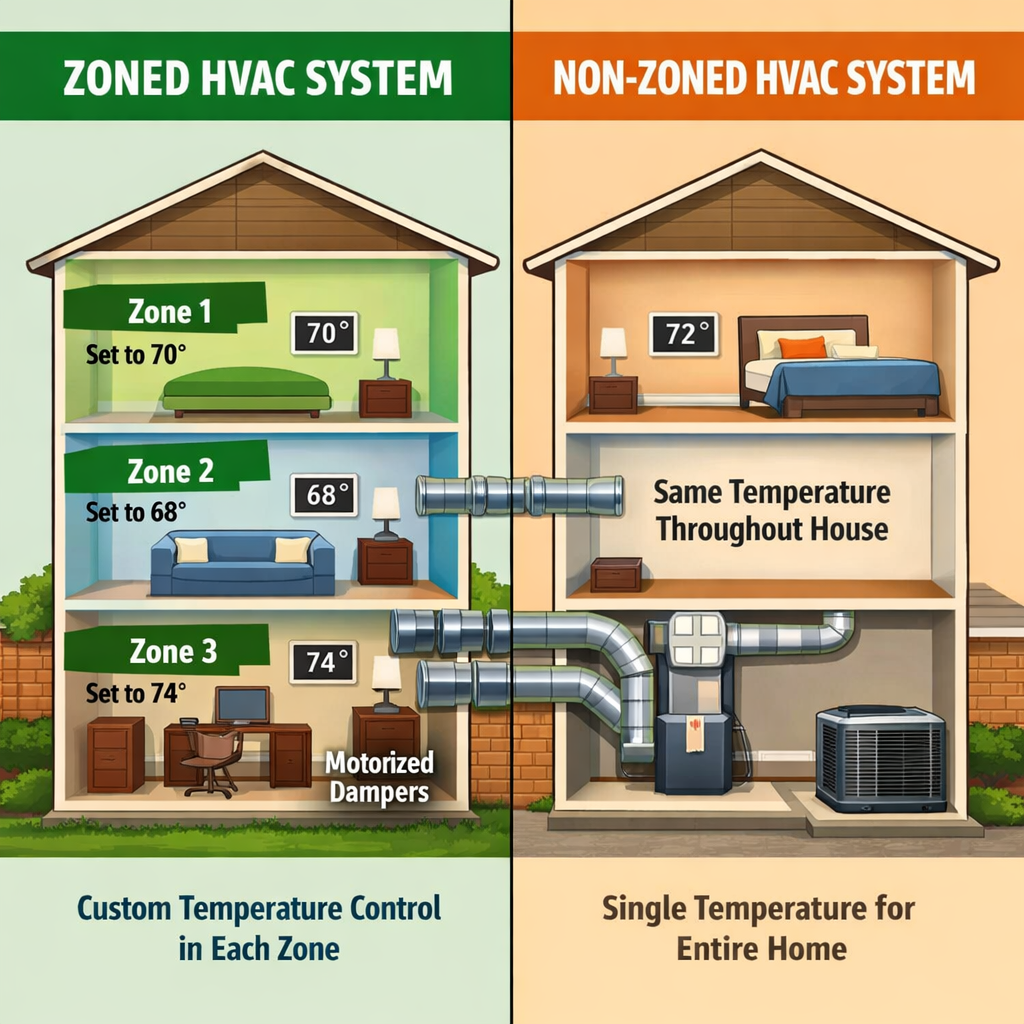
A non-zoned AC system cools your entire home from one thermostat. A zoned system uses multiple thermostats and motorized dampers to control different areas independently. Zoned systems improve comfort in multi-level or uneven-layout homes common in Steubenville and Weirton, but they add equipment, design complexity, and installation cost.
Homes near the Ohio River in Steubenville, hillside split-levels in Weirton, ranch homes in Wintersville, and older properties in Toronto, Mingo Junction, Follansbee, Wellsburg, Brilliant, New Cumberland, Colliers, and Hooverson Heights often struggle with uneven cooling. Valley humidity, mixed insulation levels, and multi-story construction patterns make temperature imbalance common across the Upper Ohio Valley.
How a Non-Zoned AC System Works
A non-zoned system includes:
- One thermostat
- One control board
- One temperature setting for the entire house
When the thermostat calls for cooling, conditioned air is distributed throughout the full duct system.
In smaller single-level homes or open floor plans, this setup works well.
However, in many Upper Ohio Valley homes we frequently see:
- Second floors running 3–5 degrees warmer
- Finished basements staying cooler
- Sun-facing rooms overheating
- Long trunk lines causing airflow loss
Non-zoned systems cannot adjust airflow based on room-by-room demand.
How a Zoned AC System Works
A zoned system adds:
- Multiple thermostats
- A zoning control panel
- Motorized dampers installed inside ductwork
Each thermostat controls a defined zone. When one zone calls for cooling, dampers open for that area and restrict airflow elsewhere.
This allows independent temperature control for:
- Upper and lower levels
- Bedrooms vs living areas
- Additions and bonus rooms
In split-level homes common in Weirton and New Cumberland, zoning reduces constant thermostat adjustments.
Zoned vs Non-Zoned: Direct Comparison
| Category | Non-Zoned System | Zoned System |
|---|---|---|
| Temperature Control | One setting for entire home | Independent control by zone |
| Energy Use | Entire home cools each cycle | Only calling zones receive airflow |
| Equipment Complexity | Fewer components | Dampers, zone board, additional wiring |
| Installation Cost | Standard HVAC installation | Added hardware, duct modifications, electrical work, and design time |
Zoning does not automatically lower energy use. It reduces unnecessary runtime when certain areas do not need cooling.
Why Zoning Matters More in This Region
Upper Ohio Valley homes present specific challenges:
- River valley humidity increases runtime
- Hillside construction creates airflow imbalance
- Older duct systems limit return air capacity
- Mixed insulation levels create uneven heat gain
A 1990s Weirton split-level with a finished basement often experiences strong temperature separation between floors.
A 1950s Steubenville brick home with undersized returns may overcool the first floor just to make upstairs livable.
Zoning helps when structure creates imbalance.
Critical Design Consideration: Static Pressure
Zoning changes airflow patterns.
If dampers close too many branches at once, static pressure inside the duct system increases.
Excess static pressure can:
- Reduce equipment lifespan
- Trigger safety shutoffs
- Cause noise issues
- Strain blower motors
Proper zoning design requires:
- Static pressure measurement
- Equipment compatibility verification
- Minimum airflow calculations
Zoning should never be added without evaluating duct capacity.
When Zoning Makes Financial Sense
Zoning is typically beneficial if:
- Your home has multiple levels
- Hot and cold spots persist
- Additions or bonus rooms exist
- Bedrooms are occupied at different times
- You plan long-term occupancy
Zoning may not be necessary if:
- The home is single-level and open concept
- Airflow is already balanced
- Temperature variation is minimal
- You plan short-term ownership
In many homes in Toronto, Wellsburg, and Brilliant, duct corrections alone resolve comfort issues without zoning.
Utility & Runtime Context
Cooling costs in Steubenville are influenced by AEP Ohio electric rates. In Weirton and surrounding areas, electric service structures vary.
Because air conditioning can represent 40–50% of summer electrical use, runtime reduction matters — but only if zones truly allow portions of the home to remain inactive.
If all zones frequently call for cooling, energy savings may be minimal.
Warranty & Long-Term Reliability
Zoning adds components:
- Damper motors
- Zone control boards
- Additional wiring connections
More components mean more potential service points.
Honest Fix offers:
Trust Shield Warranty
- 5-year parts coverage
- 5-year labor coverage
Trust Guardian Warranty
- 15-year extended protection
- Designed for long-term homeowners
Warranty strength becomes more important when additional electrical and mechanical controls are introduced.
Frequently Asked Questions
Can zoning be added to an existing system?
In many cases, yes — if duct layout supports damper placement and equipment airflow capacity is verified.
Will zoning fix a hot upstairs bedroom?
If insulation and duct sizing are adequate, zoning improves independent control. If airflow is restricted, duct correction may be required first.
Does zoning lower electric bills?
It can reduce unnecessary cooling, but savings depend on how often zones operate independently.
Is zoning better for river-adjacent humidity?
Zoning improves temperature distribution. Humidity control depends primarily on system sizing and runtime, not zoning alone.
Zoned systems provide independent temperature control and improved comfort in multi-level Upper Ohio Valley homes. Non-zoned systems remain practical for balanced layouts. The right decision depends on structure, airflow design, and how long you plan to stay.
Scott Merritt is a co-founder of Honest Fix Heating, Cooling and Plumbing and brings more than 30 years of experience across HVAC, leadership, and industry education. He serves in a senior leadership and oversight role, providing licensed guidance, reviewing HVAC educational content, and supporting technician training and documentation standards. Prior to co-founding Honest Fix, Scott founded and owned Fire & Ice Heating & Air Conditioning in Columbus, Ohio, which he operated for more than two decades before selling the company in 2025. During that time, he led programs and partnerships including Carrier Factory Authorized Dealer, Trane Comfort Specialist, and Rheem Pro Partner, helping establish high technical and training standards. Scott is the Ohio State HVAC license holder for Honest Fix and provides licensed oversight to help ensure work meets applicable codes and manufacturer requirements. Learn more about Scott’s background and role at Honest Fix by viewing his full leadership bio.