Dehumidifier vs AC: Which Controls Humidity Better in Steubenville, OH & Weirton, WV?
February 14th, 2026
3 min read
Quick Answer
Air conditioners remove some humidity while cooling, but they are designed to control temperature first. A whole-home dehumidifier removes moisture independently of cooling cycles. In humid Ohio River valley climates like Steubenville and Weirton, a dedicated dehumidifier provides more consistent and controlled humidity reduction than an AC system alone.
Homes near the Ohio River in Steubenville, hillside properties in Weirton, ranch homes in Wintersville, and older homes in Toronto, Mingo Junction, Follansbee, Wellsburg, Brilliant, New Cumberland, Colliers, and Hooverson Heights often experience persistent indoor moisture. River valley humidity, finished basements, and mixed insulation levels make humidity control a comfort and indoor air quality issue across the Upper Ohio Valley.
How an AC System Handles Humidity
Air conditioners remove humidity as a secondary effect of cooling.
When warm air passes over the evaporator coil:
- Moisture condenses
- Water drains away
- Air temperature drops
However, humidity removal only happens when the system is actively cooling.
In the Upper Ohio Valley, it’s common to see days where it’s 72°F and cloudy with 65% outdoor humidity. The AC doesn’t run much — but the house feels damp.
Short cooling cycles reduce moisture removal.
AC systems are designed to control temperature. Humidity control is secondary.
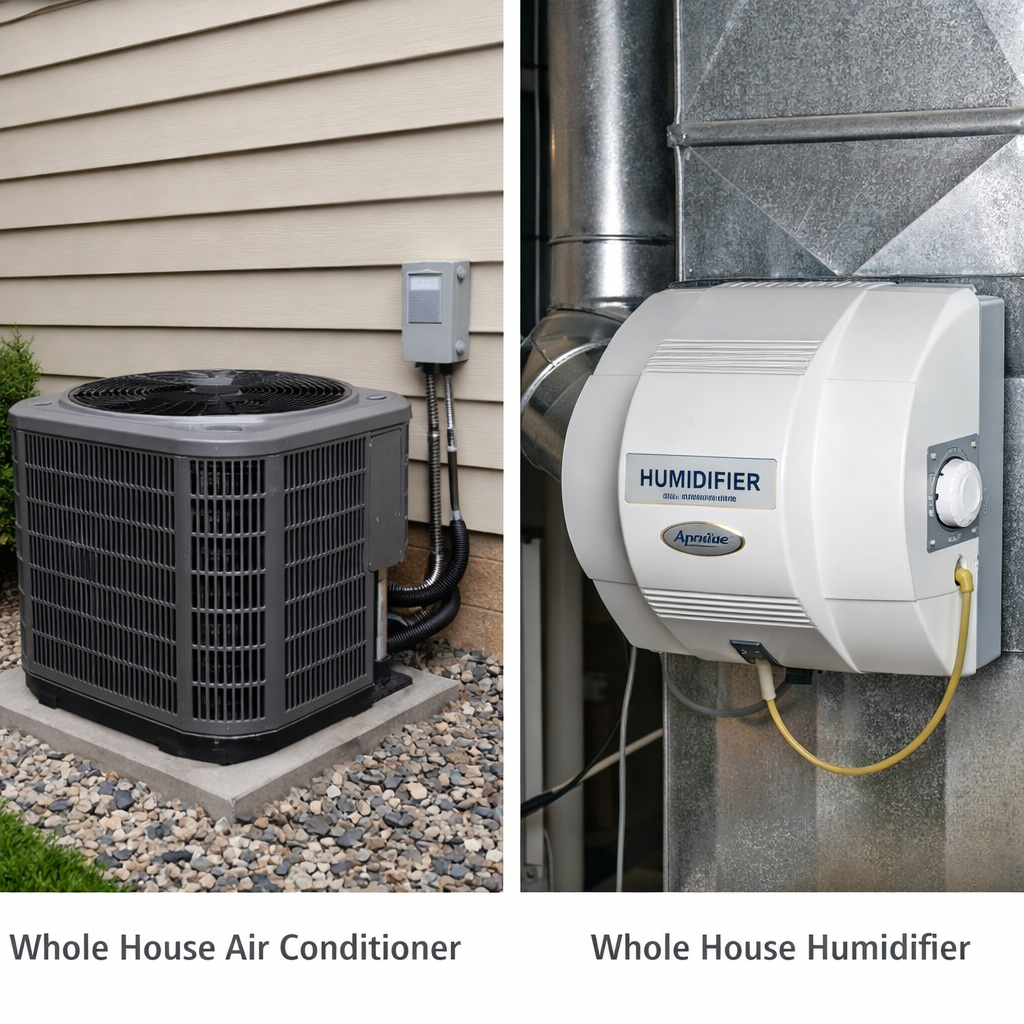
How a Whole-Home Dehumidifier Works
A whole-home dehumidifier:
- Connects to the duct system
- Pulls return air independently
- Removes moisture regardless of cooling demand
- Drains water through a dedicated line
It runs based on humidity level, not temperature.
This allows it to maintain 45–50% relative humidity even during mild spring and fall weather.
We install Aprilaire whole-home dehumidifiers for this reason. I have one in my own home after years of seeing persistent valley humidity affect comfort despite proper AC sizing.
Side-by-Side Comparison
| Category | Air Conditioner | Whole-Home Dehumidifier |
|---|---|---|
| Primary Purpose | Temperature control | Moisture control |
| Operation | Runs only when cooling is needed | Runs whenever humidity exceeds setpoint |
| Spring/Fall Performance | Limited control | Consistent humidity reduction |
| System Investment | Included in standard HVAC replacement | Additional equipment requiring duct integration and electrical connection |
Why This Matters More in River Valley Homes
Upper Ohio Valley homes experience:
- 70–85% summer humidity
- River-adjacent moisture exposure
- Basement dampness
- Window condensation
- Musty odors in finished lower levels
Sustained indoor humidity above 60% increases mold growth risk and dust mite activity.
In Steubenville brick homes near the river and Weirton hillside split-levels, moisture lingers even when temperatures are comfortable.
Lowering the thermostat to remove humidity often leads to overcooling and higher energy use.
A dedicated dehumidifier targets moisture directly without excessive cooling.
AC Upgrade vs Dehumidifier: Important Distinction
High-efficiency variable-speed AC systems improve moisture removal compared to single-stage units.
However:
- They still depend on cooling runtime.
- They cannot control humidity when cooling is not needed.
A dehumidifier operates independently.
Upgrading AC improves performance. Adding a dehumidifier improves moisture control specifically.
They solve different problems.
Energy & Electrical Considerations
Whole-home dehumidifiers use electricity.
However, they may:
- Reduce overcooling
- Allow slightly higher thermostat settings
- Improve perceived comfort
Because comfort depends on humidity as much as temperature, many homeowners feel comfortable at higher thermostat settings once humidity is controlled.
When You Likely Do NOT Need One
A whole-home dehumidifier may not be necessary if:
- Indoor humidity consistently stays below 50–55%
- No musty odors exist
- No basement dampness is present
- Windows do not sweat in summer
- Your AC runs long cycles daily
Some newer homes in New Cumberland and parts of Colliers with tight construction and variable-speed systems maintain stable humidity without additional equipment.
Installation & Design Considerations
Whole-home dehumidifiers:
- Tie into the return duct
- Require dedicated drainage
- Add airflow considerations
Proper duct sizing and static pressure evaluation matter before installation.
Like any HVAC component, integration quality determines performance.
Warranty & Protection
For systems installed by Honest Fix:
Trust Shield Warranty
- 5-year parts coverage
- 5-year labor coverage
Trust Guardian Warranty
- 15-year extended protection
Adding equipment introduces additional components. Warranty structure helps stabilize long-term ownership cost.
Frequently Asked Questions
Can I just lower my thermostat instead?
You can, but that increases energy usage and may make the home too cold. A dehumidifier targets moisture directly.
Does a high-efficiency AC eliminate the need for a dehumidifier?
Not always. It improves moisture removal during cooling, but cannot control humidity independently.
Are portable basement units the same?
No. Portable units treat isolated areas. Whole-home systems integrate with ductwork for balanced control.
Is humidity really that significant locally?
Yes. River valley conditions in Steubenville, Weirton, and surrounding towns frequently produce indoor humidity above ideal comfort levels.
Air conditioners reduce humidity as a secondary effect of cooling. Whole-home dehumidifiers are designed specifically for moisture control. In the humid river climate of the Upper Ohio Valley, dedicated dehumidification often provides more consistent comfort than relying on AC alone.
Scott Merritt is a co-founder of Honest Fix Heating, Cooling and Plumbing and brings more than 30 years of experience across HVAC, leadership, and industry education. He serves in a senior leadership and oversight role, providing licensed guidance, reviewing HVAC educational content, and supporting technician training and documentation standards. Prior to co-founding Honest Fix, Scott founded and owned Fire & Ice Heating & Air Conditioning in Columbus, Ohio, which he operated for more than two decades before selling the company in 2025. During that time, he led programs and partnerships including Carrier Factory Authorized Dealer, Trane Comfort Specialist, and Rheem Pro Partner, helping establish high technical and training standards. Scott is the Ohio State HVAC license holder for Honest Fix and provides licensed oversight to help ensure work meets applicable codes and manufacturer requirements. Learn more about Scott’s background and role at Honest Fix by viewing his full leadership bio.