Forced-Air vs. Radiant HVAC Systems in Steubenville OH and Weirton WV: What’s the Difference?
January 19th, 2026
4 min read
By Alex Largent
Quick Answer
Forced-air systems heat and cool by moving air through ducts, while radiant systems heat surfaces like floors without airflow. Forced-air systems support cooling, filtration, and faster temperature changes. Radiant systems provide steady, quiet heat only. In Steubenville and Weirton, existing ductwork, cooling needs, and retrofit limits usually make forced-air the more practical option.
This comparison explains how forced-air and radiant systems actually behave in real homes, including comfort differences, retrofit challenges, and cooling limitations. In older Ohio Valley houses, choosing the wrong system can lead to major construction costs or comfort problems that are difficult to reverse later.
Forced-Air vs. Radiant Systems: Key Differences at a Glance
- Forced-air: Uses ducts to distribute heated or cooled air; supports air conditioning; faster response
- Radiant: Delivers heat through floors, walls, or panels; no airflow; slow, even warmth
- Cooling capability: Forced-air yes; radiant no
- Retrofit difficulty: Forced-air moderate; radiant high in existing homes
Rule of thumb:
If the home needs cooling or quick temperature changes, forced-air fits better.
Second rule:
If a home already has ducts and needs year-round comfort, forced-air is usually the practical choice.
What Each System Actually Does—and Does Not Do
A forced-air HVAC system heats or cools air and distributes it through ductwork using a blower. It can provide heating, cooling, filtration, and humidity control within one system.
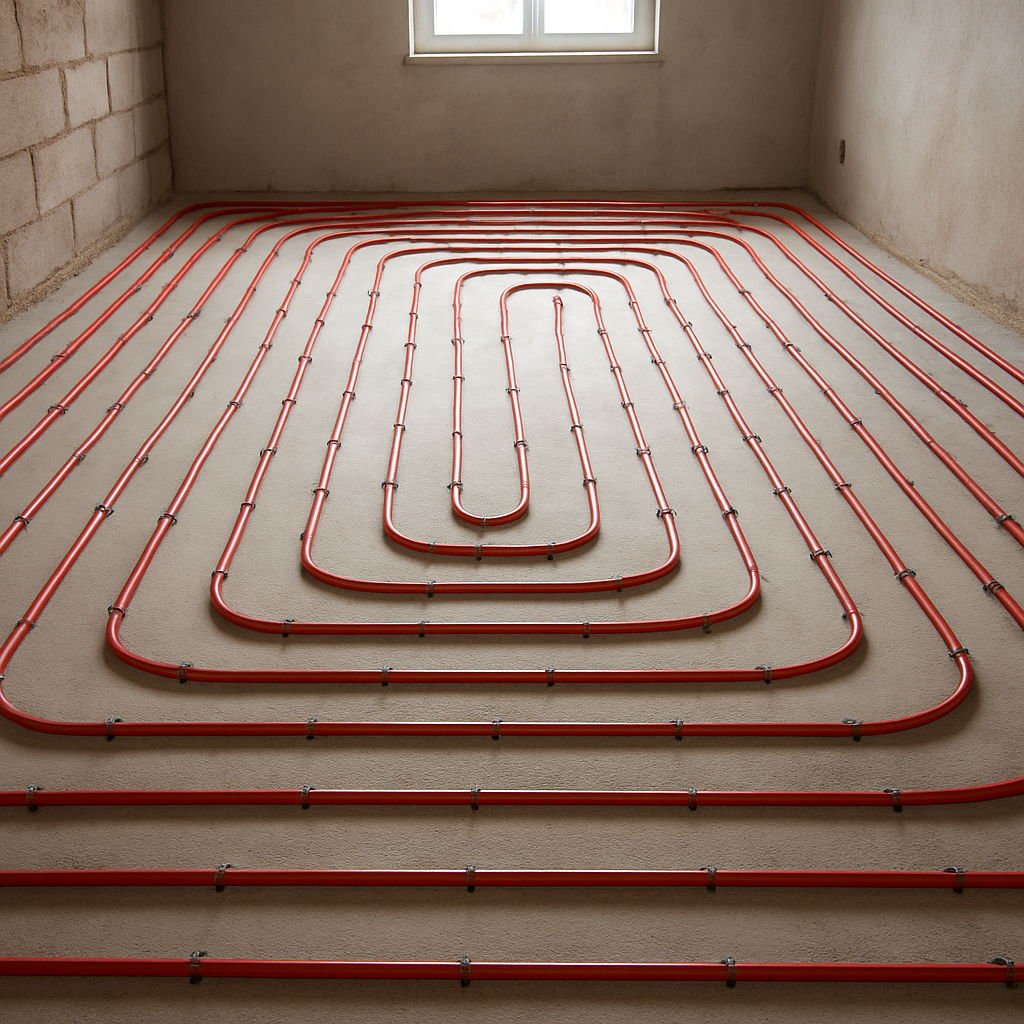
A radiant system heats surfaces—most commonly floors—using hot water or electric elements. Heat rises naturally into the space, creating even temperatures without moving air.
Important clarification:
Radiant heating is not a full HVAC system. It provides heat only and does not offer cooling, air filtration, or ventilation on its own.
Pros and Cons of Forced-Air HVAC Systems
Pros
- Provides both heating and central air conditioning
- Faster response to thermostat changes
- Supports air filtration and humidity control
- Easier to service and modify in most homes
Cons
- Ductwork can leak or create noise if poorly designed
- Airflow issues can cause uneven room temperatures
- Comfort depends heavily on duct condition
Forced-air systems remain the most common choice in Steubenville and Weirton because they align with existing ducted homes and regional cooling needs.
Pros and Cons of Radiant Heating Systems
Pros
- Even, consistent heat with minimal temperature swings
- Silent operation with no moving air
- Warm floors during winter
Cons
- No cooling capability
- Very slow temperature changes
- Difficult and costly to retrofit into existing homes
- Repairs may require opening floors or walls
A common misconception is that radiant heat is always “more efficient.” In practice, efficiency depends on insulation, fuel type, and how the home is built—not just the heating method.
New Construction vs. Existing Homes: Why This Matters
This comparison looks very different for new construction than for existing homes.
Radiant systems are best suited for homes designed around them from the start. In existing Ohio Valley homes, adding radiant heat often means removing finished floors or rebuilding structural assemblies.
Forced-air systems are far easier to replace or upgrade in homes that already have ductwork.
Common Local Mistake to Avoid
A common local mistake is assuming radiant heat can be added to an existing home without major floor or structural work. In many cases, the disruption and cost outweigh the comfort benefit—especially when cooling is still required.
Local Factors by Town That Affect the Best Choice
- Steubenville, OH: Older brick homes with basements favor forced-air due to existing ducts and cooling needs.
- Weirton, WV: Hills and elevation changes make airflow control important; forced-air allows zoning adjustments.
- Wintersville, OH: Suburban layouts often prioritize central cooling, favoring forced-air.
- Toronto, OH: River humidity increases the value of air movement and dehumidification.
- Mingo Junction, OH: Smaller homes often struggle to justify radiant retrofit costs.
- Follansbee, WV: Compact homes benefit from simpler forced-air upgrades.
- Wellsburg, WV: Mixed housing stock makes forced-air easier to adapt.
- Brilliant, OH: Straightforward layouts pair well with duct improvements.
- New Cumberland, WV: Drafty areas benefit from airflow and filtration.
- Colliers, WV: Multi-level homes often need active air circulation.
- Hooverson Heights, OH: Exposed walls and elevation changes favor systems that respond quickly to temperature swings.
Cost and Ownership Considerations
- Lower retrofit cost: Forced-air in existing homes
- Higher retrofit cost: Radiant in existing homes
Long-term satisfaction depends more on insulation quality, layout, and service access than on the heating method alone.
Installation and safety requirements are shaped by national mechanical and energy codes, which affect duct design, boiler installation, and access requirements.
A Real Local Example
A Steubenville home with existing ductwork and summer cooling needs is usually better served by improving or replacing a forced-air system rather than attempting a radiant retrofit. A newly built home in Weirton could incorporate radiant heating from the start—but would still need a separate cooling system.
Service Scope Clarification
Radiant heating systems require specialized design and installation. While they can be effective in specific applications, Honest Fix focuses on forced-air HVAC systems and does not install radiant heating systems. This comparison is provided strictly to help homeowners understand the differences and make informed decisions.
Who Each System Is—and Isn’t—a Good Fit For
Forced-air is usually a better fit if:
- The home already has ductwork
- Air conditioning is required
- Faster temperature changes matter
- Filtration and humidity control are priorities
Radiant heating is usually not a good fit if:
- The home requires cooling
- The project is a retrofit rather than new construction
- Floor or slab access is limited
Decision Shortcut for Ohio Valley Homes
If your home needs cooling and already has ducts, forced-air is usually the practical solution. Radiant systems make sense mainly in new construction designed specifically for them—not most existing Ohio Valley homes.
Warranties and Long-Term Reliability
Forced-air systems benefit from accessible components and widespread service support. Radiant systems can be durable, but repairs are often more complex when components are embedded beneath finished surfaces.
FAQ
Is radiant heat better than forced-air in Steubenville and Weirton?
Not usually. Radiant heat can feel comfortable, but most homes still need cooling, filtration, and responsive temperature control—making forced-air the more complete solution for the region.
Final Takeaway
Forced-air and radiant systems deliver heat in very different ways. Radiant systems offer quiet, even warmth but limited flexibility. Forced-air systems provide heating, cooling, and air control with easier serviceability. In most existing Ohio Valley homes, forced-air aligns better with layout, climate, and year-round comfort needs.
Alex Largent is the Owner and Senior HVAC Efficiency Analyst at Honest Fix Heating, Cooling & Plumbing. With more than 20 years of field experience, NATE and EPA certifications, and a hands-on leadership style, Alex teaches his team to fix systems right the first time — with transparency, precision, and no upsells. He writes about HVAC diagnostics, home energy efficiency, and practical maintenance advice for homeowners across the Upper Ohio Valley. Read Alex Largent’s full bio to learn more about his expertise in the HVAC and Plumbing industry. Updated October 2025.