Geothermal HVAC vs. Standard Systems in Steubenville OH and Weirton WV: What’s the Difference?
January 21st, 2026
4 min read
By Alex Largent
Quick Answer
Geothermal systems move heat between a home and the ground using buried loops, while standard HVAC systems use outdoor air and high-efficiency equipment for heating and cooling. Geothermal offers stable efficiency but comes with very high installation cost and site limitations. In Steubenville and Weirton, modern high-efficiency systems often deliver equal or better real-world efficiency, comfort, and value without excavation or major property disruption.
This comparison explains how geothermal and standard HVAC systems actually perform in real homes, including cost reality, comfort outcomes, and retrofit practicality. In many Ohio Valley houses, geothermal’s theoretical efficiency advantage disappears once installation complexity, airflow limits, and total ownership cost are considered.
Geothermal vs. Standard HVAC: Key Differences at a Glance
- Geothermal: Uses underground loops; stable source temperature; very high installation cost
- Standard HVAC: Uses outdoor air; wide range of high-efficiency options; far easier to install
- Property impact: Geothermal requires drilling or trenching; standard systems do not
- Retrofit practicality: Geothermal limited; standard HVAC widely adaptable
Rule of thumb: If the home is existing construction with limited land or budget, standard high-efficiency HVAC is usually the practical choice.
Second rule: If drilling, excavation, or property disruption is a concern, geothermal is rarely the right fit.
What Geothermal Systems Actually Do—and What They Don’t
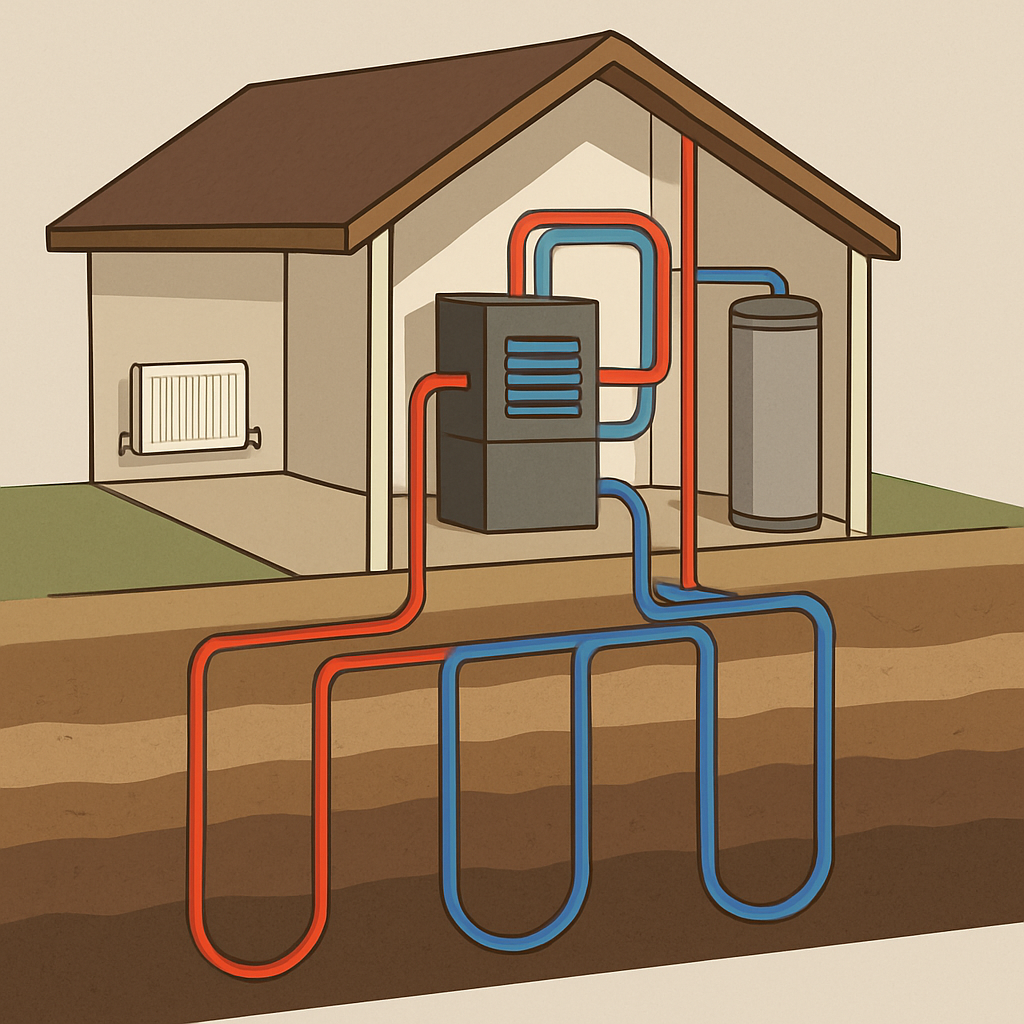
A geothermal HVAC system uses buried ground loops to exchange heat with the earth, which stays at a relatively consistent temperature year-round. That stable source temperature is the basis for geothermal’s efficiency claims.
However, geothermal efficiency does not measure comfort, airflow, or temperature consistency. Just like any other system, geothermal performance still depends on:
- Proper sizing
- Duct design and airflow
- Insulation and air sealing
Geothermal does not fix duct problems, uneven rooms, or poor insulation.
What Modern High-Efficiency HVAC Systems Do Differently
A standard high-efficiency HVAC system uses outdoor air as the heat source or heat sink, but modern designs have changed the equation. Today’s systems often include:
- Variable-speed compressors and blowers
- Cold-climate heat pump technology
- Advanced controls and zoning
- Smarter defrost and staging logic
These features allow modern systems to adapt output to actual demand, which in many Ohio Valley homes results in operating efficiency that rivals—or exceeds—geothermal once real usage and comfort are considered.
Pros and Cons of Geothermal HVAC Systems
Pros
- Stable operating efficiency year-round
- Long lifespan for underground loop fields
- Quiet outdoor operation
Cons
- Very high upfront installation cost
- Requires drilling, trenching, or significant land access
- Repairs can be complex and disruptive
- Limited flexibility for future home changes
Important cost reality: Geothermal is not automatically cheaper over time. In many homes, the installation cost outweighs any operating savings—especially when modern systems narrow the efficiency gap.
Pros and Cons of Standard High-Efficiency HVAC Systems
Pros
- Much lower installation cost than geothermal
- No excavation or drilling
- Easier service, repairs, and future upgrades
- Broad compatibility with existing homes
Cons
- Efficiency varies with outdoor conditions
- Requires good duct design and airflow
- Equipment replacement cycles are shorter than ground loops
For most Ohio Valley homes, these systems provide better overall value, comfort control, and serviceability.
Budget-Driven vs. Efficiency-Driven Decisions
Homeowners often approach this comparison from different angles:
- Efficiency-driven: Attracted to geothermal’s stable efficiency claims
- Budget-driven: Focused on total cost, disruption, and payback
In existing homes, budget-driven realities usually favor modern high-efficiency HVAC, while geothermal tends to fit only very specific, well-planned scenarios.
New Construction vs. Existing Homes: A Critical Divider
- New construction: Geothermal can be designed into the site if land, soil conditions, and budget allow
- Existing homes: Geothermal retrofits often require major excavation or drilling, making them impractical for most properties
Standard HVAC systems adapt far more easily to the existing Ohio Valley housing stock.
Common Local Mistake to Avoid
A common local mistake is assuming geothermal eliminates the need for duct improvements. Even with geothermal, poor airflow and duct leakage can erase efficiency gains and create comfort problems.
Local Factors by Town That Affect the Best Choice
- Steubenville, OH: Older brick homes with basements and limited yard access favor standard systems
- Weirton, WV: Hills and lot constraints make geothermal drilling difficult
- Wintersville, OH: Suburban layouts still face cost barriers for geothermal retrofits
- Toronto, OH: River-adjacent properties often lack space for ground loops
- Mingo Junction, OH: Smaller lots reduce geothermal feasibility
- Follansbee, WV: Compact properties favor flexible forced-air upgrades
- Wellsburg, WV: Mixed housing stock benefits from adaptable HVAC options
- Brilliant, OH: Existing ducted homes pair well with modern high-efficiency systems
- New Cumberland, WV: Drafty homes see more benefit from envelope improvements than geothermal
- Colliers, WV: Multi-level homes often need zoning rather than ground loops
- Hooverson Heights, OH: Elevation changes and lot limitations restrict geothermal practicality
Environmental Considerations (Without the Hype)
Some homeowners consider geothermal for environmental reasons. Modern electric heat pumps, especially when paired with cleaner power sources, can achieve similar environmental benefits without excavation or land disturbance.
Cost and Ownership Reality
- Highest installation cost: Geothermal
- Lower installation cost: Standard high-efficiency HVAC
Long-term satisfaction depends more on sizing, airflow, insulation, and service access than on system type alone.
A Real Local Example
A Steubenville home with existing ductwork and limited yard space would require extensive drilling for geothermal, often exceeding the cost of a high-efficiency variable-speed system. Upgrading to modern equipment with duct improvements can deliver excellent comfort and efficiency without disrupting the property.
Service Scope Clarification
Geothermal systems require specialized drilling and loop installation. Honest Fix does not install geothermal HVAC systems. This comparison is provided strictly for educational purposes so homeowners can understand differences and evaluate realistic options for their homes.
Who Each Option Is—and Isn’t—a Good Fit For
Geothermal may be a fit if:
- The home is new construction
- Land and drilling access are available
- Upfront cost is not a limiting factor
Standard HVAC is usually a better fit if:
- The home already exists
- Budget and disruption matter
- Flexibility and service access are priorities
Decision Shortcut for Ohio Valley Homes
If the home is existing construction and efficiency is the goal, modern high-efficiency HVAC systems usually provide better value than geothermal. Geothermal makes sense mainly when the site is designed for it from the ground up.
Warranties and Long-Term Reliability
Standard HVAC systems benefit from readily available parts and service coverage. While geothermal ground loops can last decades, repairs are specialized and often more costly when problems occur.
FAQ
Is geothermal HVAC worth it in Steubenville and Weirton?
For most existing homes, no. High installation costs, land constraints, and comparable performance from modern systems make standard HVAC the more practical choice.
Final Takeaway
Geothermal HVAC offers stable efficiency but comes with high cost and strict site requirements. Modern high-efficiency HVAC systems have narrowed—or eliminated—the real-world performance gap in many homes. In the Ohio Valley, standard systems usually deliver better value, flexibility, and comfort for existing houses.
Alex Largent is the Owner and Senior HVAC Efficiency Analyst at Honest Fix Heating, Cooling & Plumbing. With more than 20 years of field experience, NATE and EPA certifications, and a hands-on leadership style, Alex teaches his team to fix systems right the first time — with transparency, precision, and no upsells. He writes about HVAC diagnostics, home energy efficiency, and practical maintenance advice for homeowners across the Upper Ohio Valley. Read Alex Largent’s full bio to learn more about his expertise in the HVAC and Plumbing industry. Updated October 2025.