Smart Thermostats vs. Traditional Thermostats in Steubenville OH and Weirton WV: What’s the Difference?
January 20th, 2026
4 min read
By Alex Largent
Quick Answer
Smart thermostat pros include automation, remote control, usage insights, and steadier temperatures when compatible. Cons include higher upfront cost, wiring and system limitations, and reliance on setup and connectivity. Traditional thermostat pros include simple operation, low cost, and broad compatibility. Cons include manual control and fewer safeguards against energy waste. In Steubenville and Weirton, wiring, HVAC system type, and home layout often matter more than the thermostat itself.
This is a pros-and-cons comparison of smart thermostats versus traditional thermostats for HVAC control. Homeowners also search for this as “smart thermostat vs traditional thermostat,” “difference between smart and traditional thermostats,” “smart thermostat compared to regular thermostat,” and “are smart thermostats worth it?” The best choice depends on system compatibility, household routines, and how homes in the Ohio Valley are wired and used.
Smart vs. Traditional Thermostats: Key Differences at a Glance
- Traditional thermostat: Manual temperature control; lowest upfront cost; minimal system interaction
- Smart thermostat: Automated scheduling or learning features, remote access, runtime data; higher upfront cost
Rule of thumb:
If schedules change often or comfort swings are common—and the system supports it—smart thermostats can help. If the system runs reliably and simplicity is preferred, traditional thermostats still work well.
Second rule:
If comfort problems are mechanical—airflow, insulation, or sizing—a smart thermostat won’t fix them.
What Each Thermostat Type Actually Does—and Does Not Do
A traditional thermostat sends basic on/off commands based on a set temperature. Adjustments are manual, and the system responds until the setpoint is reached.
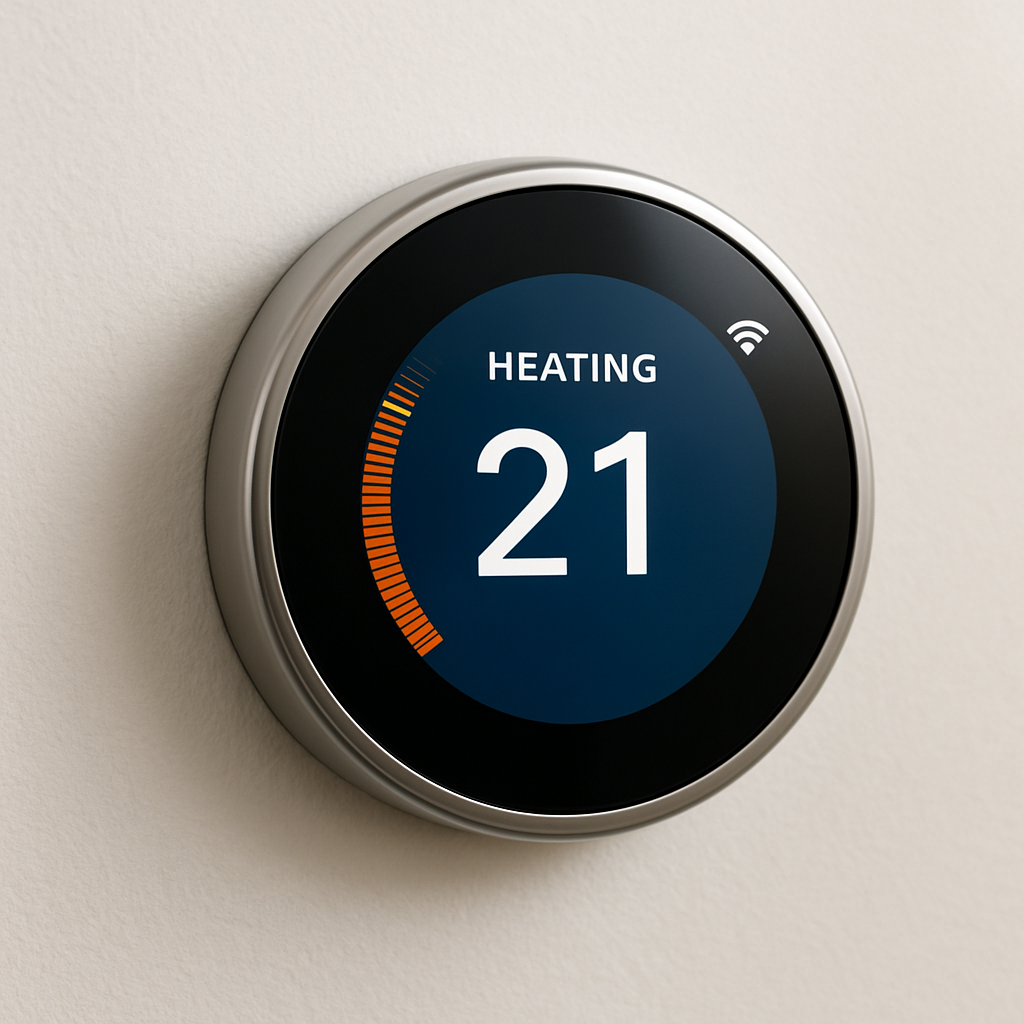
A smart thermostat connects to Wi-Fi and uses schedules, sensors, or learned patterns to adjust heating and cooling automatically. Many provide remote access and runtime visibility through an app.
Important clarification:
Neither type changes system capacity, airflow, or efficiency ratings. Thermostats control when systems run—not how heating or cooling is produced.
Learning vs. Scheduling: Not All Smart Thermostats Are the Same
Smart thermostats fall into two common categories:
- Learning models that adapt to habits over time
- App-scheduled models that follow user-defined schedules
Learning features aren’t always beneficial in homes with irregular routines, while app-scheduled models rely more on user input. Understanding this difference helps avoid paying for features that don’t match how a household actually operates.
Pros and Cons of Traditional Thermostats
Pros
- Lowest upfront cost
- Simple operation with minimal setup
- Compatible with most older HVAC systems
Cons
- Manual scheduling and adjustments
- No insight into runtime or patterns
- Easy to forget setbacks, leading to wasted energy
A common local mistake is expecting a thermostat upgrade to fix uneven temperatures caused by duct leaks or poor airflow. In older Steubenville and Weirton homes, those issues must be addressed mechanically.
Pros and Cons of Smart Thermostats
Pros
- Automated scheduling and learning options
- Remote temperature changes and monitoring
- Runtime insights that can highlight inefficiencies
- Can reduce short cycling when configured correctly
Cons
- Higher upfront cost
- Compatibility depends on system type and wiring
- Advanced features require setup, engagement, and connectivity
Smart thermostats rely on controls and electronics. Without proper compatibility, features may be limited or unavailable.
Wiring and Power: The Most Common Local Limitation
Many older Ohio Valley homes lack a common (C) wire, which powers smart thermostats. Without it, options may be limited or require additional wiring or adapters. Older low-voltage wiring can also restrict compatibility.
Traditional thermostats typically avoid these constraints, which is why they remain common in established neighborhoods.
Compatibility Matters More Than Features
Before upgrading, compatibility should be checked for:
- HVAC system type (single-stage, two-stage, variable-speed, heat pump, gas furnace)
- Available thermostat wiring
- Whether the system uses communicating controls
Installing a smart thermostat on an incompatible system can reduce functionality or create comfort issues.
Humidity and Comfort in the Ohio Valley
Summer humidity is a major comfort driver across the Ohio Valley. Some smart thermostats allow longer run times or humidity-aware strategies—but only if the HVAC system supports those functions.
In river-adjacent and valley areas, thermostat strategy can influence comfort, but it cannot overcome undersized returns, leaky ducts, or poor insulation.
Local Factors by Town That Affect Thermostat Choice
- Steubenville, OH: Older homes with mixed wiring often favor traditional thermostats unless upgrades are made.
- Weirton, WV: Hills and elevation changes create room-to-room swings; scheduling helps once airflow is balanced.
- Wintersville, OH: Suburban homes with predictable routines often benefit from smart scheduling.
- Toronto, OH: River humidity makes runtime visibility useful for spotting moisture issues.
- Mingo Junction, OH: Smaller homes may see limited benefit from advanced features without airflow corrections.
- Follansbee, WV: Compact layouts and older systems often pair best with simple controls.
- Wellsburg, WV: Mixed housing stock makes compatibility checks essential before upgrading.
- Brilliant, OH: Straightforward ducted homes may benefit from smart setbacks after insulation work.
- New Cumberland, WV: Drafty areas cause frequent adjustments; automation helps only after sealing.
- Colliers, WV: Multi-level homes often see gains from scheduled temperature changes.
- Hooverson Heights, OH: Exposed walls and elevation changes increase load swings, making accurate scheduling more important than app features.
Cost Tiers and Ownership Reality
- Lowest upfront cost: Traditional thermostats
- Mid to higher upfront cost: Smart thermostats
Long-term satisfaction depends more on correct setup, system compatibility, stable Wi-Fi, and user engagement than on the thermostat itself.
Replacement vs. Comfort Upgrade: Why It Matters
- System replacement: Thermostat choice should match the new system’s control requirements.
- Comfort upgrade: A thermostat alone won’t solve airflow or insulation issues but can improve consistency once those are addressed.
A Real Local Example
A Steubenville home with an older single-stage furnace and limited wiring may gain little from a smart thermostat beyond remote access. In contrast, a newer Weirton home with a two-stage system and balanced ducts can see steadier temperatures and better humidity control when smart scheduling is used correctly.
Who Each Option Is—and Isn’t—a Good Fit For
Smart Thermostats Are Usually a Better Fit If:
- Schedules vary or the home is unoccupied part of the day
- The HVAC system supports advanced controls
- Runtime visibility and automation are valued
Smart Thermostats Are Often Not a Good Fit If:
- Wiring or system compatibility is limited
- Wi-Fi reliability is inconsistent
- Comfort issues are mechanical
Traditional Thermostats Are Usually a Better Fit If:
- The system is older or basic
- Minimal setup and reliability matter most
- Manual control is sufficient
Decision Shortcut for Ohio Valley Homes
If your system and wiring support it and schedules vary, a smart thermostat can improve consistency. If the system is older or comfort issues are mechanical, a traditional thermostat often performs just as well.
Warranties and Long-Term Reliability
Because smart thermostats rely on electronics and connectivity, long-term coverage that includes controls and service can reduce ownership risk—especially when paired with modern HVAC equipment.
FAQ
Are smart thermostats worth it in Steubenville and Weirton?
They can be, but only when the HVAC system, wiring, and household routines support their features. Without compatibility and proper setup, benefits are often limited.
Final Takeaway
Smart and traditional thermostats each have clear pros and cons. The right choice depends on system compatibility, wiring, household behavior, and whether comfort issues are mechanical or behavioral. Matching the thermostat to how the home and HVAC system actually operate delivers the best results.
Alex Largent is the Owner and Senior HVAC Efficiency Analyst at Honest Fix Heating, Cooling & Plumbing. With more than 20 years of field experience, NATE and EPA certifications, and a hands-on leadership style, Alex teaches his team to fix systems right the first time — with transparency, precision, and no upsells. He writes about HVAC diagnostics, home energy efficiency, and practical maintenance advice for homeowners across the Upper Ohio Valley. Read Alex Largent’s full bio to learn more about his expertise in the HVAC and Plumbing industry. Updated October 2025.