Upflow vs. Downflow HVAC Configurations in Steubenville OH and Weirton WV: What’s the Difference?
January 19th, 2026
3 min read
By Alex Largent
Quick Answer
Upflow HVAC systems move air upward from the unit into ductwork above, while downflow systems push air downward into ducts below. The difference is not performance or efficiency, but physical layout. In Steubenville and Weirton, homeowners usually do not choose between upflow or downflow—the home’s structure, foundation, and duct location determine the correct configuration.
When matched properly to the home, both configurations deliver the same comfort.
What “Upflow” and “Downflow” Actually Mean
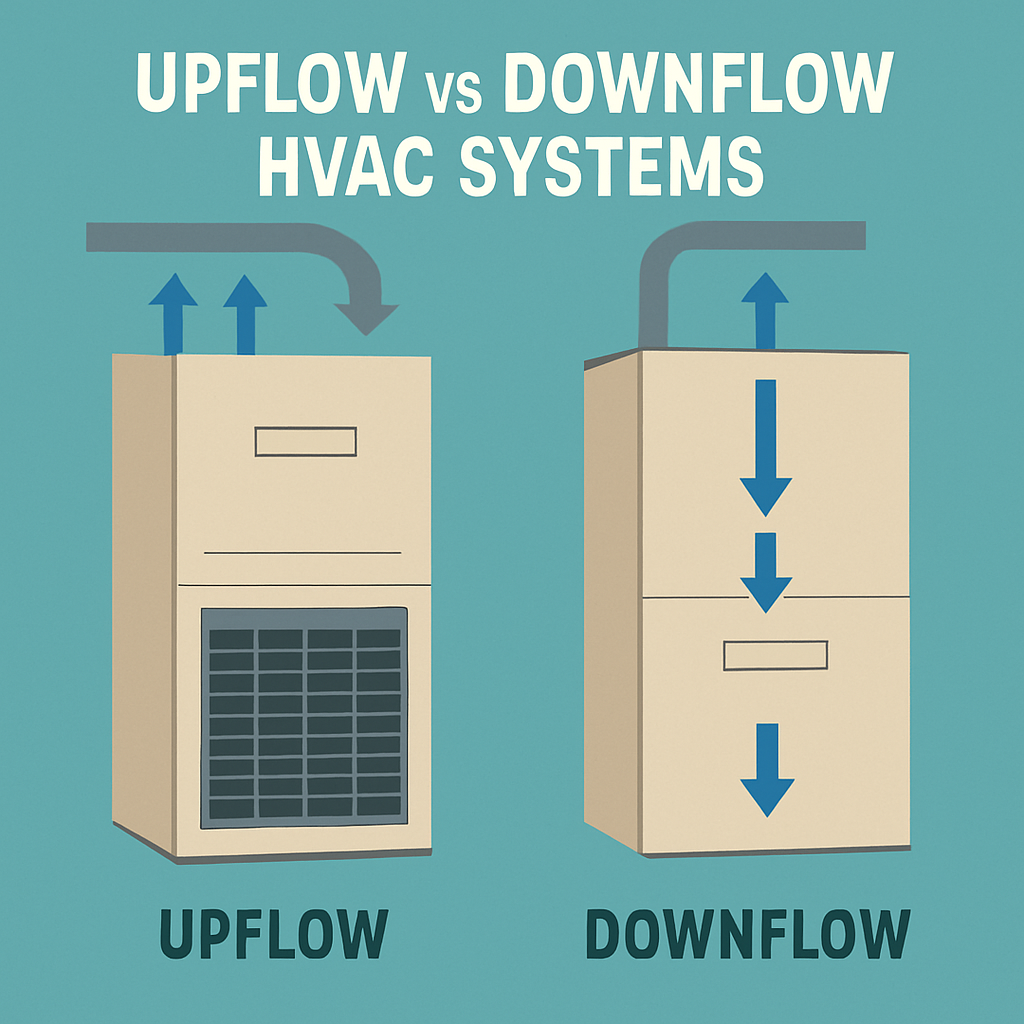
Upflow and downflow describe air movement direction, not heating or cooling strength.
- Upflow systems: Pull return air in from the bottom and deliver supply air out the top into overhead ductwork.
- Downflow systems: Pull air in from the top and deliver it downward into ductwork below the unit.
The internal components are often similar. The key difference is how the system connects to the existing duct layout.
How Upflow HVAC Systems Are Typically Used
Upflow systems are most common in homes with:
- Full basements
- Raised foundations
- Ductwork located above the unit
In an upflow setup:
- The furnace or air handler sits on the basement floor
- Supply ducts run overhead
- Drainage and airflow work naturally with gravity
In Steubenville and Weirton, many older homes with basements were designed specifically around upflow systems, making replacement straightforward when the configuration is maintained.
How Downflow HVAC Systems Are Typically Used
Downflow systems are usually installed in homes with:
- Slab foundations
- Crawlspaces
- Utility closets or interior mechanical rooms
In a downflow setup:
- The unit sits on a platform or inside a closet
- Supply ducts run beneath the unit
- Air is pushed downward into floor-level ductwork
Homeowners sometimes attempt to switch configurations to reuse equipment or reduce upfront cost, but this often creates airflow, drainage, or code issues when the duct system was not designed for it.
Performance and Efficiency Reality
Upflow and downflow systems do not differ inherently in:
- Heating capacity
- Cooling output
- Energy efficiency
Upflow and downflow systems do not heat or cool better than one another.
Actual performance depends on:
- Proper equipment sizing
- Duct design and sealing
- Installation quality
When installed correctly, the same equipment will perform the same regardless of airflow direction.
Installation and Service Considerations
Upflow Systems
- Easier access in basements
- More flexibility for duct modifications
- Drainage typically simpler to manage
Downflow Systems
- Tighter service clearances
- Drainage and airflow must be planned carefully
- Installation mistakes are harder to correct later
Downflow systems require more precision because errors are less forgiving once the system is set in place.
Cost Differences to Expect
Equipment pricing is usually similar. Cost differences come from:
- Platform construction
- Duct transitions
- Condensate drain routing
- Clearance and safety requirements
If the existing duct system feeds air from above, an upflow system is required. If it feeds air from below, a downflow system is required.
Common Local Mistake to Avoid
A common local mistake is replacing an upflow system with a downflow unit—or the reverse—without redesigning the duct layout. This often leads to airflow restriction, noise, drainage problems, or failed inspections.
The configuration must match the home, not just the available equipment.
Local Factors by Town That Influence Configuration Choice
- Steubenville, OH: Older homes with basements typically require upflow systems
- Weirton, WV: Mixed housing stock demands careful evaluation
- Wintersville, OH: Newer slab homes often require downflow
- Toronto, OH: Space constraints influence unit orientation
- Mingo Junction, OH: Compact homes rely on efficient duct routing
- Follansbee, WV: Crawlspaces commonly pair with downflow systems
- Wellsburg, WV: Split-level homes vary by section
- Brilliant, OH: Existing duct orientation often dictates configuration
- New Cumberland, WV: Closet installations favor downflow
- Colliers, WV: Multi-level homes require detailed airflow planning
- Hooverson Heights, OH: Elevation and layout affect duct routing
Basements and regional moisture conditions also influence drainage design and correct orientation throughout the Ohio Valley.
A Real Local Example
A Steubenville home with a basement typically replaces an older upflow furnace with a modern upflow unit, reusing overhead ductwork. A Weirton home built on a slab often requires a downflow furnace installed in a hallway closet to distribute air below the floor safely and evenly.
Safety and Code Considerations
Improper configuration can lead to:
- Inadequate combustion air
- Condensation and drainage problems
- Moisture damage
- Code violations
Correct orientation is a safety decision as much as a comfort one.
Decision Shortcut for Ohio Valley Homes
If the HVAC unit sits in a basement with overhead ducts, upflow is usually correct. If the unit sits on a slab, in a crawlspace, or in a closet feeding ducts below, downflow is usually required.
Home layout determines configuration, not homeowner preference.
Warranties and Long-Term Reliability
Manufacturers design furnaces and air handlers for specific orientations. Installing the wrong configuration can void warranty coverage and shorten system life.
Honest Fix evaluates the home’s structure first and then matches the equipment to it—not the other way around.
FAQ
Does upflow or downflow HVAC work better in Steubenville and Weirton?
Neither works better by default. The correct choice depends on the home’s foundation, duct layout, and installation location.
Final Takeaway
Upflow and downflow HVAC systems differ in airflow direction, not performance. In the Ohio Valley, the correct configuration is dictated by home structure, duct placement, and moisture considerations. When matched correctly, both systems deliver reliable comfort and long-term performance.
Next Steps
If you’re replacing an HVAC system and aren’t sure which configuration your home requires, Honest Fix can evaluate the existing layout and recommend the correct solution based on structure, safety, and long-term reliability.
Exact HVAC replacement quotes available at (740) 825-9408 or HonestFix.com/schedule-service.
Alex Largent is the Owner and Senior HVAC Efficiency Analyst at Honest Fix Heating, Cooling & Plumbing. With more than 20 years of field experience, NATE and EPA certifications, and a hands-on leadership style, Alex teaches his team to fix systems right the first time — with transparency, precision, and no upsells. He writes about HVAC diagnostics, home energy efficiency, and practical maintenance advice for homeowners across the Upper Ohio Valley. Read Alex Largent’s full bio to learn more about his expertise in the HVAC and Plumbing industry. Updated October 2025.