Zoned vs. Non-Zoned HVAC Systems in Steubenville OH and Weirton WV: What’s the Difference?
January 19th, 2026
3 min read
By Alex Largent
Quick Answer
Zoned HVAC systems divide a home into separate temperature areas controlled independently, while non-zoned systems use one thermostat for the entire house. Zoning can improve comfort in multi-level or uneven homes but adds cost and mechanical complexity. In Steubenville and Weirton, zoning works best when temperature differences are structural—not when airflow or duct problems are unresolved.
In most Ohio Valley homes, zoning improves comfort far more often than it reduces energy bills. Results depend on duct layout, system capacity, and how the home gains and loses heat.
Zoned vs. Non-Zoned HVAC: How They Differ in Real Homes
- Non-zoned systems: One thermostat controls the entire home
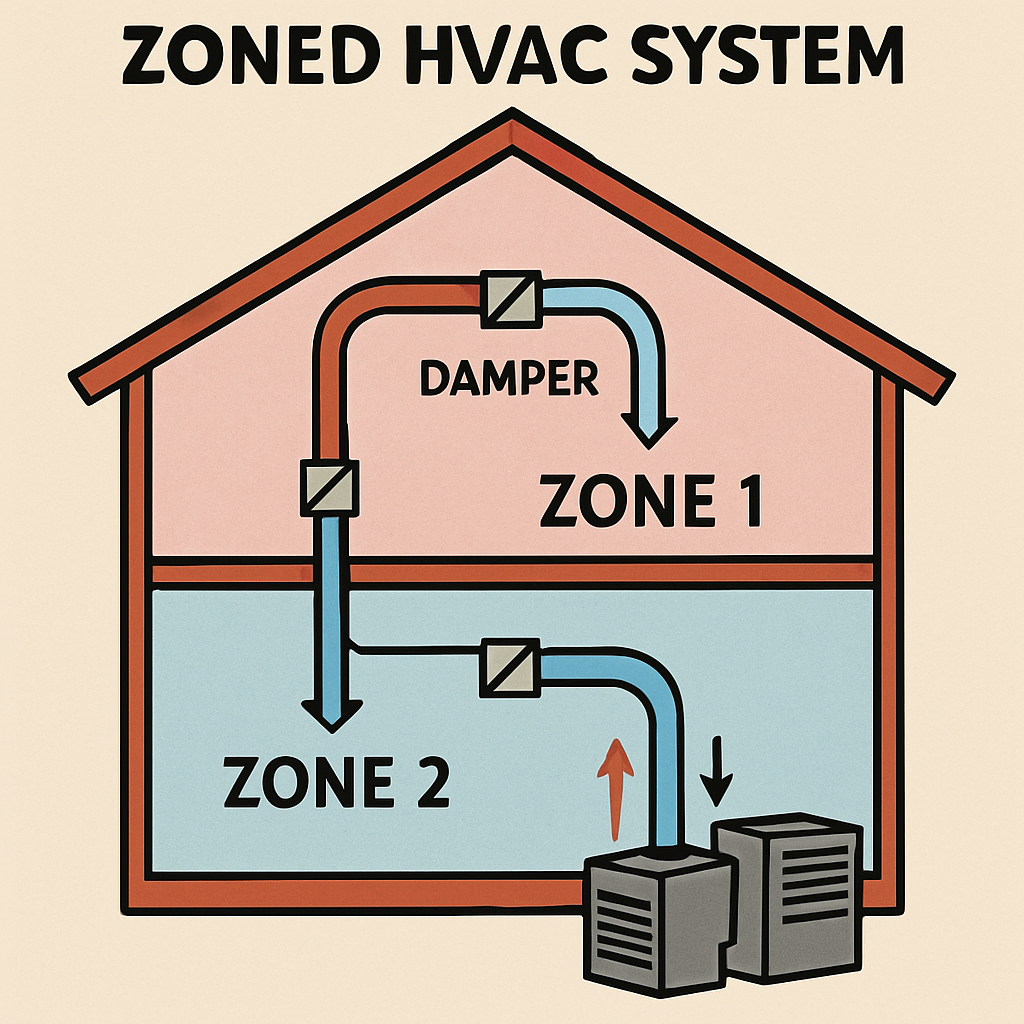
- Zoned systems: Multiple thermostats control motorized dampers in ductwork
- Upfront cost: Lower for non-zoned systems; higher for zoned systems due to controls and dampers
- Complexity: Minimal for non-zoned; higher for zoned
A practical rule many homeowners use:
If certain floors or rooms are consistently uncomfortable, zoning may help.
Another practical rule:
If comfort problems are widespread, zoning alone won’t solve them.
What Zoning Does—and What It Doesn’t Do
A zoned HVAC system uses dampers inside the ductwork to send more or less air to different parts of the home based on thermostat demand. All zones still rely on the same central heating and cooling equipment.
A non-zoned system distributes air evenly based on one thermostat, assuming the home heats and cools uniformly.
Important clarification:
Zoning is a comfort strategy, not an efficiency upgrade by default. It controls where air goes but does not increase system capacity or fix poor duct design.
Why Comfort Gains Usually Exceed Energy Savings
Zoning is often associated with energy savings, but those savings are not guaranteed.
In real Ohio Valley homes:
- Zoning reduces over-conditioning in unused areas
- Comfort improvements are usually immediate and noticeable
- Utility savings range from limited to moderate
Because heating systems still run frequently during long winters, zoning often improves comfort more than it lowers total energy use.
Pros and Cons of Non-Zoned HVAC Systems
Pros
- Lowest upfront cost
- Simple design and operation
- Fewer components to maintain
Cons
- One thermostat assumes even temperatures
- Hot and cold rooms are common in multi-level homes
- Limited comfort control
Non-zoned systems work best in compact, open layouts with balanced airflow.
Pros and Cons of Zoned HVAC Systems
Pros
- Better comfort in multi-level or uneven homes
- Independent temperature control by area
- Reduced over-conditioning of unused spaces
Cons
- Higher upfront cost
- Added mechanical and electrical components
- Requires proper duct design and setup
Zoning works best when designed intentionally—not as a workaround for airflow problems.
Comfort Balance vs. Space Control
Homeowners usually consider zoning for one of two reasons:
- Comfort balance: Fixing hot and cold floors or rooms
- Space control: Adjusting temperatures in rarely used areas
Zoning can address both, but expectations should match the goal. It’s most effective when temperature differences are consistent and structural.
New Construction vs. Existing Homes
Zoning outcomes depend heavily on when it’s introduced.
- New construction: Zoning can be designed into duct layout and equipment selection
- Existing homes: Adding zones may require duct changes or system adjustments
In older Ohio Valley homes, zoning should be evaluated carefully to avoid restricting airflow.
Common Local Mistake to Avoid
A common local mistake is adding zoning to fix hot and cold rooms caused by undersized or poorly designed ductwork. When airflow is already limited, zoning can make some areas worse by further restricting air.
Local Factors by Town That Affect Zoning Results
- Steubenville, OH: Older multi-story brick homes often have floor-to-floor temperature swings.
- Weirton, WV: Hills and elevation changes create uneven heat gain and loss.
- Wintersville, OH: Split-level homes may benefit from zoning if ducts support it.
- Toronto, OH: River humidity and sun exposure can cause room-specific comfort issues.
- Mingo Junction, OH: Smaller homes often see limited benefit from zoning.
- Follansbee, WV: Compact layouts usually perform well without zoning.
- Wellsburg, WV: Mixed housing stock leads to variable outcomes.
- Brilliant, OH: Straightforward layouts often benefit more from airflow balancing.
- New Cumberland, WV: Drafty areas can undermine zoning performance.
- Colliers, WV: Multi-level homes may benefit when zoning is paired with proper duct sizing.
- Hooverson Heights, OH: Exposed walls and elevation increase temperature differences between levels.
A Real Local Example
A Steubenville home with a finished upper floor and cooler basement may benefit from two zones—one per level—if duct sizing supports it. A similar home with undersized returns may see little improvement until airflow issues are corrected.
Service and Reliability Considerations
Zoned systems add motors, sensors, and control boards. Over time, these components may require service or replacement. Non-zoned systems have fewer moving parts and typically lower long-term service complexity.
Who Zoning Is—and Isn’t—a Good Fit For
Zoned systems often make sense if:
- The home has multiple levels
- Temperature differences are consistent
- Comfort balance is the primary goal
Non-zoned systems often make sense if:
- The home is compact or open-concept
- Airflow is already balanced
- Simplicity and reliability are priorities
Decision Shortcut for Ohio Valley Homes
If temperature problems are isolated and airflow is adequate, zoning can improve daily comfort. If issues are widespread, fixing ducts and insulation usually delivers better results than zoning alone.
FAQ
Are zoned HVAC systems worth it in Steubenville and Weirton?
They can be, but only when duct design and system capacity support zoning. Without proper airflow, zoning adds complexity without improving comfort.
Final Takeaway
Zoned HVAC systems offer targeted comfort control, while non-zoned systems prioritize simplicity. In the Ohio Valley, zoning works best when temperature differences are structural and airflow is solid. When comfort issues stem from duct or insulation problems, those fixes usually matter more than zoning.
Alex Largent is the Owner and Senior HVAC Efficiency Analyst at Honest Fix Heating, Cooling & Plumbing. With more than 20 years of field experience, NATE and EPA certifications, and a hands-on leadership style, Alex teaches his team to fix systems right the first time — with transparency, precision, and no upsells. He writes about HVAC diagnostics, home energy efficiency, and practical maintenance advice for homeowners across the Upper Ohio Valley. Read Alex Largent’s full bio to learn more about his expertise in the HVAC and Plumbing industry. Updated October 2025.