
Ductless Heat Pump vs. Traditional Heat Pump: What's the Difference for Colliers, WV Homes?
June 27th, 2026
4 min read
Quick Answer
A traditional heat pump conditions air through ducts and a central air handler. Ductless sends refrigerant directly to wall-mounted heads -- no ductwork. In Colliers, duct condition, whether a space was ever on the duct system, and zone control needs are what separate them.
Colliers is inland Brooke County -- no Ohio River frontage, no flood zone, rolling plateau at roughly 1,040 feet. Without river humidity as a factor, the comparison comes down to system performance and your home's specific setup.
What's Actually Different Between These Two Systems?
Quick Answer:
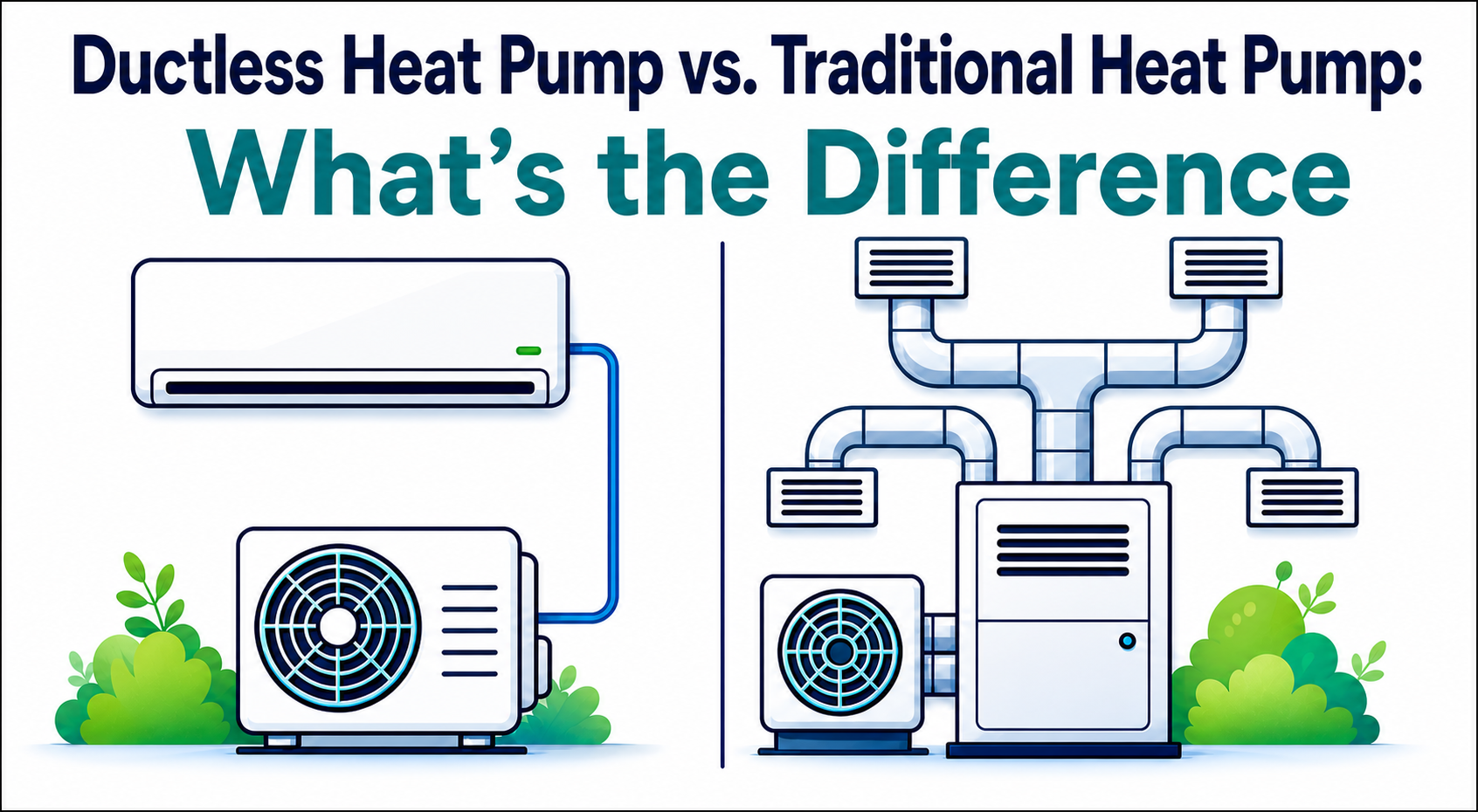
A traditional heat pump moves conditioned air through ducts connected to an indoor air handler. A ductless system sends refrigerant to wall-mounted heads through a 3-inch wall penetration -- no ductwork. Both heat and cool on the same refrigerant cycle with no combustion.
The equipment works the same way anywhere. What changes is whether ductwork is in place, how good it is, and what comfort problem you are trying to solve.
Traditional heat pumps require three things:
- An indoor air handler connected to the outdoor unit
- A supply duct network sized for the equipment and the floor plan
- Return ducts large enough to pull air back without starving the system
When all three are already in place and in decent condition, a traditional heat pump replaces a furnace-and-AC combination directly. You are swapping equipment, not redesigning the mechanical system.
Ductless skips the air handler and ducts entirely. Each head connects to the outdoor unit via refrigerant line set. A single outdoor unit can run two to five heads, each controlling its own zone.
When Does Ductless Make More Sense Than Traditional in Colliers?
Quick Answer:
Ductless beats traditional in Colliers when existing ductwork runs through unconditioned attic or crawlspace and is leaking efficiency, when a room or addition was never on the duct system, or when you want independent temperature control in different parts of the house.
Colliers runs mostly 1950s through 1980s ranch and split-level homes. Most have ductwork, but the routing varies. Ranches with attic duct runs face the same efficiency penalty Hooverson Heights ranches do: attic temperatures can hit 130 to 140 degrees in July.
Ductless makes a strong case in Colliers when any of these apply:
- Ducts run through an uninsulated attic or crawlspace and show signs of leakage or damage
- A finished basement, garage, or addition was never tied into the main duct system
- One part of the house consistently runs too hot or too cold no matter how the thermostat is set
- You want separate temperature control for the main floor and upstairs without a zoning upgrade
Does the Coal and Rail History Here Affect Which System Is Better?
Quick Answer:
Coal mine dust in older Colliers homes near former mine corridors can load filters faster than average. Ductless head filters are washable. Central system filters are disposable and need replacement every 30 to 60 days in a higher-dust environment.
Colliers has a coal and rail history -- the Blanche Mine and other operations ran through this corridor. The mines are gone, but homes near former corridors can carry residual dust in duct cavities from decades of operation.
This is worth knowing before sizing either system. If an older Colliers home has never had the ductwork cleaned and it was built near mine activity, a duct inspection is a reasonable first step before installing anything new.
Colliers is also Zone X -- no Ohio River flood risk. This matters for equipment placement:
- No elevation requirements for outdoor units or indoor air handlers
- Ground-level pad installation is fine without flood-proofing
- Basement mechanical rooms are not at risk the way they are in the river towns
8-Factor Head-to-Head: Ductless vs. Traditional Heat Pump
|
Factor |
Ductless Heat Pump |
Traditional Heat Pump |
|
Ductwork required |
No |
Yes |
|
Works with existing duct system |
Yes; can supplement or replace |
Yes; direct replacement |
|
Attic duct efficiency losses |
None; bypasses ducts |
Significant if attic runs are uninsulated |
|
Zone control |
Yes; each head is independent |
No; whole-home thermostat |
|
Flood risk equipment elevation |
Not required (Zone X) |
Not required (Zone X) |
|
Filter maintenance (coal dust area) |
Washable mesh; every 4-6 weeks |
Disposable; every 30-60 days |
|
Cooling efficiency |
SEER2 rated; varies by model |
SEER2 rated; varies by model |
|
Heating efficiency |
HSPF2 rated; varies by model |
HSPF2 rated; varies by model |
7-Scenario Decision Guide for Colliers Homes
|
Your situation |
Better fit |
|
Good existing ductwork through conditioned or interior space |
Traditional heat pump |
|
Ducts run through uninsulated attic or crawlspace with evidence of leakage |
Ductless |
|
Adding a room, garage, or space that was never on the duct system |
Ductless (single-zone) |
|
Want independent temperature control room by room or floor by floor |
Ductless |
|
Replacing aging furnace and AC; ducts are sound |
Traditional heat pump |
|
Budget is the primary constraint and existing ductwork is in good shape |
Traditional heat pump |
|
High efficiency is the priority and ducts run through unconditioned space |
Ductless |
Frequently Asked Questions
Can ductless handle a full Brooke County winter?
Yes. Modern inverter ductless systems hold full heating output down to 5 degrees Fahrenheit. Brooke County winters get cold but rarely sustain temperatures that low for extended periods. A properly sized multi-zone system handles whole-home heating without backup.
Is ductless noticeably quieter inside than a traditional system?
Yes. The indoor head runs at low fan speed most of the time and produces a soft ambient hum. Traditional forced-air systems push air through ducts and create register rush noise plus the mechanical sound of the air handler cycling on and off.
Do I need to do anything special about the old coal dust in my ducts before installing?
If the home is near a former mine corridor and ducts have never been cleaned, a duct inspection makes sense before installing new equipment. Coal dust residue in duct cavities can coat new coils quickly and shortens the interval before your first professional cleaning.
How is the maintenance different between the two systems?
Ductless: clean the indoor head filters every four to six weeks, schedule annual professional coil cleaning. Traditional: replace central filters every 30 to 60 days, schedule annual coil and duct inspection. Ductless filters are washable; traditional filters are disposable.
A duct inspection is often the right first step in Colliers -- it tells you whether your existing system is worth building on. Call (740) 825-9408 or schedule at honestfix.com.
Scott Merritt is a co-founder of Honest Fix Heating, Cooling and Plumbing and brings more than 30 years of experience across HVAC, leadership, and industry education. He serves in a senior leadership and oversight role, providing licensed guidance, reviewing HVAC educational content, and supporting technician training and documentation standards. Prior to co-founding Honest Fix, Scott founded and owned Fire & Ice Heating & Air Conditioning in Columbus, Ohio, which he operated for more than two decades before selling the company in 2025. During that time, he led programs and partnerships including Carrier Factory Authorized Dealer, Trane Comfort Specialist, and Rheem Pro Partner, helping establish high technical and training standards. Scott is the Ohio State HVAC license holder for Honest Fix and provides licensed oversight to help ensure work meets applicable codes and manufacturer requirements. Learn more about Scott’s background and role at Honest Fix by viewing his full leadership bio.
