
Ductless Heat Pump vs. Traditional Heat Pump: What's the Difference for Your Wintersville Home?
June 27th, 2026
4 min read
Quick Answer
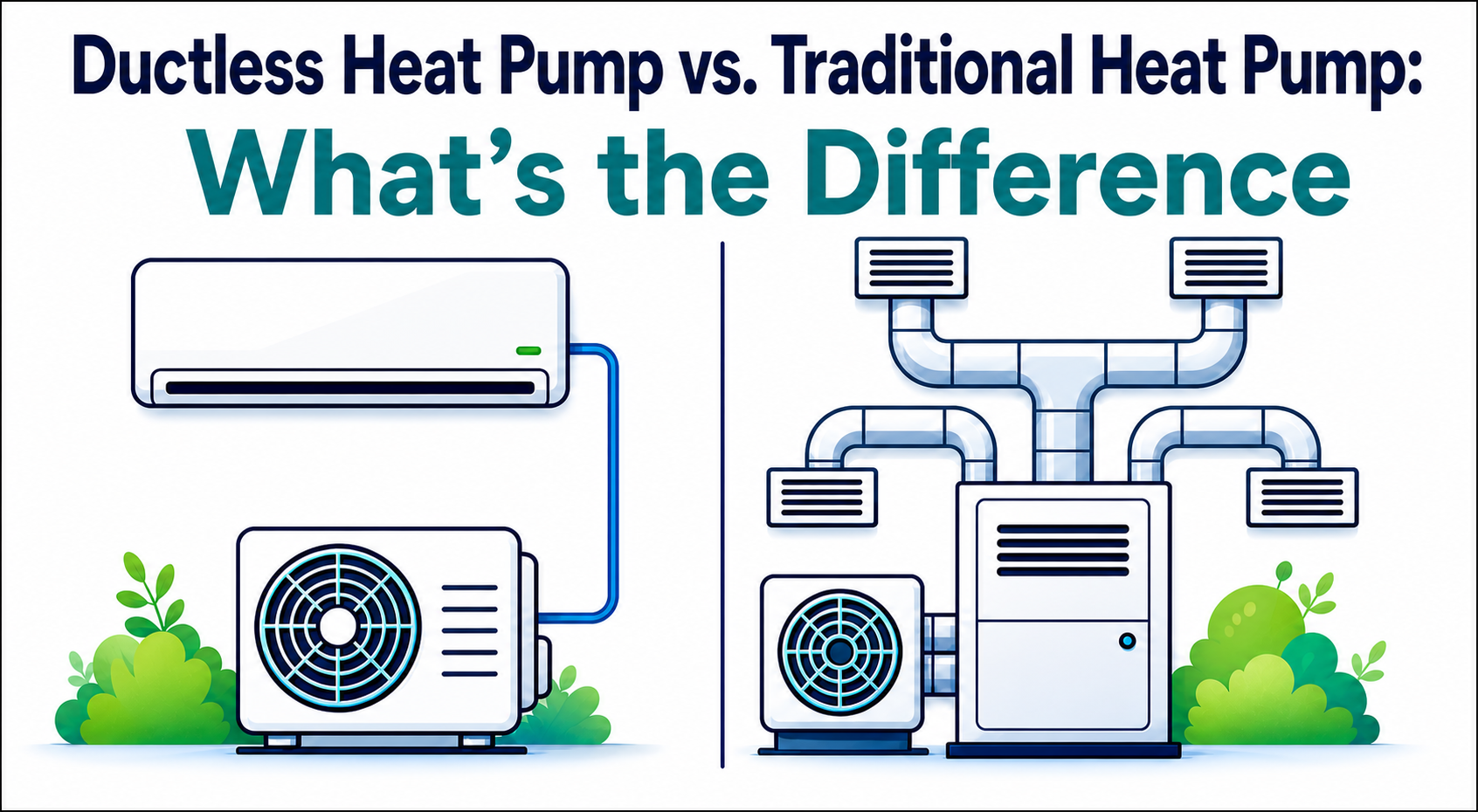
Both move heat using the same refrigerant cycle. The difference is distribution: traditional heat pumps use ductwork; ductless delivers directly to each zone. In Wintersville's 1960s ranch housing stock, the ductwork usually exists -- the question is whether it performs well enough to matter.
After 30+ years in HVAC across Ohio, Wintersville is where this comparison gets genuinely bilateral. Unlike Steubenville's pre-1940 homes, most Wintersville ranches from the 1960s and 1970s have forced-air systems in place. That changes the math.
Having ductwork and having ductwork that supports a modern high-efficiency heat pump are two different things.
Is Wintersville's existing ductwork a good fit for a traditional heat pump?
Quick Answer:
Wintersville's dominant 1960s ranch ductwork was sized for lower-static-pressure equipment. Modern variable-speed heat pumps require more airflow than the original systems those ducts were built for. A duct assessment is the first step before committing to either system.
Wintersville's median construction year is approximately 1970. The dominant housing type is the post-WWII ranch built during the 1950s through 1970s, when Steubenville's steel-industry prosperity funded suburban growth on the plateau. Those homes typically have round metal attic ductwork or under-floor runs originally sized for single-stage gas furnaces.
A modern variable-speed heat pump moves more air at lower static pressure than the equipment those ducts were designed for. Running a new system through an undersized distribution network means higher operating static pressure, which strains the blower, shortens equipment life, and cuts real-world efficiency below the rated SEER2.
Key Point: In Wintersville, the duct assessment is the deciding variable. If the static pressure tests within range and the trunk runs are in good condition, a traditional heat pump swap is a strong option. If the ducts need a retrofit, ductless becomes more competitive on total installed cost.
Which system is more efficient at Wintersville's upland elevation?
Quick Answer:
Wintersville sits at roughly 1,135 feet, above the Ohio River humidity corridor. Ductless systems carry higher SEER2 and HSPF2 ratings and deliver that efficiency with no duct loss. At plateau elevation, the heating efficiency story matters as much as the cooling story.
At 1,135 feet, Wintersville is one of the highest base elevations in the Upper Ohio Valley service area. The plateau position means greater winter wind exposure than the sheltered river towns -- infiltration loads on older ranch homes are real, and heating efficiency is a meaningful system selection factor here.
How the two systems compare for Wintersville homes:
|
Factor |
Traditional Heat Pump |
Ductless Heat Pump |
|
Requires ductwork |
Yes, properly sized and sealed |
No |
|
Typical SEER2 range |
15-20 |
18-26 |
|
Typical HSPF2 range |
7.8-10 |
9-13 |
|
Zone control |
Single thermostat, whole home |
Independent per indoor head |
|
Cold-climate heating |
To -13 to -22 deg F |
To -13 to -22 deg F |
|
Attic duct heat loss |
Yes, if ducts run through unconditioned attic |
None -- no ducts |
|
Refrigerant delivery |
Air handler plus duct distribution |
Direct to each indoor head |
|
Best fit |
Ranch with assessed, compatible ductwork |
Ranch needing zone control or adding a room |
What does Wintersville's ranch housing stock mean for zone control?
Quick Answer:
Most Wintersville ranches run one thermostat for the whole main floor. That works well for open floor plans. When a finished basement or converted attic is the comfort problem, ductless handles that zone without modifying the existing central system at all.
The 1960s ranch is the most common home type in Wintersville -- slab or crawlspace foundation, open main floor, either a finished basement or an attic space that was converted to living area later. The central system handles the main floor adequately.
Where traditional heat pumps fall short in Wintersville ranches: the finished basement that the system was never designed to reach, and the converted attic room that gets no supply. Ductless puts a zone exactly where the problem is without touching the existing equipment.
Key Point: The most common Wintersville scenario we see: homeowners running a traditional heat pump for whole-home comfort plus a window unit in the finished basement in summer. One ductless zone replaces the window unit and handles the basement year-round on one refrigerant line.
Which system handles Wintersville's winter heating demands better?
Quick Answer:
Both systems offer cold-climate models rated to -13 degrees F or below, which covers Wintersville winters. The heating differentiation at Wintersville's plateau elevation is infiltration load, not temperature extremes -- and that is a building envelope question, not a heat pump question.
Either system handles the Wintersville heating load. Your Comfort Guide sizes the equipment to your specific home's load calculation -- square footage, insulation values, window area, and infiltration rate -- not a generic square-footage rule. Every system we install carries the Lifetime Trust Shield: 15-year labor, 90-day money-back, transferable. Full terms on request.
Which system fits your Wintersville situation:
|
Your Situation |
Better Fit |
|
1960s ranch with assessed, properly sized ductwork |
Traditional heat pump |
|
Ranch where duct assessment reveals undersized return runs |
Ductless |
|
Finished basement the central system does not reach |
Ductless (add one zone) |
|
Converted attic room with no supply register |
Ductless (add one zone) |
|
Replacing a whole-home heat pump with solid existing ducts |
Traditional heat pump |
|
New addition where running duct is expensive or disruptive |
Ductless |
|
Whole-home system with no existing ductwork |
Ductless |
FAQs
My Wintersville ranch already has a gas furnace and AC. Is switching to a heat pump worth it?
It depends on your gas rates and cooling load. A heat pump consolidates heating and cooling into one system and can reduce energy costs when electricity rates allow. Your Comfort Guide runs the numbers for your specific usage at the free exact quote visit -- no generic estimate.
Can I add a single ductless zone without replacing my existing furnace or AC?
Yes. A ductless system operates completely independently of your existing equipment. We commonly install one ductless zone in a finished basement or converted room while leaving the existing furnace and AC in place. Your Comfort Guide identifies whether that is the right approach for your layout.
How often do ductless filters need cleaning in a Wintersville home?
Every one to two months during the cooling season. The washable filter slides out, rinses under the tap, and goes back in when dry. Wintersville's upland position means less ambient dust than river-valley towns, but filter checks every six to eight weeks during cooling season are still the right interval.
Does wind exposure at Wintersville's elevation affect heat pump selection?
It affects sizing, not system type. Both traditional and ductless heat pumps are sized to the home's actual heating load, which includes infiltration from wind exposure. The key is a proper load calculation, not a brand or system preference. Ask for a Manual J load calculation on any heat pump quote.
Your Comfort Guide walks through both options at the free exact quote visit: ductwork condition, static pressure assessment, zone layout, and an honest comparison for your specific Wintersville home.
No upsells. No pressure. Just honest answers.
Schedule your free exact quote in Wintersville at (740) 825-9408 or online. Honest Fix serves Wintersville and the Upper Ohio Valley.
Scott Merritt is a co-founder of Honest Fix Heating, Cooling and Plumbing and brings more than 30 years of experience across HVAC, leadership, and industry education. He serves in a senior leadership and oversight role, providing licensed guidance, reviewing HVAC educational content, and supporting technician training and documentation standards. Prior to co-founding Honest Fix, Scott founded and owned Fire & Ice Heating & Air Conditioning in Columbus, Ohio, which he operated for more than two decades before selling the company in 2025. During that time, he led programs and partnerships including Carrier Factory Authorized Dealer, Trane Comfort Specialist, and Rheem Pro Partner, helping establish high technical and training standards. Scott is the Ohio State HVAC license holder for Honest Fix and provides licensed oversight to help ensure work meets applicable codes and manufacturer requirements. Learn more about Scott’s background and role at Honest Fix by viewing his full leadership bio.
