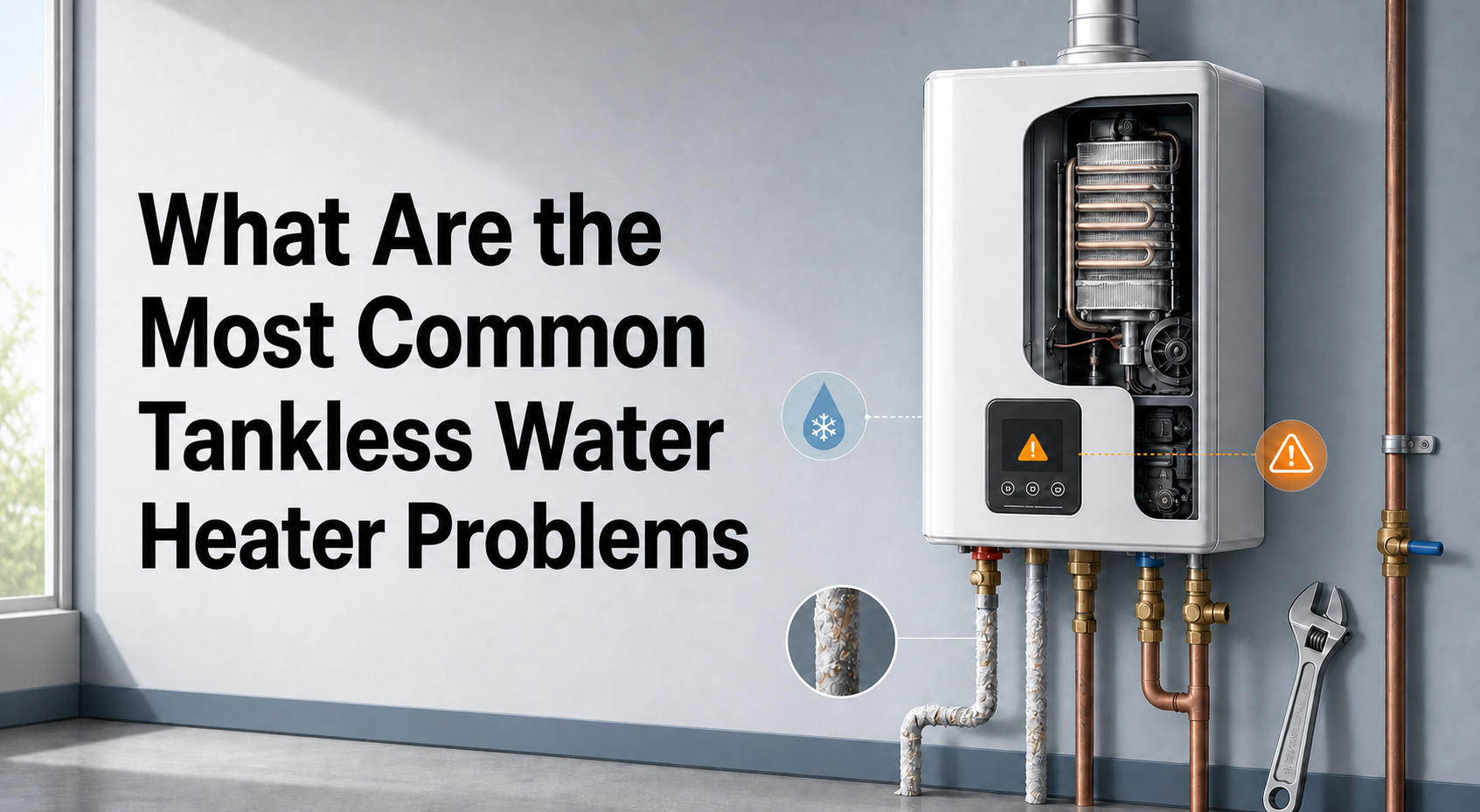
What Are the Most Common Tankless Water Heater Problems in Toronto, OH?
July 16th, 2026
4 min read
Quick Answer
In Toronto, the most common tankless problems are mineral scale from hard water and, in older homes, an undersized gas line left over from a retrofit. An annual descaling and a proper gas line keep it reliable.
Tankless water heaters are efficient, but two things trip them up in Toronto: hard water that scales the unit, and the older homes where a tankless was retrofitted onto an undersized gas line.
Hard water scales the heat exchanger over time, the main reason for lost flow. In Toronto's older homes, a tankless added later sometimes runs on a gas line too small for it, which causes ignition faults and error codes.
After 30-plus years on water heaters across Ohio, what we see on Toronto tankless calls is that scale and undersized gas lines on older-home retrofits are behind most of the problems we are called for.
What Is the Most Common Tankless Problem?
Quick Answer:
The most common tankless problem is mineral scale from hard water. It coats the heat exchanger, cuts hot-water flow, and triggers error codes. An annual descaling flush prevents it and is the single best maintenance step.
In Toronto, hard water makes scale the top tankless problem, just as elsewhere. But the town's older homes add a second: a tankless needs more gas than a tank, and a retrofit onto an old gas line can starve it.
Why Won't My Tankless Keep Up With Demand?
Quick Answer:
If a tankless cannot keep up, it is usually demand or temperature. Too many fixtures at once, or very cold incoming water in winter, can outrun its capacity. Right-sizing and a recirculation option usually solve it.
The cold water sandwich, a short burst of cool between hot draws, is normal and not a fault. Struggling to keep up points to capacity: the unit may be undersized, or too many fixtures run at once.
An undersized gas line can also look like a capacity problem. If the unit cannot draw enough gas, it cannot keep up or hold temperature, so on a Toronto retrofit we check the gas line before blaming the unit.
Why Is My Tankless Showing an Error Code?
Quick Answer:
Error codes and ignition faults are the other common issues. They often trace to gas supply, venting, or scale on the sensors. Many clear with a descaling and a venting check, but persistent codes need a professional.
A tankless unit relies on steady gas, clear venting, and clean sensors. Scale, a blocked vent, or an undersized gas line can each trip an error code. We read the code, descale, and fix the cause, not just reset it.
In Toronto, error and ignition codes on older-home tankless units often trace to a gas line or vent that was undersized at install. We read the code, check the gas and venting, and descale, fixing the real cause.
Key Point: In an older Toronto home, a tankless is only as good as its gas line. We confirm the gas supply and venting suit the unit, then keep it descaled so hard water does not cut your flow.
Tankless Maintenance That Prevents Problems
- A yearly descaling for hard water.
- A gas line and venting check on older-home retrofits.
- An annual descaling flush, the key to preventing scale.
- Cleaning the inlet filter screen that catches sediment.
- A check of the venting and gas supply for safe operation.
- Right-sizing the unit and gas line for your home's demand.
What Does This Mean for a Toronto Home?
Quick Answer:
In Toronto, hard water and older-home retrofits drive most tankless problems. An annual descaling handles the scale, and on an older install we confirm the gas line and venting are sized for the unit's higher demand.
Toronto's hard water scales the heat exchanger like the other river towns, so a yearly descaling is essential. Skipping it is the most common reason a tankless here loses hot-water flow over time.
The town's old housing adds the second factor. A tankless needs more gas than the tank it replaced, so a retrofit onto an undersized gas line causes ignition faults until the gas supply is corrected.
Common Tankless Problems in a Toronto Home, at a Glance
|
What you notice |
Likely cause and fix |
|
Low or dropping hot-water flow |
Scale on the heat exchanger, descale |
|
Ignition or error codes |
Often an undersized gas line |
|
Hard water |
Scales the unit year-round |
|
Older-home retrofit |
Gas line may be too small |
|
No yearly descaling |
The usual cause of lost flow |
Honest Fix services tankless water heaters as part of our plumbing work. We descale, inspect venting and gas, and read error codes to fix the real cause, not just reset it. Every install carries the Lifetime Trust Shield, including a 15-year labor warranty. Full terms are available on request.
Frequently Asked Questions
How often should a tankless water heater be descaled?
About once a year, more often with hard water. Descaling flushes mineral scale off the heat exchanger before it cuts your hot-water flow or trips an error code. It is the single most important tankless maintenance step.
Why does my Toronto tankless show ignition errors?
In an older home, the usual cause is a gas line too small for the unit. A tankless needs more gas than the tank it replaced, so a retrofit onto an old line can starve it. We check and correct the gas supply.
Why does my tankless run hot then cold?
A brief burst of cool water between hot draws, the cold water sandwich, is normal on tankless units and not a fault. If hot water cuts out repeatedly or will not stay hot, that points to scale, capacity, or a gas or venting issue.
Are tankless water heaters worth the maintenance?
For many homes, yes. They are efficient and long-lasting, and the main upkeep is an annual descaling and filter clean. Skip that with hard water and scale builds up fast, so the maintenance is what protects the investment.
Tankless Trouble in Toronto? We Can Help
Tankless acting up? Call us at (740) 825-9408 or schedule a visit online. We descale, clean the filter, read the error code, and check gas and venting, fixing the real cause with no upsells.
Scott Merritt is a co-founder of Honest Fix Heating, Cooling and Plumbing and brings more than 30 years of experience across HVAC, leadership, and industry education. He serves in a senior leadership and oversight role, providing licensed guidance, reviewing HVAC educational content, and supporting technician training and documentation standards. Prior to co-founding Honest Fix, Scott founded and owned Fire & Ice Heating & Air Conditioning in Columbus, Ohio, which he operated for more than two decades before selling the company in 2025. During that time, he led programs and partnerships including Carrier Factory Authorized Dealer, Trane Comfort Specialist, and Rheem Pro Partner, helping establish high technical and training standards. Scott is the Ohio State HVAC license holder for Honest Fix and provides licensed oversight to help ensure work meets applicable codes and manufacturer requirements. Learn more about Scott’s background and role at Honest Fix by viewing his full leadership bio.
