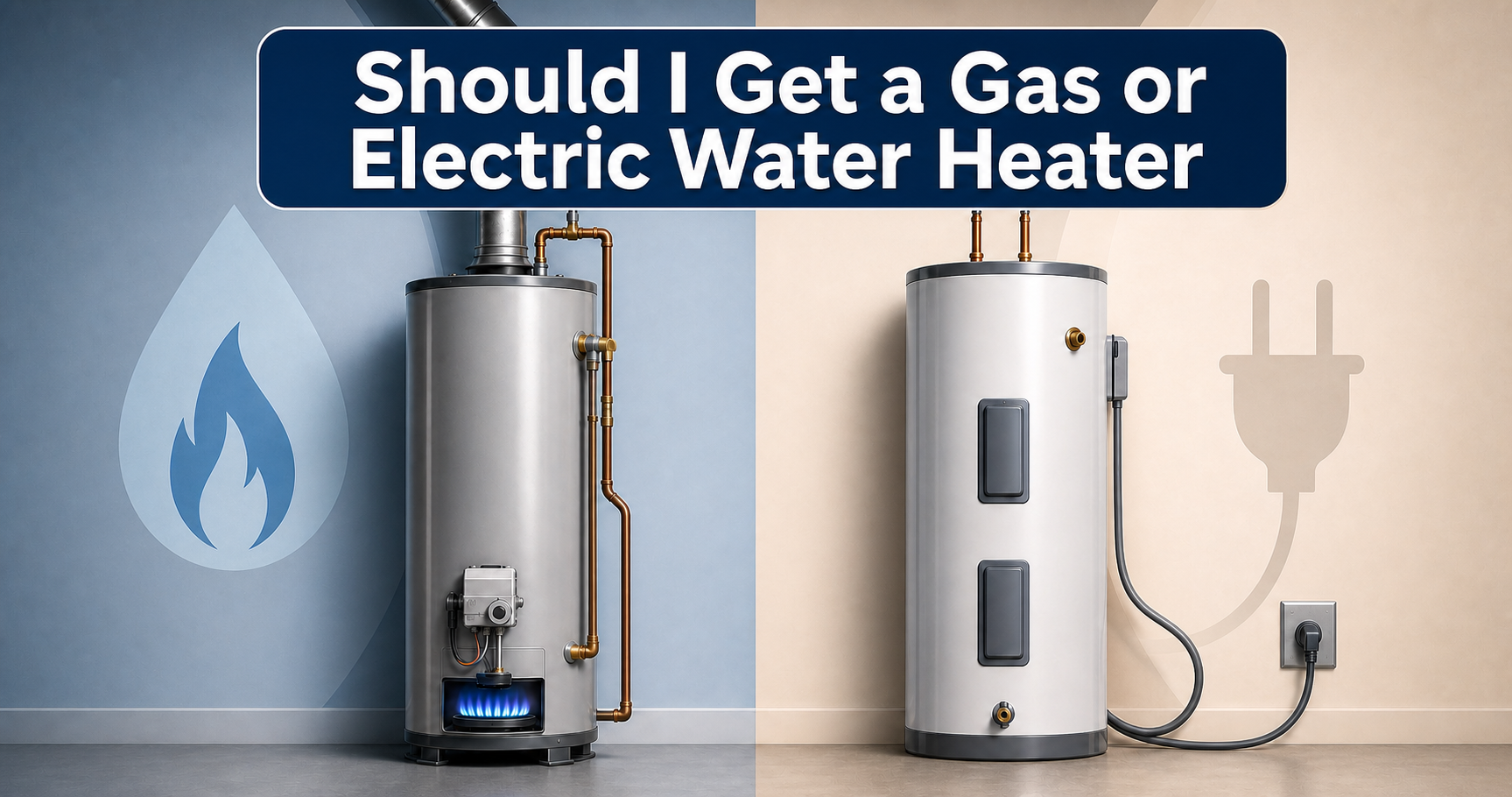
Should I Get a Gas or Electric Water Heater in Mingo Junction, OH?
July 17th, 2026
4 min read
Quick Answer
In Mingo Junction, the simplest choice is usually to match your existing fuel. Many homes have natural gas, so a gas swap is cheapest. In a compact home, an electric model is simple, but a heat-pump needs more space.
Gas or electric is one of the first water heater decisions, and both work well. In Mingo Junction, the answer leans on what the home already has and, for a heat-pump model, whether there is enough space.
Many Mingo Junction homes have natural gas, so a gas-to-gas swap is simplest. A standard electric unit fits almost anywhere, but a heat-pump model pulls heat from the air and needs more room than a compact utility space offers.
After 30-plus years on water heaters across Ohio, what we see on Mingo Junction jobs is that matching the existing fuel is usually cheapest, and a compact home can limit whether a space-hungry heat-pump model fits.
What Is the Difference Between Gas and Electric?
Quick Answer:
The main differences are speed and running cost. A gas water heater heats faster and often costs less to run where natural gas is available. An electric one is cheaper to install, simpler, and has no venting or combustion.
In Mingo Junction, the choice starts with the fuel and the space. Gas favors a gas swap, and a standard electric fits a tight spot. A heat-pump model is efficient but needs more room, which we check at the quote.
Is Gas or Electric Cheaper?
Quick Answer:
It depends. Electric units cost less to buy and install, with no venting. Gas usually costs less to run where gas is cheap, while a high-efficiency heat-pump electric model can be the cheapest to operate of all.
Upfront, electric wins; over years, the cheaper-to-run option depends on local gas and electric rates. If a home already has a gas line and venting, replacing gas with gas avoids new install costs, which often tips the math.
Which Should I Choose for My Home?
Quick Answer:
Start with what your home already has. If a gas line and venting are in place, gas is usually simplest. With no gas service, or in an all-electric home, electric or a heat-pump model is the practical choice.
Other factors matter too: a larger household may want gas's faster recovery, while an electric model needs enough panel capacity and a heat-pump unit needs space and a warmer spot. We weigh all of it for your home.
For a Mingo Junction home with gas, a gas swap is simplest. If you prefer electric, a standard model fits a tight space, while a more efficient heat-pump unit needs more room, which we confirm before recommending it.
Key Point: In Mingo Junction, match your existing fuel for the simplest, cheapest swap. A standard electric fits a compact home, while a space-hungry heat-pump model only suits homes with room to spare.
How to Decide: Gas vs Electric
- A look at your existing fuel and available space.
- A gas-versus-electric comparison for a compact home.
- What is already installed: a gas line and venting, or electric only.
- Whether natural gas is available at your home.
- Your household size and how fast you need hot water to recover.
- Electrical panel capacity for an electric or heat-pump model.
What Does This Mean for a Mingo Junction Home?
Quick Answer:
In Mingo Junction, natural gas is common, so a gas-to-gas swap is often cheapest. A standard electric model fits a compact home, while an efficient heat-pump needs more space, which we check before suggesting one.
Many Mingo Junction homes have a gas line and venting, so replacing gas with gas avoids new install costs and is usually the most economical. That existing setup is the main factor in the decision here.
For electric, space matters in a compact home. A standard electric unit fits almost anywhere, but an efficient heat-pump model needs room and a spot that stays warm, so we confirm there is space before recommending it.
Gas vs Electric in a Mingo Junction Home, at a Glance
|
Your situation |
What usually fits |
|
Home already has gas |
Gas-to-gas swap usually cheapest |
|
Compact home |
Standard electric fits a tight spot |
|
Heat-pump electric |
Needs more space than a tight utility area |
|
Switching fuels |
Adds a gas line or wiring cost |
|
Running cost |
Depends on local gas and electric rates |
Honest Fix helps you pick the water heater that fits your home and budget, gas, electric, or heat-pump, with one clear quote and no upsells. Every install carries the Lifetime Trust Shield, including a 15-year labor warranty. Full terms are available on request.
Frequently Asked Questions
Is gas or electric cheaper to run?
It depends on your local rates. Gas is often cheaper to operate where natural gas is available and inexpensive. But a high-efficiency heat-pump electric water heater can be the cheapest of all to run, even where gas is cheap.
Can a heat-pump water heater fit a compact Mingo Junction home?
It depends on space. A heat-pump model pulls heat from the surrounding air, so it needs more room and a spot that stays warm than a tight utility closet offers. A standard electric or gas unit fits more easily; we confirm what suits.
Can I switch from electric to gas, or gas to electric?
You can, but it adds cost. Going to gas means running a gas line and venting; going to electric may need panel and wiring work. That is why matching what your home already has is usually the most economical choice.
What about a heat-pump water heater?
A heat-pump, or hybrid electric, water heater uses far less energy than a standard electric one, so it is often the cheapest to run. It needs some space and a spot that stays warm, plus a higher upfront cost, which we can help you weigh.
Choosing a Water Heater in Mingo Junction? We Can Help
Not sure which water heater fits? Call us at (740) 825-9408 or schedule a free quote online. We look at your home's fuel, space, and panel, then recommend gas, electric, or heat-pump, with one clear price and no upsells.
Scott Merritt is a co-founder of Honest Fix Heating, Cooling and Plumbing and brings more than 30 years of experience across HVAC, leadership, and industry education. He serves in a senior leadership and oversight role, providing licensed guidance, reviewing HVAC educational content, and supporting technician training and documentation standards. Prior to co-founding Honest Fix, Scott founded and owned Fire & Ice Heating & Air Conditioning in Columbus, Ohio, which he operated for more than two decades before selling the company in 2025. During that time, he led programs and partnerships including Carrier Factory Authorized Dealer, Trane Comfort Specialist, and Rheem Pro Partner, helping establish high technical and training standards. Scott is the Ohio State HVAC license holder for Honest Fix and provides licensed oversight to help ensure work meets applicable codes and manufacturer requirements. Learn more about Scott’s background and role at Honest Fix by viewing his full leadership bio.
