
Is a Ductless Mini-Split the Right Choice for My Finished Basement in New Cumberland, WV?
July 4th, 2026
4 min read
Quick Answer
In New Cumberland, river-valley humidity affects finished basements the same way it affects the Ohio towns. Deferred maintenance means systems often run undersized. A properly sized single-zone ductless install gives an older home a clean, right-sized start for basement comfort.
New Cumberland sits at 640 to 720 feet in the Ohio River valley at the northern edge of the service area, in the same humidity zone as the Ohio towns to the south.
With a median housing build year of 1958 and common deferred HVAC maintenance, finished basements here often have no conditioning at all, or a single floor register that has never kept pace with the space.
Why do finished basements struggle with standard ductwork?
Quick Answer:
Floor registers push conditioned air into a basement and leave moisture control to the upstairs system. When the basement sits below the main return air, the result is uneven temperatures, elevated humidity, and a space that never feels right.
A floor register relies on the upstairs return path to pull air back to the main unit. In most New Cumberland homes, that return is a first-floor hallway grille. The basement gets whatever the upstairs does not use first.
The main system was sized for above-grade living. It cools to setpoint and shuts off. Those short cycles keep temperature near target but never run long enough to pull moisture. The room reads 72 degrees and still feels muggy.
How does New Cumberland's river-valley location affect finished basement humidity?
Quick Answer:
New Cumberland sits at 640 to 720 feet in the Ohio River valley. Summer humidity matches the river-level profile of the Ohio towns. Historic clay subsoil adds ground moisture against foundation walls on top of ambient air.
New Cumberland was historically the nation's brick and ceramics capital, built on Ohio River clay deposits. That same clay subsoil presses against home foundations today, adding ground moisture to the ambient river-valley humidity load.
Where deferred maintenance has left a home without any basement conditioning, a properly sized ductless unit is often the first real HVAC investment the basement has seen.
The inverter compressor runs long, low-speed cycles that pull moisture from the air. In New Cumberland, that often means addressing a space starting at 65 to 70 percent relative humidity with no prior conditioning in place.
A common New Cumberland call: a 1958 bungalow where the finished basement has no HVAC beyond one floor register. A portable heater runs in winter; a window unit failed in summer. A single-zone ductless handles all four seasons.
What does a ductless mini-split do differently in a finished basement?
Quick Answer:
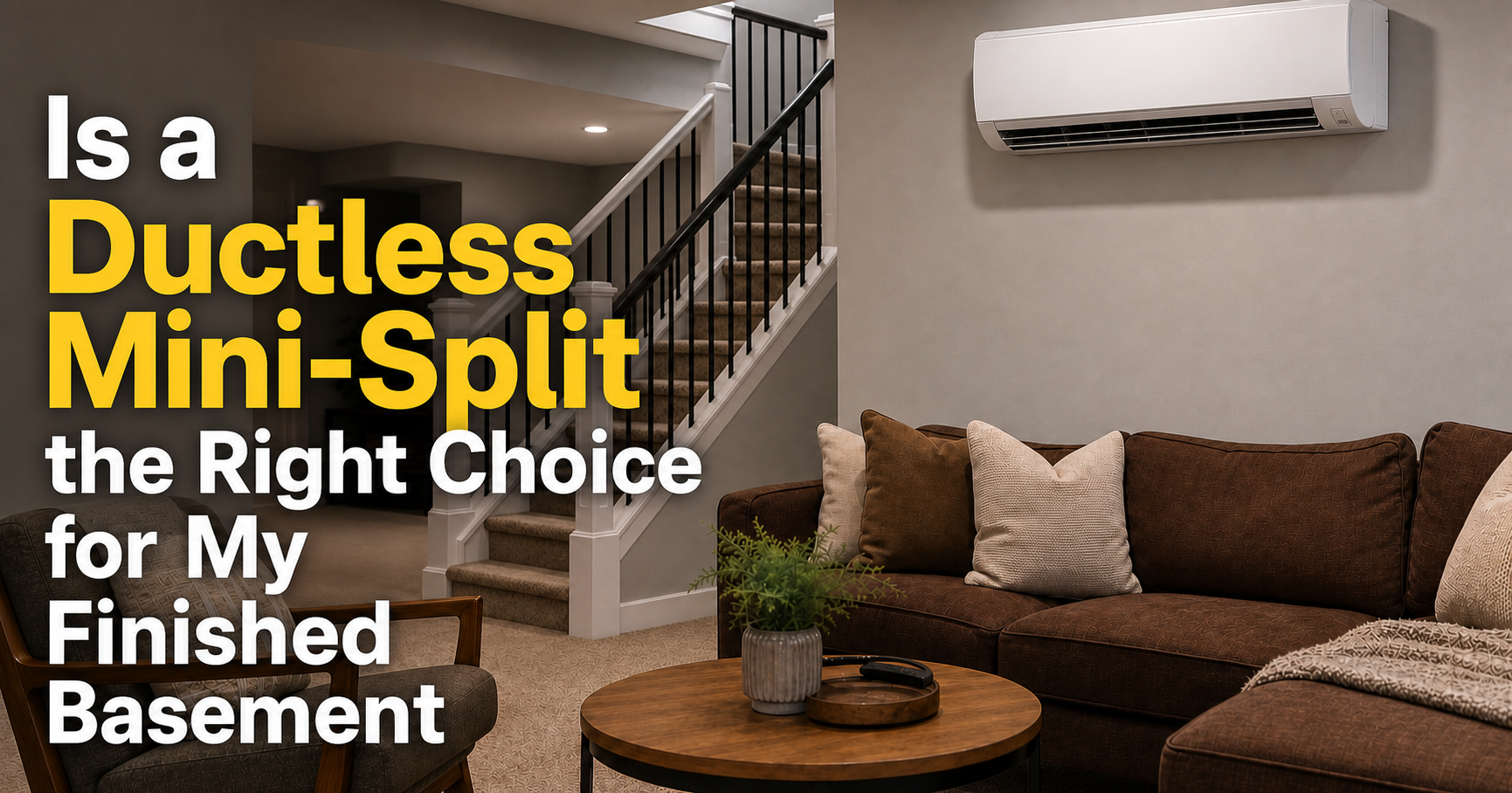
A ductless mini-split places a wall-mounted head directly in the basement. The inverter compressor runs at reduced speed for long cycles, pulling moisture while conditioning. No duct trunk competes for capacity with the rest of the house.
The wall-mounted head sits 7 to 8 feet off the floor and circulates air across the entire basement. The outdoor unit connects through a 3-inch rim joist penetration. No ductwork, no trunk lines, no grilles cut into finished ceilings.
The inverter compressor steps down to 30 to 40 percent capacity and keeps running rather than cycling on and off. That extended run time is what removes latent moisture in a way short cycles never can.
A basement that held 60 percent relative humidity in August can reach 45 to 50 percent with a properly sized system running consistent low-speed cycles through the night.
Key Point: Oversizing kills the moisture benefit. A unit too large short-cycles just like a ducted system. We size every install with a Manual J load calculation. Basement square footage, ceiling height, insulation level, and window count all factor in.
When ductless makes sense for your finished basement
|
Your situation |
Why ductless fits |
|
River-valley location in your town |
Inverter long-cycle removes latent moisture better than short-cycling ducted system |
|
No return air path in the basement |
Ductless is self-contained; no return trunk needed |
|
No existing ductwork reaches the basement |
One line-set penetration vs. major duct renovation |
|
Year-round living space (office, bedroom, gym) |
Single-zone handles heating and cooling independently |
|
Historic home where cutting ductwork is not feasible |
3-inch line-set penetration vs. structural renovation |
What does a single-zone ductless system cost for a basement in New Cumberland?
Quick Answer:
A single-zone ductless install for a finished basement in New Cumberland typically runs $4,250 to $6,800. Older panels may need a capacity check before adding a 240-volt circuit. The free exact quote, 60 to 90 minutes on-site, confirms electrical scope.
The most common add-on cost in New Cumberland is electrical. A 1958 home on original 60 to 100 amp service may lack capacity for a ductless circuit. We check during the quote visit and include any upgrade in the price.
Every install includes the Lifetime Trust Shield: 15-year labor warranty, 90-day money-back guarantee, Energy Savings Guarantee, and Apples-to-Apples Price Match. Full terms on request. Financing is available at 0 percent for 18 months or extended terms.
Frequently Asked Questions
What if the New Cumberland basement has never had any HVAC -- where do I start?
A ductless system is a clean starting point: a wall-mounted head, outdoor condenser, and one line set through the rim joist. No ductwork required. The electrical circuit is the only pre-condition. A free exact quote covers the install.
Does New Cumberland's clay soil create a moisture problem that ductless cannot fix?
Clay soil pressing against foundation walls is a waterproofing issue, not HVAC. A ductless system removes airborne moisture effectively. Active ground water intrusion requires waterproofing or a sump pump first. We flag those needs separately during the site visit.
Is financing available for a ductless basement install in New Cumberland?
Yes. Financing is available at 0 percent for 18 months or extended terms for qualified homeowners. We present the options during or after the free exact quote visit. No commitment is required to get the quote.
Can a ductless outdoor unit be placed safely on a New Cumberland river-valley property?
For properties in FEMA Zone AE near the riverfront, the outdoor unit must sit above the base flood elevation. We check and specify an elevated pad or wall bracket when needed. Hillside properties above flood level use standard ground-level placement.
If your New Cumberland basement has never had real conditioning, a ductless mini-split is a practical, right-sized fix. Call (740) 825-9408 or schedule your free exact quote online. The quote visit is free and covers the electrical scope as well.
Scott Merritt is a co-founder of Honest Fix Heating, Cooling and Plumbing and brings more than 30 years of experience across HVAC, leadership, and industry education. He serves in a senior leadership and oversight role, providing licensed guidance, reviewing HVAC educational content, and supporting technician training and documentation standards. Prior to co-founding Honest Fix, Scott founded and owned Fire & Ice Heating & Air Conditioning in Columbus, Ohio, which he operated for more than two decades before selling the company in 2025. During that time, he led programs and partnerships including Carrier Factory Authorized Dealer, Trane Comfort Specialist, and Rheem Pro Partner, helping establish high technical and training standards. Scott is the Ohio State HVAC license holder for Honest Fix and provides licensed oversight to help ensure work meets applicable codes and manufacturer requirements. Learn more about Scott’s background and role at Honest Fix by viewing his full leadership bio.
