
Is a Ductless Mini-Split the Right Choice for My Finished Basement in Steubenville, OH?
July 4th, 2026
4 min read
Quick Answer
In Steubenville's lower neighborhoods, finished basements face the highest ambient humidity in the service area, with river-valley dewpoints reaching 65 to 70 degrees in peak summer. A single-zone ductless system manages both the temperature and the moisture load.
After 30-plus years in HVAC across Ohio, the call we get about finished basements starts the same way: the room never feels comfortable.
In lower Steubenville, that complaint has a specific cause tied to the Ohio River valley. The floor at 650 to 700 feet holds warm, moist air overnight in ways a floor register was never designed to address.
Why do finished basements struggle with standard ductwork?
Quick Answer:
Floor registers push conditioned air into a basement and leave moisture control to the upstairs system. When the basement sits below the main return air, the result is uneven temperatures, elevated humidity, and a space that never feels right.
A floor register relies on the upstairs return path to pull air back to the main unit. In most Steubenville homes, that return is a first-floor hallway grille. The basement gets whatever the upstairs does not use first.
The main system was sized for above-grade living. It cools to setpoint and shuts off. Those short cycles keep temperature near target but never run long enough to pull moisture. The room reads 72 degrees and still feels muggy.
How does Steubenville's humidity affect a finished basement?
Quick Answer:
Steubenville's lower city sits at 650 to 700 feet in the Ohio River valley. Summer dewpoints hit 65 to 70 degrees on peak days, and overnight relative humidity stays above 75 percent even after outdoor temperatures drop.
River evaporation and valley topography trap warm, moist air at grade level overnight. Pre-1940 homes with minimal vapor barriers and uninsulated crawlspace walls allow that moisture to migrate inward through the foundation.
A short-cycling central system shuts off at temperature setpoint before pulling meaningful moisture from basement air. An inverter-driven ductless at 40 percent capacity runs long, slow cycles that remove far more latent humidity per hour.
A common call in lower Steubenville: a 1940s foursquare near the flood plain with a finished recreation room that sweats all summer. The floor register delivers cool air, but the upstairs system cycles off before humidity drops below 65 percent.
What does a ductless mini-split do differently in a finished basement?
Quick Answer:
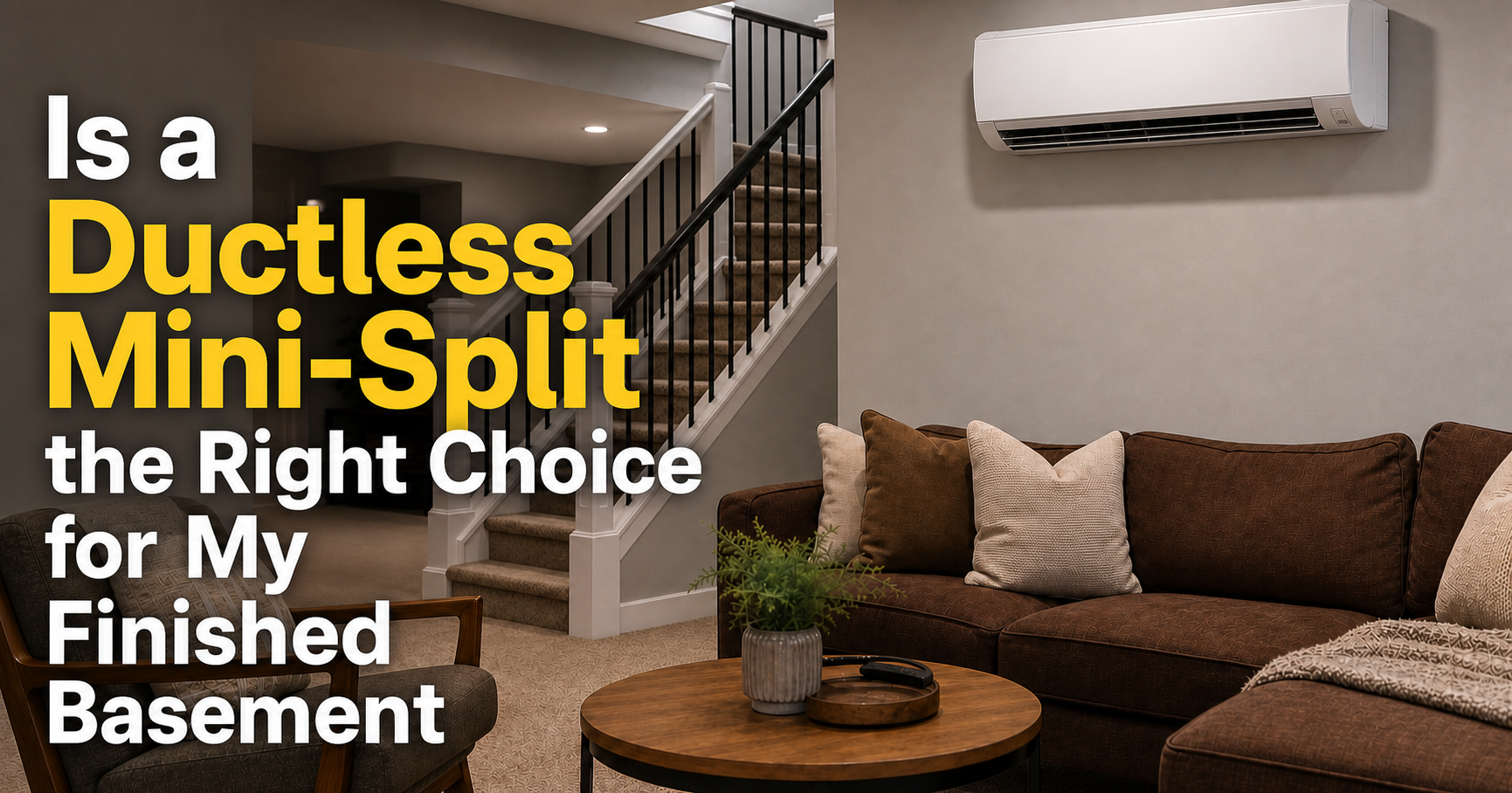
A ductless mini-split places a wall-mounted head directly in the basement. The inverter compressor runs at reduced speed for long cycles, pulling moisture while conditioning. No duct trunk competes for capacity with the rest of the house.
The wall-mounted head sits 7 to 8 feet off the floor and circulates air across the entire basement. The outdoor unit connects through a 3-inch rim joist penetration. No ductwork, no trunk lines, no grilles cut into finished ceilings.
The inverter compressor steps down to 30 to 40 percent capacity and keeps running rather than cycling on and off. That extended run time is what removes latent moisture in a way short cycles never can.
A basement that held 60 percent relative humidity in August can reach 45 to 50 percent with a properly sized system running consistent low-speed cycles through the night.
Key Point: Oversizing kills the moisture benefit. A unit too large short-cycles just like a ducted system. We size every install with a Manual J load calculation. Basement square footage, ceiling height, insulation level, and window count all factor in.
When ductless makes sense for your finished basement
|
Your situation |
Why ductless fits |
|
River-valley location in your town |
Inverter long-cycle removes latent moisture better than short-cycling ducted system |
|
No return air path in the basement |
Ductless is self-contained; no return trunk needed |
|
No existing ductwork reaches the basement |
One line-set penetration vs. major duct renovation |
|
Year-round living space (office, bedroom, gym) |
Single-zone handles heating and cooling independently |
|
Historic home where cutting ductwork is not feasible |
3-inch line-set penetration vs. structural renovation |
What does a single-zone ductless system cost for a basement in Steubenville?
Quick Answer:
A single-zone ductless install for a finished basement in Steubenville typically runs $4,250 to $6,800. Bluff-side homes with long refrigerant line runs add to that range. The free exact quote, scheduled at your convenience, confirms the actual scope.
The $4,250 to $6,800 range covers equipment, labor, permits, and line set. Line set length is the main cost driver in Steubenville. Bluff-side homes above the lower city often need a longer refrigerant run, which adds labor and material.
Every install includes the Lifetime Trust Shield: 15-year labor warranty, 90-day money-back guarantee, Energy Savings Guarantee, and Apples-to-Apples Price Match. Full terms on request. Financing is available at 0 percent for 18 months or extended terms.
Frequently Asked Questions
How large does the wall-mounted head need to be for a finished basement?
Most finished basements in the 400 to 900 square foot range need a 12,000 to 18,000 BTU head. The right size depends on insulation, ceiling height, and window count. We calculate the correct size before any equipment is ordered.
Can the basement ductless system also heat in winter?
Yes. Cold-climate inverter systems run at full heating capacity down to 5 degrees Fahrenheit and continue below minus 13. In lower Steubenville at an 8-degree design temperature, a properly specified system heats the basement independently of the upstairs furnace.
How loud is a ductless mini-split in a finished basement?
Indoor heads run at 26 to 32 decibels at low speed -- quieter than a normal conversation. In a basement used as a home office or media room, the sound level is rarely noticeable during normal operation.
Does a ductless mini-split need its own electrical circuit?
Yes. A single-zone system typically requires a dedicated 240-volt, 20 to 30 amp circuit. In older Steubenville homes with 100-amp panels, we check available capacity during the quote visit. A panel upgrade is sometimes needed and priced separately.
If your Steubenville basement never feels right regardless of the upstairs thermostat, a ductless mini-split is worth a serious look. Free exact quote, 60 to 90 minutes on-site. Call (740) 825-9408 or schedule online.
Scott Merritt is a co-founder of Honest Fix Heating, Cooling and Plumbing and brings more than 30 years of experience across HVAC, leadership, and industry education. He serves in a senior leadership and oversight role, providing licensed guidance, reviewing HVAC educational content, and supporting technician training and documentation standards. Prior to co-founding Honest Fix, Scott founded and owned Fire & Ice Heating & Air Conditioning in Columbus, Ohio, which he operated for more than two decades before selling the company in 2025. During that time, he led programs and partnerships including Carrier Factory Authorized Dealer, Trane Comfort Specialist, and Rheem Pro Partner, helping establish high technical and training standards. Scott is the Ohio State HVAC license holder for Honest Fix and provides licensed oversight to help ensure work meets applicable codes and manufacturer requirements. Learn more about Scott’s background and role at Honest Fix by viewing his full leadership bio.
