
Should I Replace My Window AC Units with a Ductless Mini-Split in Wellsburg, WV?
June 29th, 2026
4 min read
Quick Answer
|
Window units cool rooms independently, one appliance per window. Ductless replaces them with wall heads per zone, at higher efficiency with individual control. In Wellsburg's historic district, where steam and radiator homes predate forced air, ductless adds cooling without routing ductwork through 100-year-old structures. |
Wellsburg has the oldest housing stock of any town in the service area -- median construction year 1938, with a National Register Historic District encompassing 693 contributing buildings in the lower river valley. Many of those buildings were heated by steam or hot water radiator systems long before ductwork was part of residential construction.
Windsor Heights to the south is a different story: higher elevation, Zone X flood designation, more mid-century construction. If your Wellsburg home is in the lower historic district, the question of whether to add ductless cooling is different from the same question in most towns in this series.
What Do You Actually Get When You Go Ductless?
Quick Answer:
|
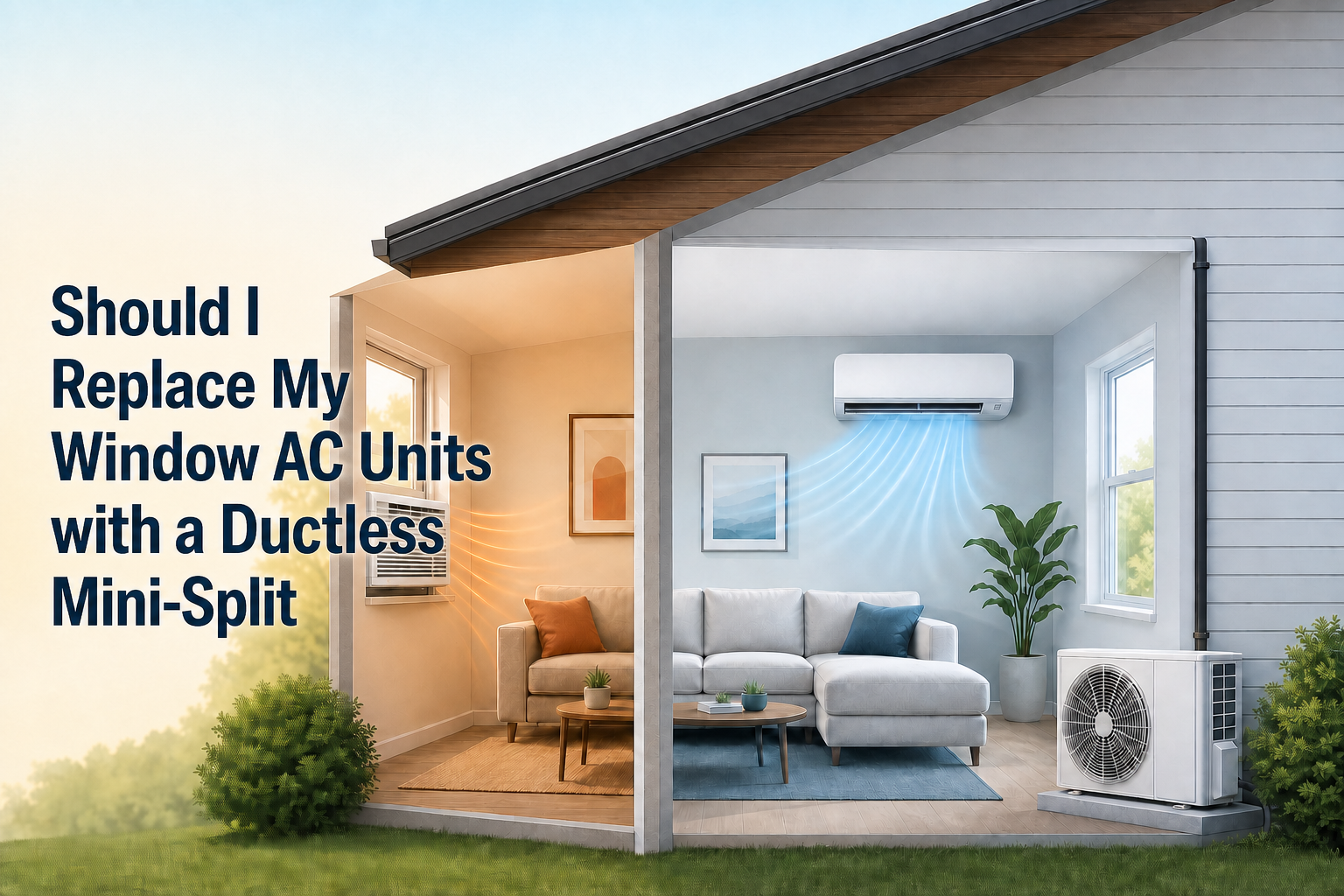
One outdoor compressor connects to wall-mounted indoor heads that deliver conditioned air directly into each zone. No duct runs between the equipment and the room. Each head operates independently, so you cool only the spaces in use, at efficiency well above aging window units. |
One outdoor compressor connects to one or more indoor heads mounted high on interior walls. Each head conditions its zone independently. The system is entirely separate from your existing heating equipment -- it can operate alongside a steam radiator system, a hot water boiler, or a gas furnace without modification to either.
For older Wellsburg homes, the case is structural as well as mechanical. Pre-1900 construction frequently contains original masonry chimney flues in the wall cavities, original knob-and-tube wiring, and plaster-over-lath walls that are costly to open and restore. Routing ductwork through those structures is a substantial project. Ductless requires two penetrations through an exterior wall and a wall-mount bracket for the indoor head. The structure stays intact.
|
Key Point: The Wellsburg Historic District contains 693 contributing structures. Exterior equipment placement -- where the outdoor condenser is mounted, how line sets run on exterior walls -- may require review by the Wellsburg Building Authority. We identify this on every quote for a lower-district home and work through compliant placement options before any commitment. |
Which Wellsburg Homes Make the Strongest Case for Going Ductless?
Quick Answer:
|
Historic district homes with steam or hot water radiators make the strongest case. Routing ductwork through Federal-style and Victorian structures built in the 1800s is costly and disruptive. Ductless adds zone cooling without touching the wall cavities or the existing heating system. |
The case for ductless is strongest when one or more of these conditions apply:
- A lower-district home heated by steam or hot water radiators -- never retrofitted with forced air -- where window units are the only current cooling option and adding ductwork would require opening plaster walls or disturbing original chimney flues
- A pre-1940 home with knob-and-tube wiring in wall cavities, where ductwork installation would require electrical remediation before any insulation or wall work could proceed
- High combined humidity load in the lower district, where masonry and wood-frame construction absorbs ambient moisture and ductless inverter operation removes latent moisture more effectively than window units
- A room in a historic home -- a third-floor bedroom, a rear addition -- that window units have been cooling in isolation because the rest of the house has no cooling infrastructure
|
Key Point: Wellsburg was chartered in 1791. Some lower-district homes have been through five recorded Ohio River flood events above 50 feet. The structural moisture history of those buildings -- absorbed into masonry foundations and wood framing over generations -- is a genuine humidity load on top of ambient river air. Ductless inverter systems that run long low-speed cycles address that load consistently. |
When Does Central AC Make More Sense Than Ductless in Wellsburg?
Quick Answer:
|
Windsor Heights homes with mid-century construction and serviceable ductwork are often straight central AC replacement candidates. In the historic district, routing ductwork through older structures usually tips the math toward ductless. If your ductwork is in place and sound, a swap is worth pricing. |
Not every Wellsburg home is a ductless candidate. The honest counter-argument:
- A Windsor Heights home with existing ductwork in good condition -- central AC replacement delivers conditioned air to every room through the established system without the disruption or cost of adding new infrastructure
- A lower-district home that was retrofitted with forced air at some point and has a serviceable duct system -- if the equipment failed and the ducts are intact, a straight swap is worth pricing alongside ductless
- Budget is the primary constraint -- a single-zone ductless install starts at $4,250 to $6,800; if ductwork is already in place, a central AC swap can be the lower entry point
The key variable is whether the home has serviceable ductwork already. We inspect duct condition and static pressure on every free exact quote visit. For homes without it, the central AC path requires that work first.
Real Example in This Area
A lower-district home in Wellsburg, built in the late 1800s. Hot water radiator heating throughout -- no forced air, no existing ductwork. The homeowner had been running two window units: one in the first-floor living room, one in the second-floor bedroom. Plaster walls, original chimney flues in the wall cavities.
Converting to forced air would have required opening walls, rerouting around chimney flues, and replacing the original lath-and-plaster throughout the affected rooms. We installed a two-zone ductless system instead: two exterior wall penetrations, two indoor heads, one outdoor unit on a rear wall bracket away from the historically visible street facade. Total install: $9,350.
The radiator system continues to handle heat. The plaster walls are intact. Both window units came out.
Frequently Asked Questions
Does installing ductless in the Wellsburg Historic District require special approval?
Exterior equipment placement on historically visible facades may be subject to review by the Wellsburg Building Authority. This typically covers where the outdoor condenser is mounted, how line sets are routed on exterior walls, and penetration locations. We account for historic district requirements on every quote for a lower-district home and can advise on compliant placement options before you commit.
What does a ductless install cost in Wellsburg, WV?
A single-zone system runs $4,250 to $6,800 installed. A two-zone system starts at $9,350. For homes without existing forced-air infrastructure, there is no ductwork removal or modification cost -- the install is a net addition. Honest Fix offers 0% financing for 18 months.
Can ductless work alongside my steam or hot water radiator system?
Yes. Ductless handles cooling independently through the outdoor unit and wall-mounted heads. Your radiator system continues to handle heat exactly as it always has. The systems operate completely separately. Many homeowners in older homes also use the ductless heat pump function for shoulder-season heating, running the radiator only on the coldest days.
How does flood history in Wellsburg affect where equipment gets installed?
Lower historic district properties near the Ohio River are in FEMA Zone AE. Equipment at ground level in a flood zone must meet elevation requirements -- outdoor condensers on wall brackets or elevated pads rather than ground-level slabs at risk of inundation. Windsor Heights is Zone X and does not carry this constraint. We note the flood zone designation for every lower-district address on the quote.
If you want a straight answer on whether ductless makes sense for your Wellsburg home -- historic district or Windsor Heights -- a free exact quote visit covers the equipment assessment, duct condition check, and flood zone review. Schedule at honestfix.com or call (740) 825-9408.
Scott Merritt is a co-founder of Honest Fix Heating, Cooling and Plumbing and brings more than 30 years of experience across HVAC, leadership, and industry education. He serves in a senior leadership and oversight role, providing licensed guidance, reviewing HVAC educational content, and supporting technician training and documentation standards. Prior to co-founding Honest Fix, Scott founded and owned Fire & Ice Heating & Air Conditioning in Columbus, Ohio, which he operated for more than two decades before selling the company in 2025. During that time, he led programs and partnerships including Carrier Factory Authorized Dealer, Trane Comfort Specialist, and Rheem Pro Partner, helping establish high technical and training standards. Scott is the Ohio State HVAC license holder for Honest Fix and provides licensed oversight to help ensure work meets applicable codes and manufacturer requirements. Learn more about Scott’s background and role at Honest Fix by viewing his full leadership bio.
