
Single-Zone vs. Multi-Zone Ductless Mini-Split: Which Do I Need for My Toronto, OH Home?
June 27th, 2026
4 min read
Quick Answer
A ductless head cannot push conditioned air up a staircase. Two occupied floors means you need two zones. Toronto has a high share of older two-story construction -- but your floor count is what determines your answer.
After 30+ years in Ohio HVAC, we see the same pattern in Toronto regularly: a homeowner installs a single head on the main floor of a two-story worker house and calls us the following July wondering why the bedrooms are still 85 degrees at 10 PM. Toronto has the highest pre-1940 housing share of any Ohio town in our service area -- roughly 34% of homes were built before 1940. Nearly all of them are two stories.
That local context is worth knowing as background. But the zone-count question comes down to your floor plan -- count your occupied levels, and that number gives you the answer.
At a Glance: Single-Zone vs. Multi-Zone
|
Feature |
Single-Zone |
Multi-Zone |
|
Coverage |
1 head — conditions the space it can directly reach |
2-4 heads — each floor or space has its own independent zone |
|
Installed Cost |
$4,250–$6,800 |
$9,350–$17,000+ |
|
Consider it when... |
Your living space is on one connected floor a single head can cover |
You have two or more floors or separate spaces that heat independently |
|
Strength |
Lower upfront cost; simpler maintenance |
Lower cost per zone than separate systems; one outdoor unit |
|
Limitation |
Cannot condition floors or spaces it can't reach |
Higher upfront; outdoor unit sized for all zones at once |
What Is the Difference Between a Single-Zone and Multi-Zone Ductless System?
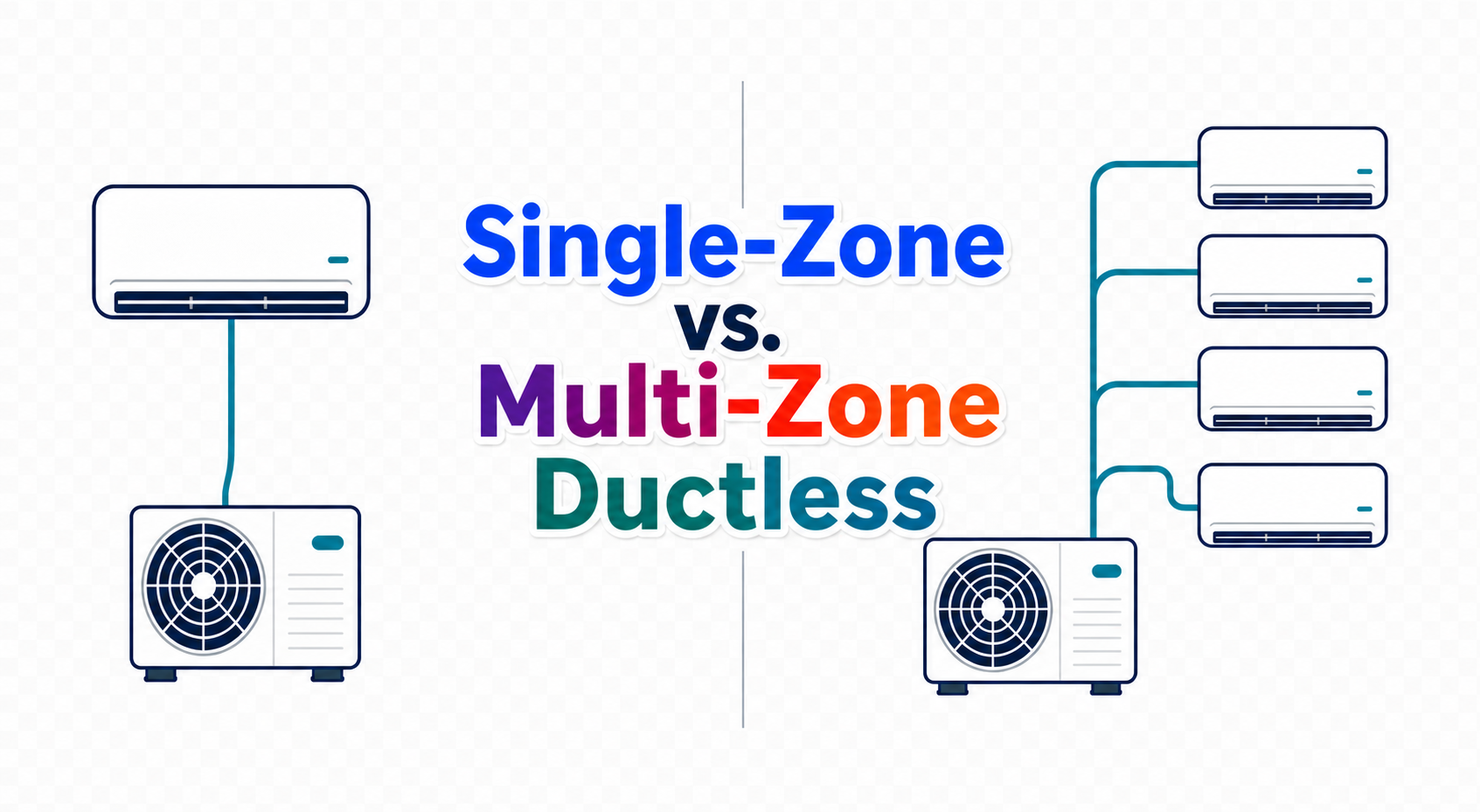
Quick Answer: Single-zone pairs one outdoor unit with one indoor head and conditions the space that head can directly reach. Multi-zone runs two to four heads from one outdoor unit, each in a different room or floor on its own thermostat.
The key distinction is coverage. A single indoor head, regardless of its BTU rating, cannot push conditioned air up a staircase and effectively cool a second floor. Hot air rises; ductless systems condition a room, not a building.
Multi-zone systems use one outdoor compressor to supply multiple indoor heads through separate refrigerant circuits. The cost per zone is lower than installing separate single-zone systems for each room, and one outdoor unit takes less pad space than two or three.
Toronto's narrow valley between the Ohio River and the bluffs limits outdoor pad options on some lots. A multi-zone system's single-compressor footprint is an advantage on tight riverfront lots where two separate outdoor units would not fit.
Which Toronto Homes Are a Good Fit for Single-Zone?
Quick Answer: Single-zone fits when your living space is on one connected floor a single head can reach. One-story construction -- a bungalow, a cottage, or an accessory space with its own entrance -- is the layout single-zone handles well.
Think about your floor plan from the head's perspective. A genuine single floor with an open plan is what single-zone handles well -- one correctly sized head placed centrally covers the living zone without dead spots. Toronto has one-story bungalows on the river terrace; that floor plan type fits single-zone. But your specific layout is what matters, not your address.
Existing ductwork is also part of the calculation. Deteriorated or undersized original ductwork is common in older Toronto homes. Where ducts can't be reasonably repaired, ductless is the straightforward upgrade path without duct modification.
When Does Multi-Zone Make More Sense for Toronto Homes?
Quick Answer: Multi-zone makes sense when your home has two floors that heat independently. An upper bedroom running noticeably hotter than the main floor in July is the clearest signal. Two occupied levels need two independent zones.
The clearest multi-zone signal is upper-floor rooms that run significantly hotter than the main living level in summer. Hot air stratifies upward, and a ductless head conditions only what it can directly reach. A head on the main floor will not meaningfully cool second-floor bedrooms on a 90-degree afternoon.
Toronto has a high share of older two-story construction -- homes built for coal-fired gravity heat with no original ductwork. That context is worth knowing when you're thinking about your own home. If you have two occupied floors, the zone question has a straightforward answer: one zone per floor. The upper head runs at low speed through hot summer nights, managing both temperature and the river valley humidity load.
How Toronto Homeowners Choose Between the Two
Start with your floor count. One occupied level points to single-zone. Two or more points to multi-zone. Toronto has a high share of older two-story construction -- that's context for what we commonly see, not a verdict on your specific home.
Single-zone runs $4,250-$6,800; multi-zone runs $9,350-$17,000+ by zone count. Older panels may need upgrading before a multi-zone install -- we check at the quote visit. Financing at 0% for 18 months. Every install includes the Lifetime Trust Shield: 15-year labor warranty, 90-day satisfaction guarantee, no-lemon replacement. Full terms on request.
Frequently Asked Questions
Can a single ductless head on the main floor cool the upstairs bedrooms?
No. A ductless head conditions the space it's mounted in. Hot air stratifies upward -- a main-floor head will not meaningfully cool second-floor bedrooms on a 90-degree afternoon. Upper floors need their own zone.
My home is older and has no ductwork -- does that affect which system I need?
No ductwork means ductless is likely the right path regardless of zone count. Whether you need single or multi-zone still comes down to your floor count -- one occupied level or two.
How does Toronto's river valley humidity affect ductless sizing?
River-level homes carry a higher latent load -- the system removes moisture as well as heat. Inverter ductless running at part load for long cycles handles this well. Oversized equipment that short-cycles does not.
Is outdoor unit placement a problem on tight Toronto lots?
Sometimes. Narrow riverfront lots can have limited level pad space. We assess pad options at the quote visit. Multi-zone's single outdoor unit footprint is an advantage on tight lots compared to multiple separate systems.
Schedule a free exact quote on a Toronto ductless install at (740) 825-9408 or HonestFix.com/schedule-service. We document your home's floor plan and panel before recommending a zone count.
Scott Merritt is a co-founder of Honest Fix Heating, Cooling and Plumbing and brings more than 30 years of experience across HVAC, leadership, and industry education. He serves in a senior leadership and oversight role, providing licensed guidance, reviewing HVAC educational content, and supporting technician training and documentation standards. Prior to co-founding Honest Fix, Scott founded and owned Fire & Ice Heating & Air Conditioning in Columbus, Ohio, which he operated for more than two decades before selling the company in 2025. During that time, he led programs and partnerships including Carrier Factory Authorized Dealer, Trane Comfort Specialist, and Rheem Pro Partner, helping establish high technical and training standards. Scott is the Ohio State HVAC license holder for Honest Fix and provides licensed oversight to help ensure work meets applicable codes and manufacturer requirements. Learn more about Scott’s background and role at Honest Fix by viewing his full leadership bio.
