
Why Are Some Rooms Colder Than Others in My Toronto, OH Home?
July 12th, 2026
3 min read
Quick Answer
Some rooms run colder because heat does not reach them evenly: weak vents, leaky or undersized ducts, poor insulation, or distance from the furnace. In a narrow older Toronto home, your upstairs rooms are usually the cold ones.
Toronto has more pre-1940 homes than any nearby town, and many are narrow two-story houses. The upstairs often has weaker ductwork than the main floor, so those rooms stay cooler.
Add thin original insulation and a long path from a basement furnace, and your upstairs bedrooms lag behind. The fix is usually airflow and insulation, not a bigger furnace.
After 30-plus years in homes across Ohio, what we see in Toronto's narrow old houses is your upstairs running cold, usually from weak or missing upstairs ducts and thin original insulation.
What Causes Cold Rooms in the First Place?
Quick Answer:
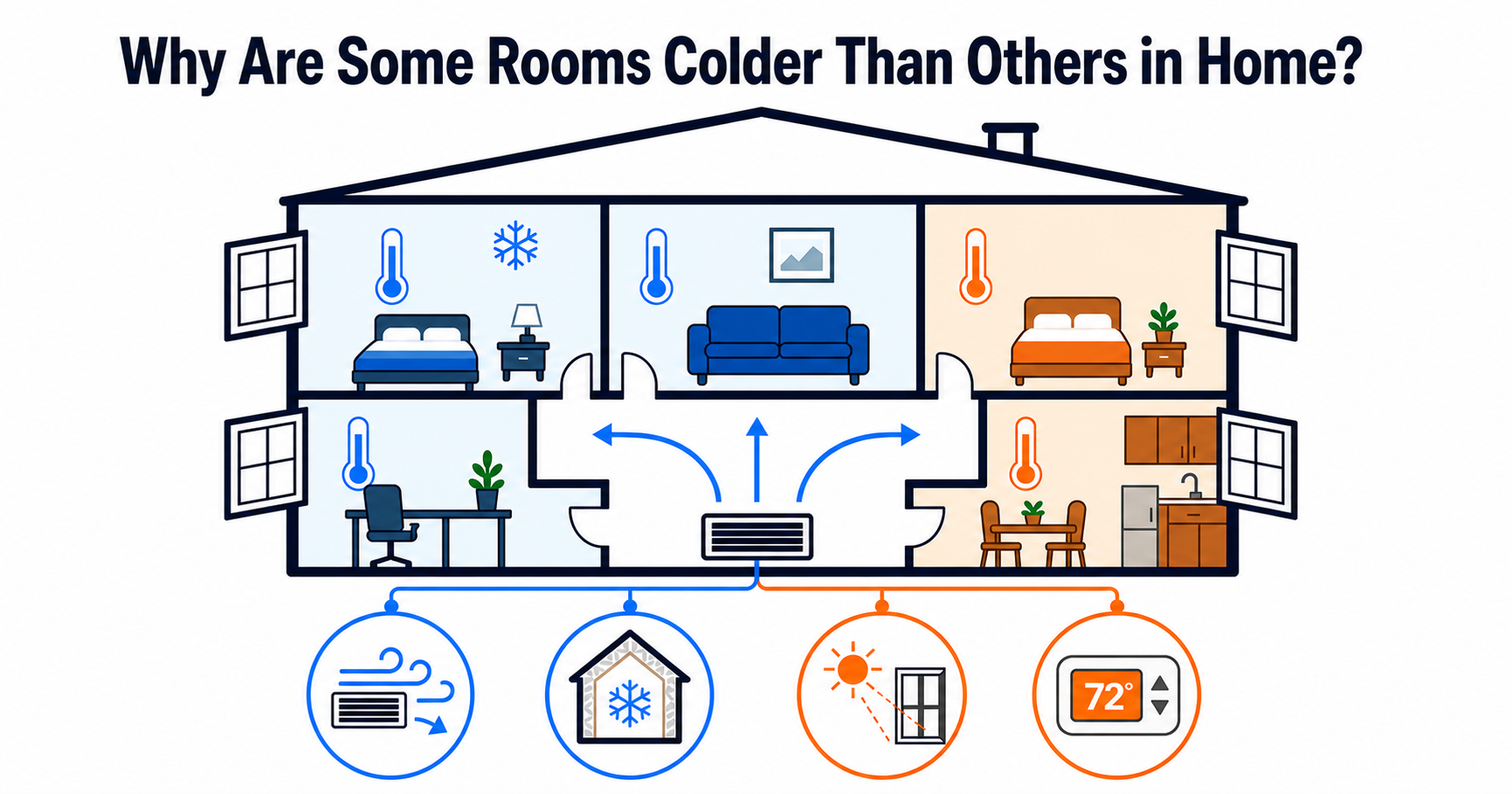
Usually airflow and insulation. Heat reaches each room through your ducts and vents, so weak or leaky ducts, blocked vents, a missing return, or thin insulation all leave that room colder than the rest of your house.
- A closed, blocked, or furniture-covered supply vent
- Leaky or undersized ducts losing heat on the way
- No return vent, so warm air cannot circulate
- Long duct runs to rooms far from the furnace
- Thin insulation in walls, floors, or above the room
- A room over a garage or in an addition
Often it is a mix: a far room with a long duct run and weak insulation feels it most. The good news is that most causes are fixable without touching your furnace itself.
Why Is This Common in My Toronto Home?
Quick Answer:
Because Toronto's narrow pre-1940 homes often have weak or retrofit upstairs ductwork, heat struggles to reach the second floor. Thin original insulation up there lets what does arrive escape, so your upstairs runs cold by midwinter.
Balancing the airflow toward your upstairs and sealing leaky ducts gets more heat where it is needed. Adding insulation upstairs holds it, and a stubborn finished attic may do best with its own ductless head.
How Do I Fix Cold Rooms?
Quick Answer:
Start easy: open and clear every vent, then check for a return in your cold room. Next, have the ducts checked for leaks and your airflow balanced. Add insulation where it is thin, and consider zoning for your stubborn rooms.
In Toronto, check that your upstairs vents are open and that there is a return up there, then have the ducts balanced toward the second floor. Add insulation upstairs, and consider a ductless head for a converted attic.
Do I Need a New System to Fix It?
Quick Answer:
Usually not. Balancing airflow, sealing ducts, and adding insulation fix most cold rooms in your home. For a room your ducts just cannot reach well, like an addition or bonus room, a single ductless head gives it its own control.
That is far cheaper than replacing a system that heats the rest of your house fine. The point is to fix the room, not oversell your house, so the right answer is usually the smallest one that works.
Key Point: In Toronto, narrow pre-1940 homes with weak upstairs ducts and thin insulation run cold upstairs, so balancing airflow and adding insulation fix most of it.
Cold-Room Causes at a Glance
|
Cold-room cause |
What helps |
|
Closed or blocked vent |
Open and clear it; check for a return |
|
Leaky or undersized ducts |
Seal and balance the airflow |
|
Thin insulation |
Add insulation to walls or above |
|
Room ducts cannot reach |
A single ductless head for zone control |
|
Toronto focus |
Weak upstairs ducts; balance airflow, insulate |
Honest Fix finds the real cause in your home: we check vents, returns, ducts, and insulation, then balance the airflow. If a room needs its own ductless head we will say so, and if not, we will say that too.
Frequently Asked Questions
Should I close vents in unused rooms to push heat elsewhere?
Usually no. Closing vents raises pressure in the ducts, which can cause leaks and make your furnace work harder, often making other rooms worse, not better. Leave your vents open and fix the real airflow problem instead.
Will a bigger furnace fix my cold rooms?
Rarely. If the heat is not reaching the room, a bigger furnace just makes more heat that still cannot get there, and can short-cycle. Fixing your ducts, returns, and insulation solves the problem a bigger unit will not.
Why is your upstairs always cold in my old Toronto house?
Narrow older homes often have weaker upstairs ductwork and thin insulation, so heat arrives weak and escapes fast. Balancing the airflow to the second floor and adding insulation up there usually evens it out.
My Toronto attic was finished into a bedroom and it is freezing. Why?
Converted attics rarely have ductwork sized for the space, and their walls and roof are often under-insulated. Adding insulation helps, but a single ductless head usually gives that room the steady heat the old ducts cannot.
Even Out the Cold Rooms in Your Toronto Home
Tired of one freezing room? Call (740) 825-9408 and we will check the vents, ducts, returns, and insulation, balance the airflow, and tell you honestly what your Toronto room needs.
Scott Merritt is a co-founder of Honest Fix Heating, Cooling and Plumbing and brings more than 30 years of experience across HVAC, leadership, and industry education. He serves in a senior leadership and oversight role, providing licensed guidance, reviewing HVAC educational content, and supporting technician training and documentation standards. Prior to co-founding Honest Fix, Scott founded and owned Fire & Ice Heating & Air Conditioning in Columbus, Ohio, which he operated for more than two decades before selling the company in 2025. During that time, he led programs and partnerships including Carrier Factory Authorized Dealer, Trane Comfort Specialist, and Rheem Pro Partner, helping establish high technical and training standards. Scott is the Ohio State HVAC license holder for Honest Fix and provides licensed oversight to help ensure work meets applicable codes and manufacturer requirements. Learn more about Scott’s background and role at Honest Fix by viewing his full leadership bio.
