
Why Paying More for HVAC Service Can Cost Less Over Time
June 17th, 2026
4 min read
Quick Answer
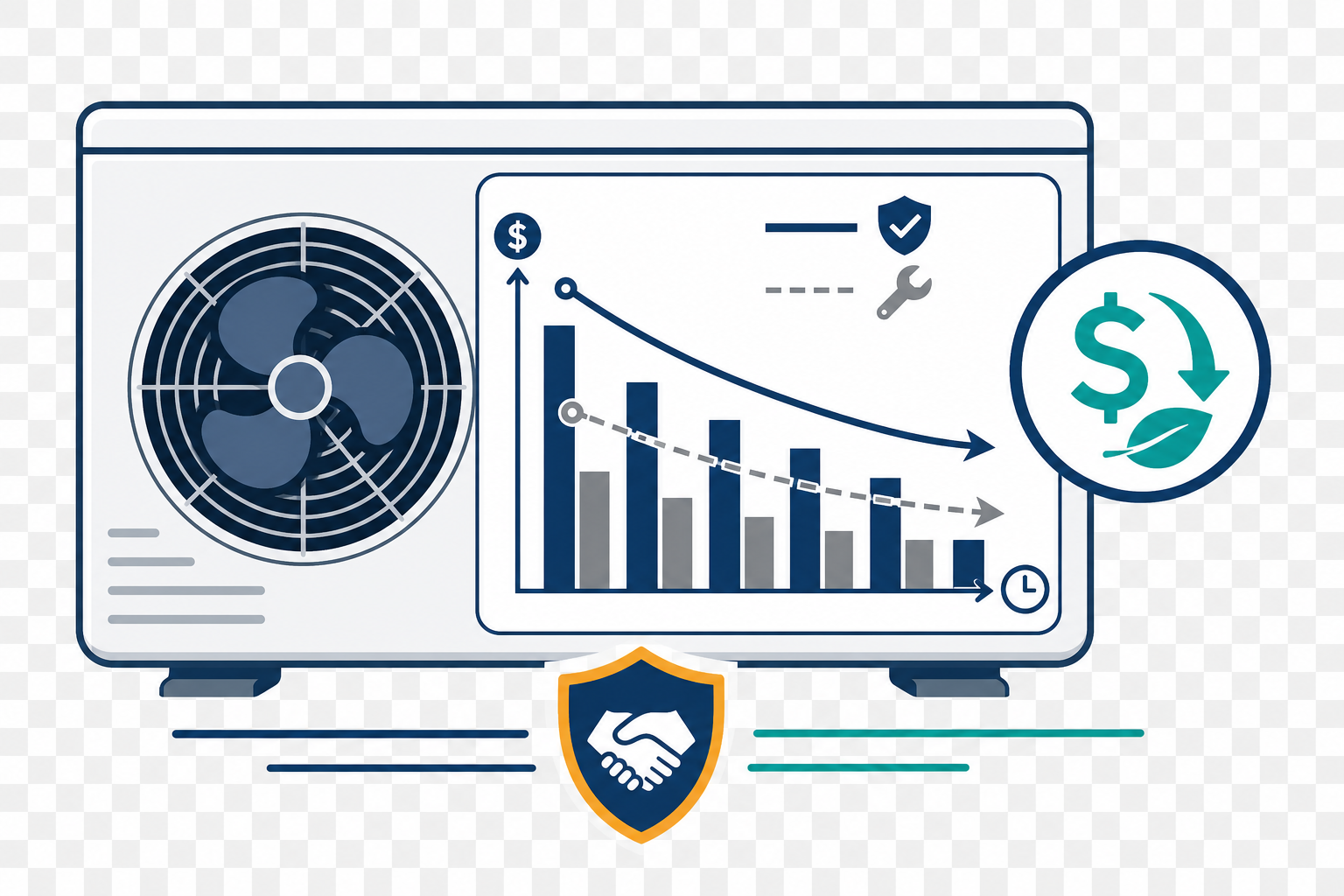
Paying more upfront for HVAC service often costs less over time because it prevents repeat repairs, avoids system damage, and includes protections that reduce future out-of-pocket costs. While some companies charge less initially, correct diagnosis, flat-rate pricing, and warranty-backed work typically result in lower total cost over a 10–15 year period.
In Steubenville, Weirton, and across the Upper Ohio Valley, HVAC systems are rarely simple. Older homes, basement installations, and Ohio River valley humidity create layered problems. These conditions increase the chance of misdiagnosis and repeat failures, which is why total cost—not initial price—is what determines what you actually pay.
Why are we sometimes not the cheapest option?
Quick Answer: We are not always the lowest upfront price because the work includes full diagnosis, correct repair, and long-term protection.
Some companies reduce pricing by:
- Limiting diagnostic time
- Fixing only the most visible issue
- Excluding long-term protection
Our model is simple: diagnose correctly, fix it once, and reduce the chance you pay again.
Key Point: Lower upfront cost often leads to higher total cost.
Why does cheaper HVAC work often cost more later?
Quick Answer: Cheaper HVAC work often costs more because it addresses symptoms instead of the root cause.
In this area, we commonly see:
- A part replaced without solving the underlying issue
- The same breakdown returning within months
- Additional repairs stacking over time
Most homeowners don’t overpay because one repair was expensive—they overpay because they had to pay multiple times.
After 30+ years servicing HVAC systems across Ohio, repeat repairs are one of the most consistent cost drivers.
Do diagnostic fees and higher-quality repairs actually save money?
Quick Answer: Yes. For most homeowners, a proper diagnostic and correct repair is the lowest total cost option.
A complete diagnosis allows:
- One repair instead of several
- Fewer unexpected breakdowns
- Longer system life
The most reliable way to reduce HVAC costs is avoiding repeat repairs.
Simple cost comparison
Quick Answer: Lower upfront pricing does not always mean lower total cost.
Example:
- 2 service calls ($74 each) = $148
- 2 partial repairs ($250 each) = $500
- Total = $648
vs
- 1 correct repair = $500
Key Point: Paying once is usually cheaper than paying multiple times.
What does “total cost of ownership” mean?
Quick Answer: Total cost of ownership is everything you pay over time—not just the first invoice.
It includes:
- Initial repair
- Repeat service calls
- System wear and efficiency loss
- Early replacement
According to ENERGY STAR, proper servicing and system care are key factors in reducing long-term heating and cooling costs. https://www.energystar.gov/saveathome/heating-cooling
The best way to avoid overpaying is focusing on long-term outcomes, not short-term price.
What happens if you choose based on price alone?
Quick Answer: Choosing based only on price often leads to higher total cost.
Common outcomes:
- Incorrect parts replaced
- Multiple service visits
- Ongoing system problems
- Shortened system lifespan
In the Upper Ohio Valley, older systems and airflow issues make repeat breakdowns more common when the root cause is not addressed.
Most higher-cost problems started as smaller issues that were not diagnosed correctly.
How warranty and maintenance reduce your risk
Quick Answer: Warranty protection lowers long-term cost by shifting repair risk away from you—but the level of protection varies.
All HVAC manufacturers require maintenance to keep equipment warranties valid and recommend yearly service to prevent failure and maintain efficiency.
The difference is what protection you receive beyond that.
- Manufacturer warranties typically cover parts only
- Labor is often not included after the initial period
- Future repair costs can still fall on the homeowner
With our approach:
- Repairs can include up to a 5-year labor warranty
- That protection is maintained with annual maintenance
- This reduces repeat out-of-pocket repair costs
All systems require maintenance—the difference is whether that maintenance also protects you from future labor costs.
Why maintenance is required for long-term protection
Quick Answer: Maintenance is required because it prevents the exact failures the warranty is designed to protect against.
- All manufacturers require maintenance to keep warranties valid
- Most system failures are tied to lack of maintenance
- Regular service keeps systems operating safely and efficiently
Key Point: Maintenance is not a hidden condition—it is a standard requirement across the industry.
Are there hidden conditions or fine print?
Quick Answer: No. Requirements like maintenance are clearly explained upfront and follow standard manufacturer guidelines.
You will know:
- What is required
- What is covered
- What to expect long term
The difference is not the requirement—the difference is the added labor protection on top of it.
How our pricing model reduces total cost
Quick Answer: Our model reduces total cost through accurate diagnosis, flat-rate pricing, and long-term protection.
What that means:
- $64–$74 diagnostic with Leo the Lion
- Flat-rate repair pricing (no hourly increases)
- Full repair price given before work begins
- Repair designed to solve the issue once
Leo the Lion is our company mascot and AI chatbot. Every first-time customer receives a Leo refrigerator magnet and can use it immediately for $25 off. As long as it stays on your fridge, you continue receiving $25 off future diagnostics and tune-ups with no expiration.
You will always know the cost before work begins and understand your options before approving any repair. There are no surprise charges or time-based increases.
Who carries the risk?
Quick Answer: With our model, more of the long-term repair risk is transferred away from the homeowner.
- Diagnosis is done thoroughly upfront
- Repairs are backed with labor protection
- Pricing is fixed before work begins
Lower-cost models often shift risk back to the homeowner through repeat failures and uncertain outcomes.
Why do HVAC companies charge different prices?
Quick Answer: Pricing varies based on diagnosis quality, pricing model, and included protection—not just parts.
“Why does one HVAC company charge more than another?”
Because one may be quoting a temporary fix, while another is quoting a complete solution.
The most reliable approach is choosing based on long-term results, not just upfront cost.
Real example in this area
A Steubenville homeowner had repeated AC issues over two summers. Multiple lower-cost repairs were done, but the system kept failing.
The root issue was restricted airflow combined with a refrigerant imbalance.
Once both were corrected, the system operated without further breakdowns.
Key Point: Most repeat failures come from treating symptoms instead of the root cause.
When a lower-cost option may make sense
Quick Answer: A lower upfront repair can make sense in short-term situations.
Examples include:
- You plan to move soon
- You need a temporary fix
- The system is near full replacement
In these cases, minimizing upfront cost may be the right decision.
Quick Decision Guide
- Comparing prices: Ask what’s included, not just the number
- Multiple past repairs: Likely a missed root cause
- Older system (10–20 years): Proper diagnosis matters more
- Want lowest total cost: Focus on long-term outcome
FAQs
Why does one HVAC company charge more than another?
Because pricing reflects diagnosis, repair approach, and protection—not just parts. A higher price often includes solving the full problem.
Is it better to choose the cheapest HVAC repair?
Not usually. Lower-cost repairs often lead to repeat service calls and higher total cost.
What actually saves the most money long term?
Correct diagnosis, proper repair, and preventing repeat failures.
How do I avoid paying for the same problem twice?
Choose a company that focuses on root cause diagnosis, clear pricing, and long-term protection.
Most repeat HVAC problems don’t just cost more—they create stress, downtime, and uncertainty about when the system will fail again.
For most homeowners, the lowest total cost comes from fixing the problem correctly the first time and reducing the chance of paying for the same issue again.
Exact HVAC replacement quotes available at (740) 825-9408 or HonestFix.com/schedule-service.
Scott Merritt is a co-founder of Honest Fix Heating, Cooling and Plumbing and brings more than 30 years of experience across HVAC, leadership, and industry education. He serves in a senior leadership and oversight role, providing licensed guidance, reviewing HVAC educational content, and supporting technician training and documentation standards. Prior to co-founding Honest Fix, Scott founded and owned Fire & Ice Heating & Air Conditioning in Columbus, Ohio, which he operated for more than two decades before selling the company in 2025. During that time, he led programs and partnerships including Carrier Factory Authorized Dealer, Trane Comfort Specialist, and Rheem Pro Partner, helping establish high technical and training standards. Scott is the Ohio State HVAC license holder for Honest Fix and provides licensed oversight to help ensure work meets applicable codes and manufacturer requirements. Learn more about Scott’s background and role at Honest Fix by viewing his full leadership bio.
