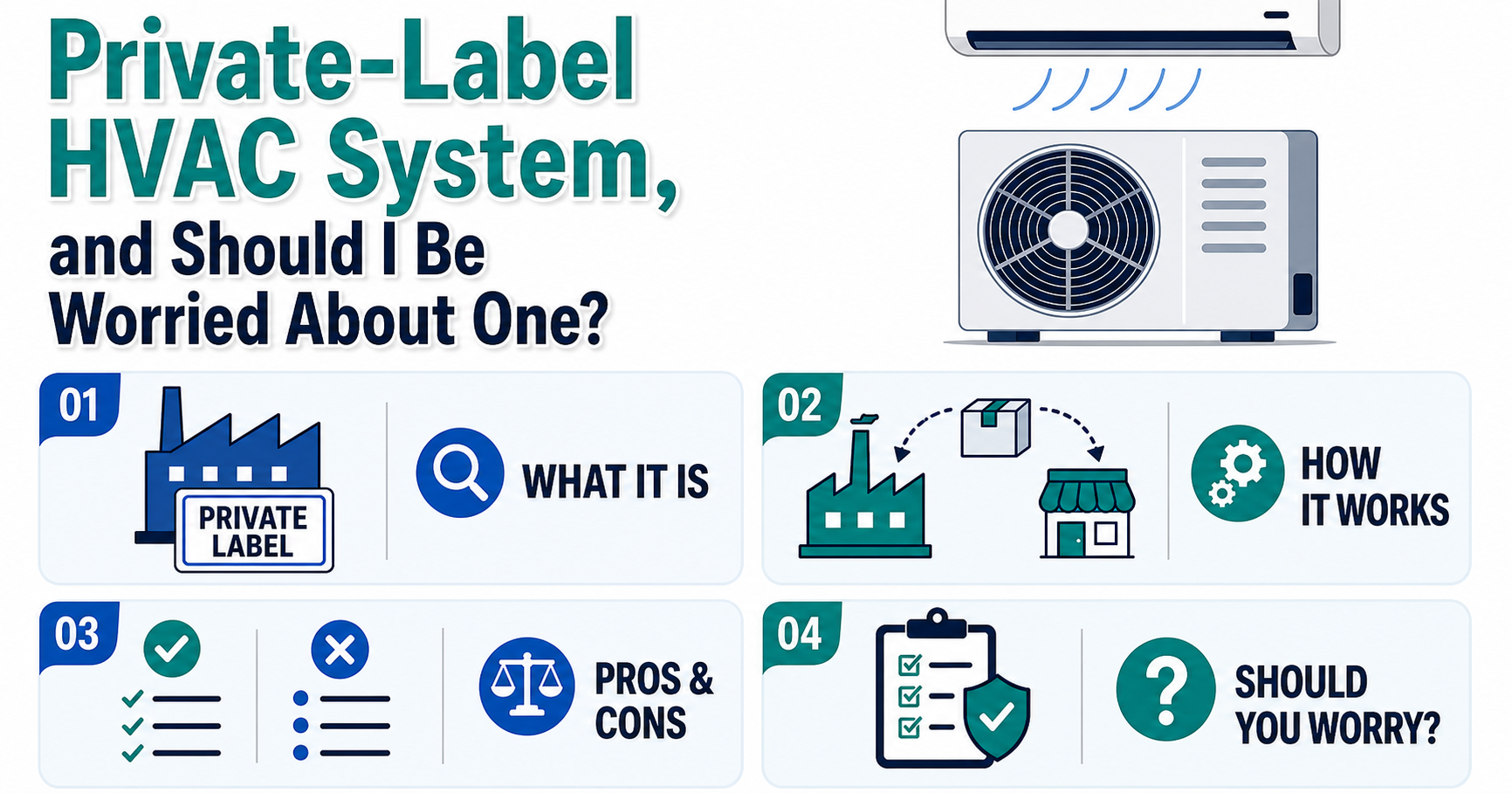
What Is a Private-Label HVAC System, and Should I Be Worried About One?
July 7th, 2026
3 min read
Quick Answer
A private-label HVAC system is equipment built by a known manufacturer but sold under a contractor's brand. It is not bad, but the concern is support: parts, warranty, and service can be hard to get if that company is gone.
After 30-plus years in HVAC across Ohio, we have serviced plenty of private-label systems. The equipment is often fine. The trouble starts when a homeowner needs parts or warranty help and the only source has moved on.
Companies private-label for good business reasons, and a few less-good ones. Understanding why they do it helps you tell a fair deal from a lock-in before you sign.
What Exactly Is a Private-Label HVAC System?
Quick Answer:
It is a white-label product. A major manufacturer builds the unit, and the selling company puts its name on it. The hardware can be solid, but the badge is the seller's, not a brand you can look up elsewhere.
You will not find independent reviews or spec comparisons for a private label the way you can for a mainstream brand. That is part of the point. The name lives and dies with the company that sells it.
Signs include a brand you cannot find online, model numbers that match no major maker, and a contractor who is the only one selling and servicing it. That does not prove a bad unit, just a reason to ask more.
Why Do Some Companies Sell Private-Label Systems?
Quick Answer:
A few reasons. It can raise their margin, give them control over branding, and make price comparison harder. The least customer-friendly reason is lock-in: if only they can service and supply the system, you have to keep coming back.
None of that is illegal or even unusual. But it shifts leverage to the seller. A widely-available brand keeps your options open; a private label can quietly close them, especially for parts and warranty service later.
Should You Be Worried About One?
Quick Answer:
Worried, no. Careful, yes. The equipment is built by a reputable maker, so quality is rarely the issue. The risk is practical: if that company closes, moves, or you relocate, finding parts, warranty support, or another servicer can be hard.
Resale is the other wrinkle. A buyer's home inspector may flag an unfamiliar system, and a future owner could struggle to service it. A mainstream brand avoids that friction because any qualified contractor recognizes and supports it.
How Do You Protect Yourself?
Quick Answer:
Ask questions before you buy. Find out who actually makes the unit, whether other local contractors can service and source parts, and get the warranty terms in writing. When in doubt, choose a widely-serviced brand backed by a labor warranty.
The installer's labor warranty matters as much as the equipment warranty. A company that stands behind its work in writing, on equipment any technician can service, gives you protection a private-label badge alone cannot.
Get it in writing, not just verbally. A quote that names the real manufacturer, lists what the warranty covers, and spells out the labor guarantee gives you something to hold onto. A vague, badge-only quote leaves you exposed.
Key Point: A private label is not a scam, but it can be a leash. Before you buy, make sure someone other than the seller can get parts and service it.
Questions to Ask Before Buying a Private-Label System
|
Before buying, ask |
Why it matters |
|
Who builds it? |
Tells you the real quality and parts source |
|
Who else can service it? |
Protects you if the seller is unavailable |
|
What does the warranty cover? |
Coverage is only as good as who backs it |
|
Are parts widely available? |
Avoids long waits on a future repair |
|
Is there a labor warranty? |
The installer's promise, in writing |
We install proven, widely-serviced equipment and back every job with the Lifetime Trust Shield, including a 15-year labor warranty. You are never locked into us for parts or service. Full terms on request.
Frequently Asked Questions
Is private-label equipment lower quality?
Usually not. Most private-label units are built by established manufacturers, so the hardware is comparable. The difference is support and transparency, not necessarily what is inside the cabinet.
How can I tell if a quote is for a private-label system?
Look up the brand name. If you cannot find an independent manufacturer, reviews, or spec sheets, it may be a private label. Ask the contractor directly who builds it and who else can service it.
What happens to my warranty if the company that sold it closes?
It depends on how the warranty is structured. If only the seller backs it, it can become hard to honor. If a major manufacturer backs it, coverage usually survives. Get this in writing first.
Can another company service a private-label system?
Sometimes, if they can identify the real manufacturer and source parts. It is often harder than with a mainstream brand, which is exactly the risk to weigh before you buy.
Find Out What You Are Really Buying
Not sure whether a quote is for a private-label system? Call us at (740) 825-9408 or schedule a free exact quote. You will get a clear answer on what you are buying and who can support it.
Scott Merritt is a co-founder of Honest Fix Heating, Cooling and Plumbing and brings more than 30 years of experience across HVAC, leadership, and industry education. He serves in a senior leadership and oversight role, providing licensed guidance, reviewing HVAC educational content, and supporting technician training and documentation standards. Prior to co-founding Honest Fix, Scott founded and owned Fire & Ice Heating & Air Conditioning in Columbus, Ohio, which he operated for more than two decades before selling the company in 2025. During that time, he led programs and partnerships including Carrier Factory Authorized Dealer, Trane Comfort Specialist, and Rheem Pro Partner, helping establish high technical and training standards. Scott is the Ohio State HVAC license holder for Honest Fix and provides licensed oversight to help ensure work meets applicable codes and manufacturer requirements. Learn more about Scott’s background and role at Honest Fix by viewing his full leadership bio.
