INSTALLATION STANDARDS · DUCT INSULATION

How Honest Fix Insulates Ductwork

Duct insulation is the blanket that keeps the air you paid to heat or cool from giving up its temperature on the way to your rooms. In an unconditioned basement, attic, or crawlspace, uninsulated metal duct bleeds off heat through its walls and sweats and drips in humid weather. Honest Fix insulates every run in those spaces to a written standard: the right R-value, complete coverage, and seams that stay taped for years. This page is that standard, published in full, so you can hold any contractor to it. Ours included.

Published from our Installation Handbook · Reviewed by Alex Largent · 100% satisfaction, no exceptions 

THE HONEST FIX INSULATION STANDARD

Four Things Duct Insulation Has to Get Right

Duct insulation looks like the simplest thing on a job, and it is the easiest to shortcut because a gap or a thin spot does not show once the work is done. Done right, it holds the temperature of the air all the way to your rooms and keeps the duct from sweating. Here is what Honest Fix requires on every run we insulate. You are welcome to check yours against it. 

The right R-value

Duct in an unconditioned space, a basement, attic, or crawlspace, is insulated to a minimum of R-12. That is the figure Honest Fix installs to, and it is only real if the insulation is fitted and secured the way the rest of this page describes. A rating printed on a roll is a starting point. What decides the R-value you actually get is how it went on.
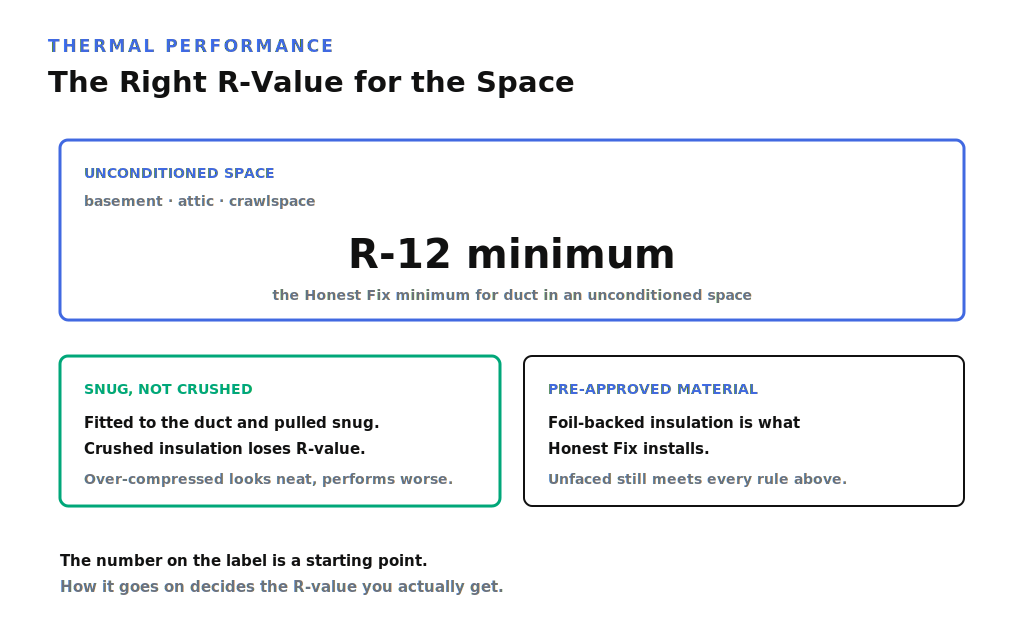
Diagram showing the Honest Fix R-12 minimum for duct in an unconditioned space, installed snug and not crushed, with foil-backed insulation as the approved material.

Complete coverage

On every run Honest Fix insulates, the insulation covers the duct end to end, with no gaps, tears, or exposed metal seams. On flex, the outer wrap is pulled all the way to the trunk so no bare metal is left at the connection. One uncovered stretch is where a duct sweats in humid weather and where the conditioned air bleeds off, so mostly covered is not the standard. When unfaced insulation is used in a hidden space, it still meets every one of these rules.
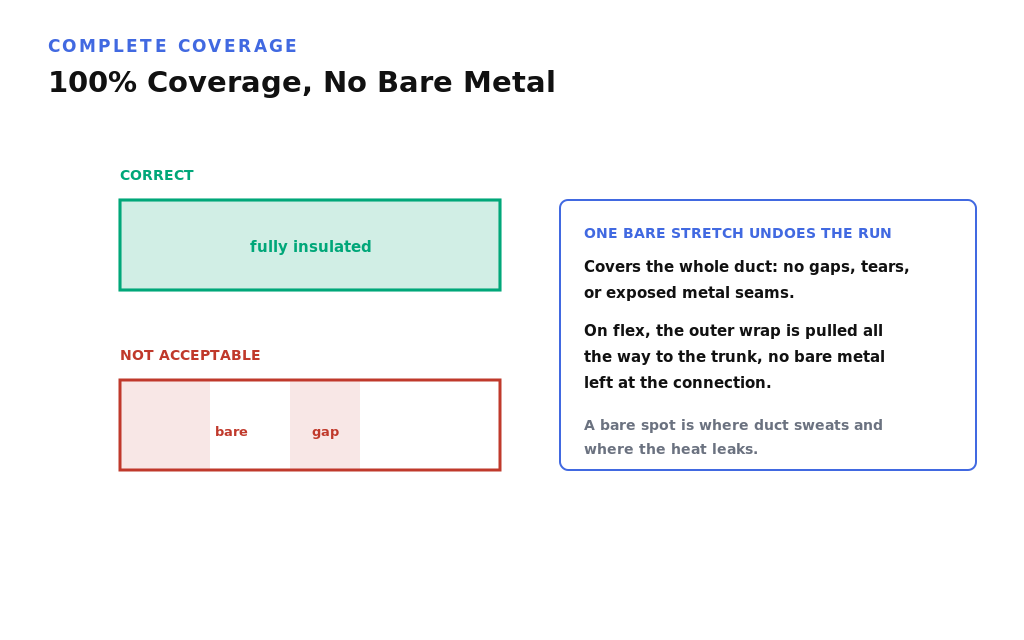
Diagram comparing fully insulated duct against a run with bare metal gaps, showing where sweating and heat loss happen.

Snug, but not crushed

Insulation is wrapped and pulled tight enough for a clean, uniform look, but not so tight that compressing it lowers the R-value. Over-compressed insulation looks neat and performs worse than loose insulation, which is the trap: the tidiest-looking job can be the one quietly losing its rating. It is fitted to the actual pipe size so it lies flat without bunching or squeezing.
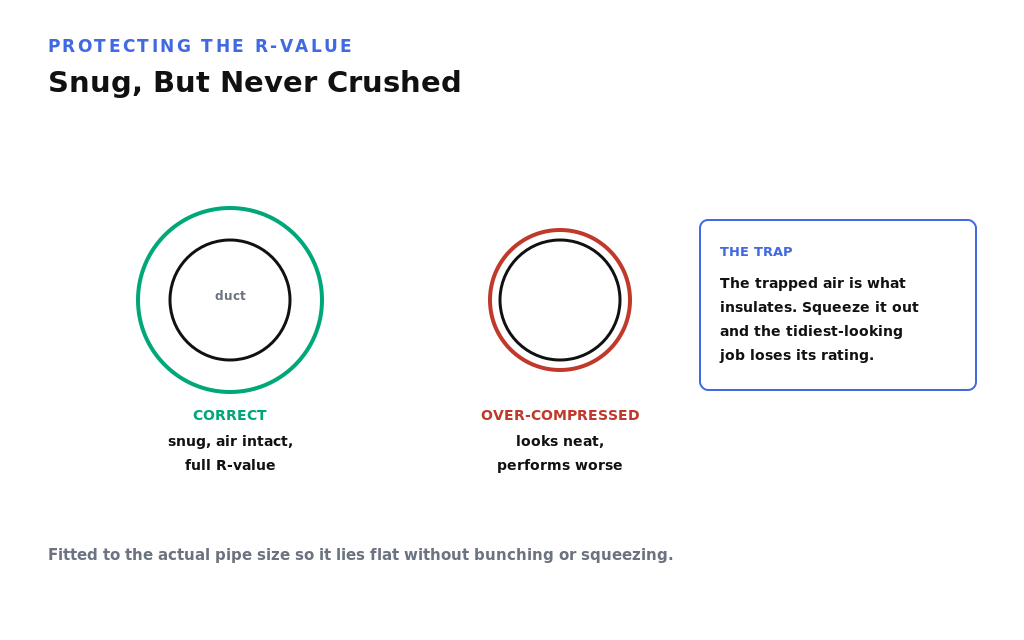
Diagram showing duct insulation pulled snug versus over-compressed, where crushing lowers the R-value.

Sealed at the seams

Every seam is taped adequately so the insulation cannot pull apart over the years. Where a run turns, the insulation follows the curve of the elbow and is taped so it stays on the bend rather than gapping open at the outside of the turn, which is exactly where a rushed job leaves a hole.
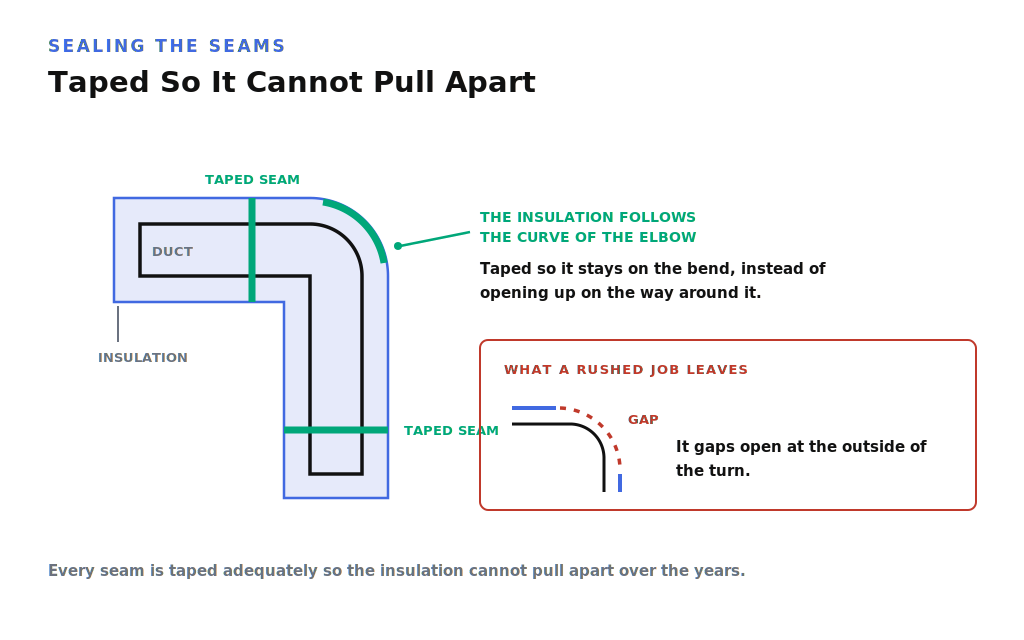
Diagram of duct insulation following the curve of an elbow with the seams taped, so the wrap stays closed on the outside of the turn.
WHY THIS ONE MATTERS HERE

In the Upper Ohio Valley, Humid Summers Make Bare Duct Sweat

Our summers are humid, and a lot of ductwork here runs through basements and crawlspaces that are not conditioned. Cold supply duct in that damp air is a magnet for condensation, and every bare spot becomes a place that drips onto whatever is below it, season after season. 

Bare metal duct sweats and drips

Cold duct in humid, unconditioned air condenses water on its surface. Wherever the metal is exposed, that water forms and falls on the framing, the floor, or the ceiling below. 

A gap in coverage is a heat leak

The duct loses or gains heat fastest wherever the insulation is missing, so one uncovered stretch undoes a lot of the run that was done right. 

Over-compressed insulation quietly underperforms

Insulation crushed too tight to look neat loses R-value. The job can look better and work worse, which is why the snug-not-crushed rule matters. 

Untaped seams open up over time

Insulation that was not taped at the seams pulls apart as the duct heats and cools, and a run that was fully covered on day one ends up gapped a few years later. 

Field conditions. Final installation details may vary based on manufacturer requirements, local code, home conditions, equipment model, safety constraints, and the written scope of work. Where the manufacturer's instructions and this standard disagree, the manufacturer's instructions win, and your technician follows them. 

DUCT INSULATION

Common Questions

Why does ductwork need to be insulated at all?

What R-value should my duct insulation be?

Can insulation be wrapped too tight?

Why is some of my duct insulation coming apart at the seams?

Does the insulation really need to cover 100% of the duct?

What kind of insulation does Honest Fix use?

How do I know my duct insulation was done right?

Last Updated: November 12th, 2026

Have a Look at Yours

Now you know what correct duct insulation looks like. If yours has bare spots, sweats, or is pulling apart, or you would rather have someone else check, Honest Fix will come out and give you a straight answer. No upsells, no games. 

Metal ductwork · Flexible ductwork · The full Installation Standard

Honest Fix service van parked outside a home in Steubenville, OH.