0% for 25 months on a qualifying new Rheem® heating or cooling system. Installed by November 15.
Two parts of your system live at opposite ends of visibility. The thermostat is the one control you touch every day, so it is mounted and finished like a fixture. The wiring behind your equipment is invisible, which is exactly why it gets shortcut. The real test of that wiring is whether the next technician can read it without pulling your system apart. Honest Fix holds both to a written standard. This page is that standard, published in full, so you can hold any contractor to it. Ours included.
Published from our Installation Handbook · Reviewed by Alex Largent · 100% satisfaction, no exceptions
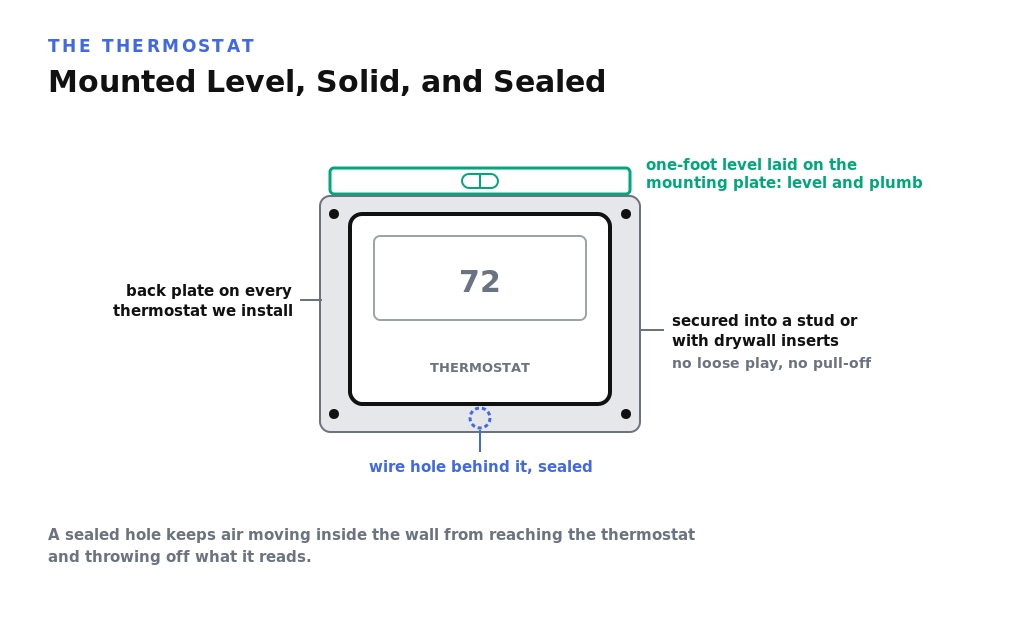
It goes on level and plumb, checked with a one-foot level on the mounting plate, backed by the back plate it comes with, secured to a stud or drywall inserts, with no loose play and the wire hole sealed against drafts.
Low-voltage wires are run straight, kept neat, and left with slack coiled for the future, so a technician can trace them without taking your work apart.
The outer jacket on a wire bundle is opened with a razor, not squeezed with wire strippers. If strippers were used, the end they gripped is cut off, because a nicked wire is what causes a short down the road.
The thermostat and the wiring behind your equipment are the two things a rushed installer treats as afterthoughts, and the two things a careful one treats as craft. One you see every day. The other you only see if something goes wrong and someone has to trace it. Here is what Honest Fix requires on both. You are welcome to check yours against it.
The thermostat goes on level and plumb, checked with a one-foot level laid on the mounting plate, and is secured into a stud or with drywall inserts so there is no loose play and no chance of it pulling off the wall over years of use. A back plate goes on every thermostat we install. It is what the thermostat itself mounts to, and a stat that does not come with one is a stat we will not put on your wall. The hole the wire comes through is sealed, normally with thumb gum, so air moving inside the wall cannot reach the thermostat and throw off what it reads.
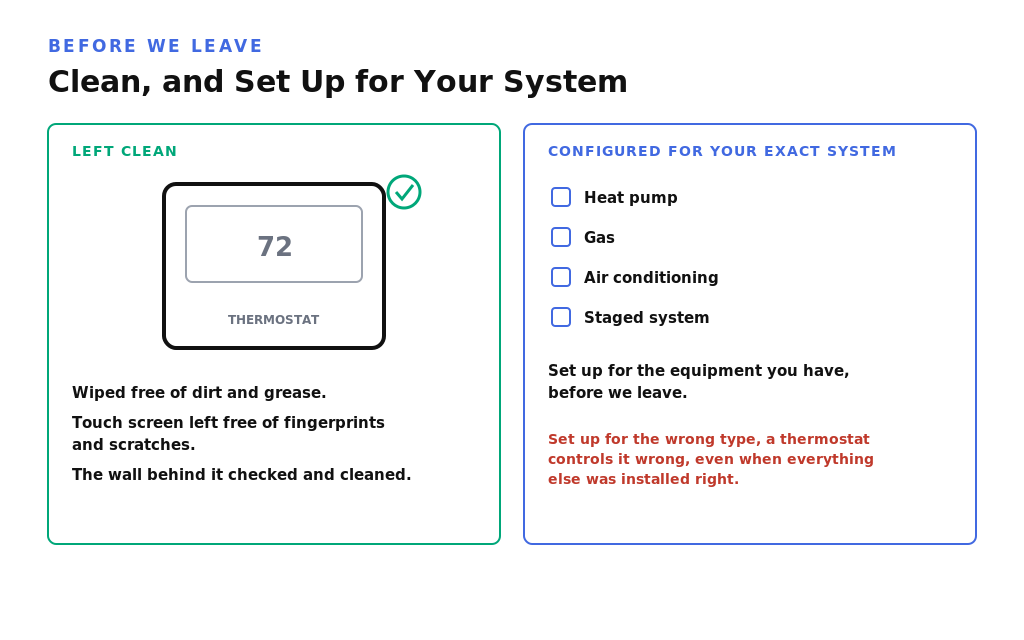
The thermostat is wiped free of any dirt or grease, a touch screen is left free of fingerprints and scratches, and the wall behind it is checked and cleaned the same way. Before we leave, it is configured for your exact system type, whether that is a heat pump, gas, air conditioning, or a staged system, because a thermostat set up for the wrong equipment type controls it wrong even when everything else was installed right.
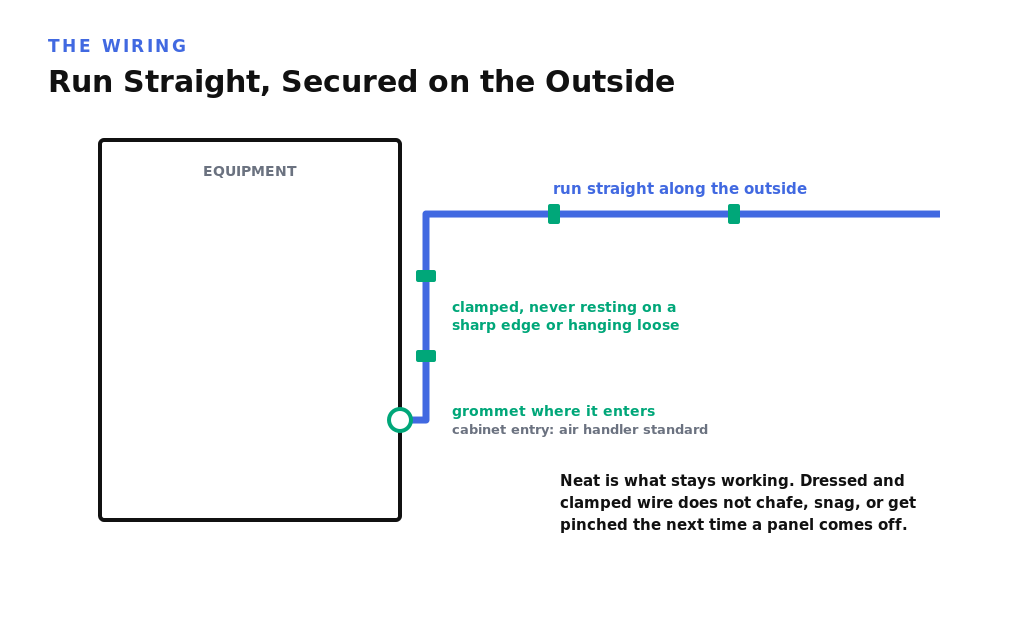
Low-voltage wiring is run straight along the outside of the equipment, secured with proper grommets and clamps so nothing rests against a sharp edge or hangs loose. Where the wire passes into the cabinet itself, the standard that applies is the one on our air handler page, so this page does not restate it. It is neat because neat is what stays working: wiring that is dressed and clamped does not chafe, snag, or get pinched the next time a panel comes off.
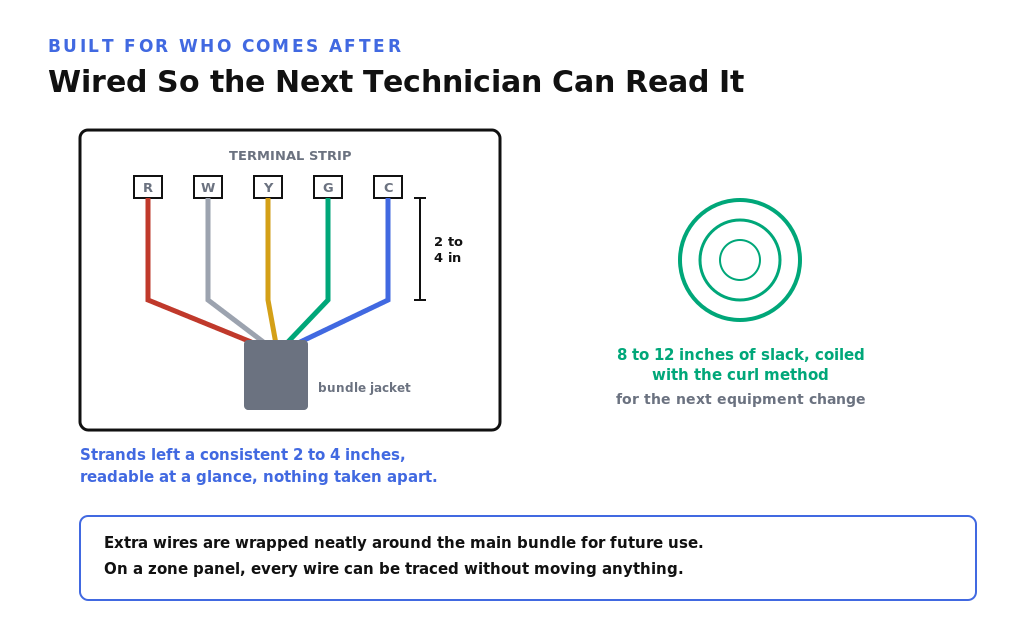
This is the standard most installers skip. Each wire is left a consistent 2 to 4 inches long at the terminal so a future technician can see at a glance what goes where without taking your work apart. Wherever possible, an extra 8 to 12 inches of low-voltage wire is left inside the equipment, coiled with the curl method, so the next equipment change has slack to work with. Extra wires are wrapped neatly around the main bundle for future use. On a zone panel, every wire is run so it can be traced without moving anything.
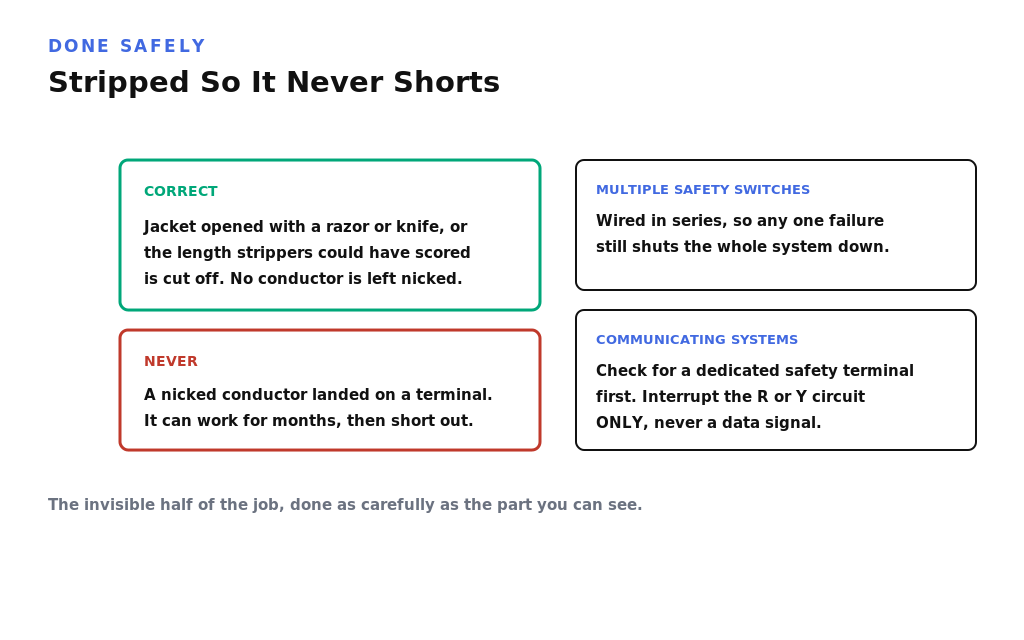
The rule on a bundle of low-voltage wire is that no conductor inside it reaches a terminal nicked. The jacket is opened with a razor or a knife, or, where wire strippers have been used on the bundle, the section they gripped is cut off before anything is connected. A scored conductor will run fine for months and then short, which is why the standard is written about the wire and not about the tool. Where multiple safety switches are wired they go in series, so any one of them failing still shuts the whole system down, and the full switch standard is on our condensate page. On a communicating system we check the board for a dedicated safety-switch terminal before wiring one in, and interrupt the R or Y circuit only, never a data signal.
A thermostat that reads wrong makes a perfectly good system feel broken, and wiring that nobody can trace turns a ten minute service call into an hour of untangling. Both are quiet problems that only show up later, which is exactly why the standard is written for later.
Air from inside the wall drifting across the sensor makes the thermostat read a temperature the room is not at, so the system runs when it should not. Sealing the hole fixes it.
A thermostat configured for the wrong equipment, gas instead of heat pump for example, can run the system incorrectly no matter how well everything else was installed.
If a technician has to take apart the wiring to work out what goes where, every future visit takes longer and costs more. Neat, traceable wiring pays off for the life of the system.
Wire strippers closed on a bundle can score the conductors inside it. A scored wire can work fine at first and short out months later, and that failure looks like a mystery instead of a shortcut.
Wiring pulled tight with no extra leaves the next technician nothing to work with. A few inches of coiled slack now saves cutting and splicing later.
Field conditions. Final installation details may vary based on manufacturer requirements, local code, home conditions, equipment model, safety constraints, and the written scope of work. Where the manufacturer's instructions and this standard disagree, the manufacturer's instructions win, and your technician follows them.
Because air from inside the wall can drift across the thermostat's sensor and make it read a temperature your room is not actually at. That drives the system to run when it should not, or not run when it should. Honest Fix seals the wire hole, normally with thumb gum, so the thermostat reads the room instead of the wall cavity.
It gives the thermostat a flat, solid surface to mount to, covers the wall opening, and keeps the unit level and firmly attached with no loose play. Honest Fix installs a back plate on every thermostat, which is also why a new thermostat sits flush and square instead of tilted or rocking.
Often it was never set up for your system type. A thermostat has to be configured for exactly what it is controlling, whether that is a heat pump, a gas furnace, air conditioning, or a staged system, and if it is set for the wrong type it can run the equipment incorrectly even when the wiring is perfect. Honest Fix configures the thermostat for your specific system before leaving.
It matters every time the system is serviced. Wiring that is run straight, kept neat, and left with a little slack lets a technician trace it at a glance. Wiring that was rushed has to be taken apart to understand, so every future visit takes longer. It is invisible when it is right, and expensive when it is wrong.
Making sure nothing nicked goes into your equipment. Wire strippers closed on a bundle can score the conductors inside it, and a scored wire can run perfectly for months and then short. Honest Fix opens the jacket of a bundle with a razor or a knife, and where strippers have been used on a bundle, the section they gripped is cut off before anything is connected to a terminal. Either way the conductor that ends up in your system is undamaged.
The next equipment change. Honest Fix leaves an extra 8 to 12 inches of low-voltage wire coiled inside the cabinet so that when the system is eventually replaced or serviced, there is slack to work with instead of having to splice in new wire. It costs nothing now and saves work later.
The thermostat you can check yourself: it should sit level and solid with no rocking, be clean, and the wall behind it unmarked. The wiring you mostly cannot see, which is why the standard is published here, so you know what a technician should find behind the panel: straight, secured, and traceable. If you would rather have someone look with you, that is what a free exact quote visit is for.
Now you know what a correct thermostat and wiring job looks like. If your stat rocks, reads oddly, or the wiring behind your equipment is a mystery, or you would rather have someone else check, Honest Fix will come out and give you a straight answer. No upsells, no games.
High-efficiency furnace · Air handlers · Condensate standards · The full Installation Standard