
Search for topics or resources
Enter your search below and hit enter or click the search icon.
0% for 25 months on a qualifying new Rheem® heating or cooling system. Installed by November 15.
Every air conditioner pulls water out of your air, and every high-efficiency furnace makes water as it cools its exhaust. That water has to go somewhere. Honest Fix installs every condensate line to a written standard: sloped, supported, trapped, and protected by a safety switch. This page is that standard, published in full, so you can hold any contractor to it. Ours included.
Published from our Installation Handbook · Reviewed by Alex Largent · 100% satisfaction, no exceptions
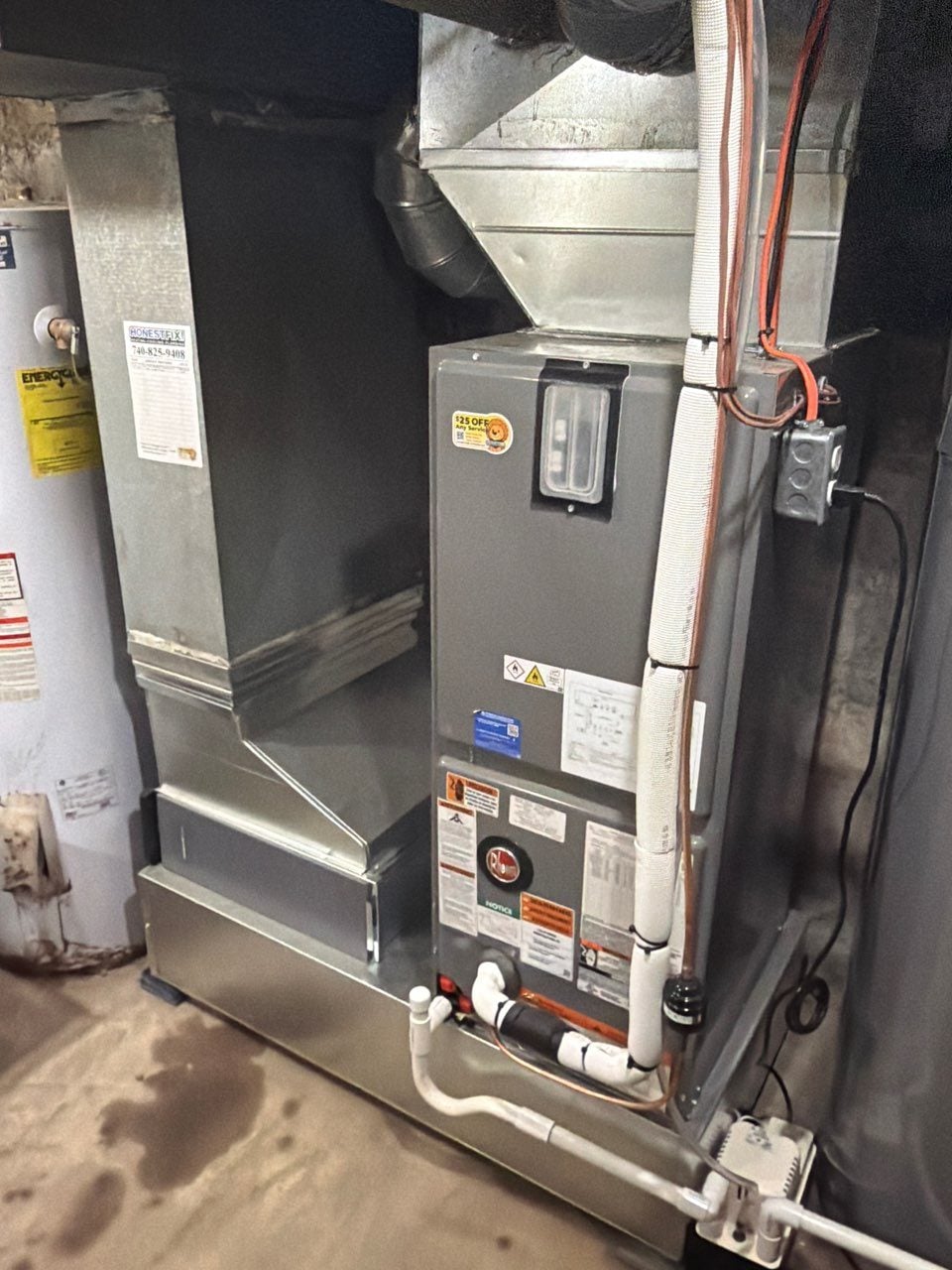

Horizontal PVC gets proper slope and a support every four feet, because unsupported PVC sags as it ages and a sag becomes an air trap.
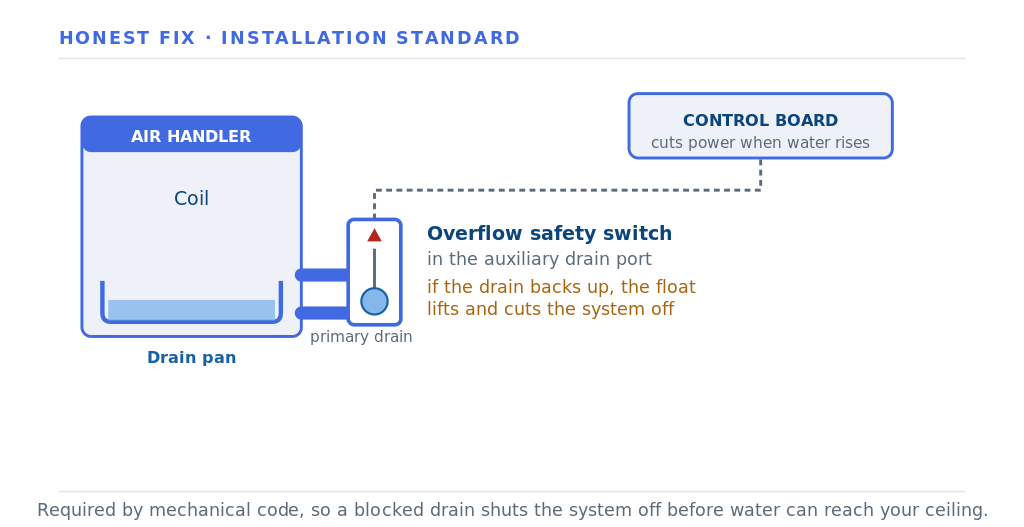
A safety switch sits in the secondary drain port on every coil and air handler, so a blocked line shuts the system down instead of soaking your ceiling.
The line never terminates on a walkway, porch, or roof in freezing weather, and never where the water runs back toward your siding or foundation.
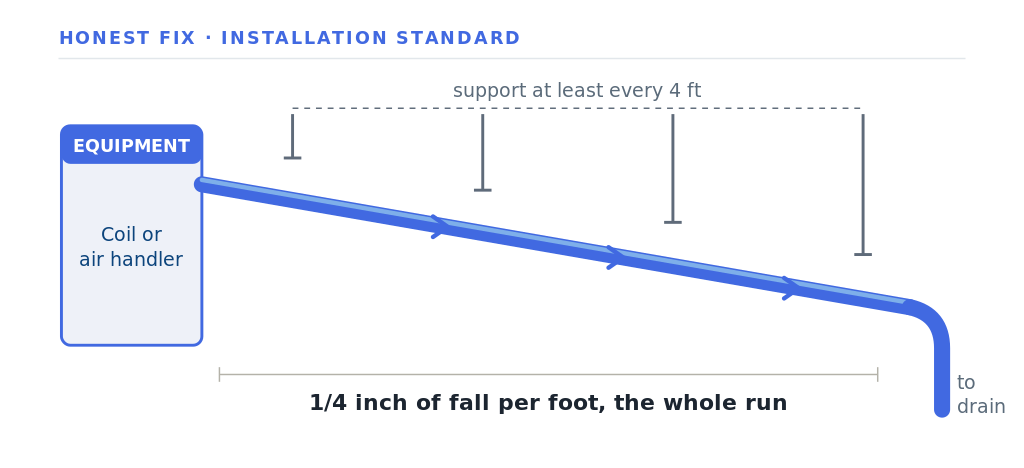
Every horizontal PVC condensate line runs at ¼ inch of fall per foot, with a support at least every four feet. PVC bows over time wherever it is unsupported, and a bow creates an air trap that stops the line from draining. Cuts are made straight so the joint seats fully inside the fitting.
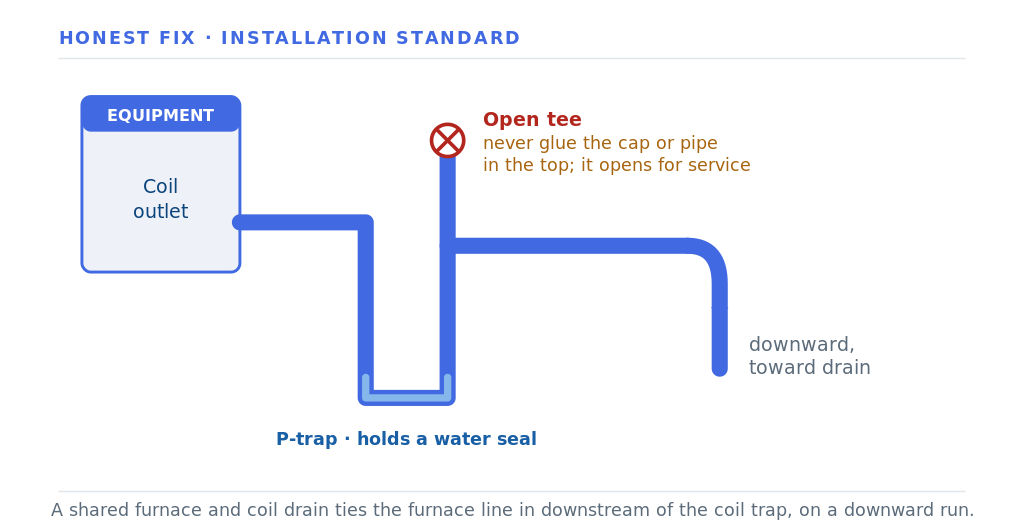
Every evaporator coil and air handler gets a properly oriented condensate trap, and the pipe or cap in the top of the tee is never glued, because that fitting has to open for service. A gas furnace will usually need an air tee as well, and which one comes from that furnace's installation instructions, not from habit. When a furnace and a coil share a drain, the furnace line ties in downstream of the coil trap, on a downward run.
Mechanical code requires overflow protection on cooling coils and air handlers, and a float-style safety switch is the method we install. It sits in the secondary drain port, and if the primary drain blocks, the switch shuts the system off before water backs into your ductwork. Where a condensate pump is used, the pump's own safety switch interrupts the control signal at the board, and the vinyl drain line is clamped to the pump fitting.
The line does not terminate on a walkway, a porch, or a roof where it can freeze, and it does not get a 90-degree elbow at the termination. It does not drain into an unconditioned space where it can freeze. And it is placed so the water does not run back toward your siding or drip onto your foundation.
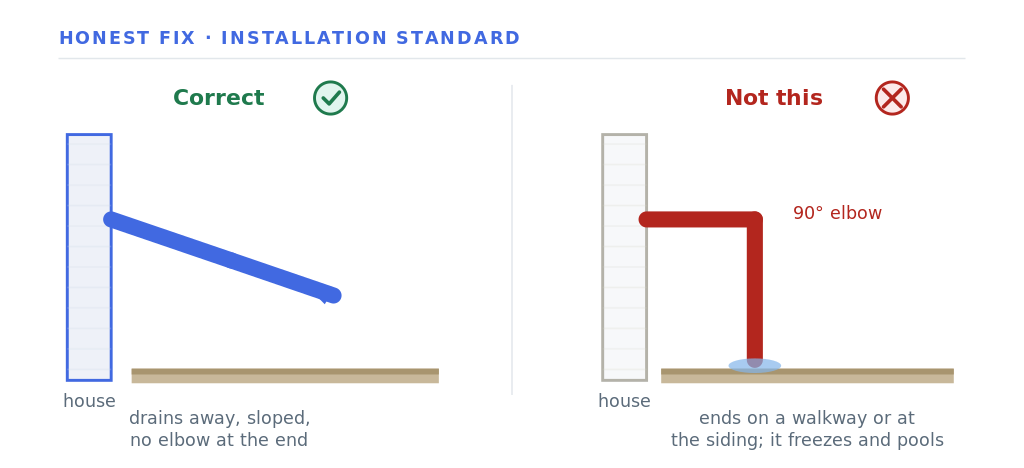

Now you know what a correct condensate line looks like. If yours does not look like this, or you would rather have someone else check, Honest Fix will come out and give you a straight answer. No upsells, no games.
Air handlers · Evaporator coils · High-efficiency furnace · Ductless head drains · AC repair · The full Installation Standard
