
Search for topics or resources
Enter your search below and hit enter or click the search icon.
0% for 25 months on a qualifying new Rheem® heating or cooling system. Installed by November 15.
Most of what determines whether an outdoor unit lasts happens before it ever runs: the base it sits on, the way the joints are brazed, and how completely the moisture is pulled out of the system. Those are also the three things you cannot see once the panels go back on. Honest Fix installs every outdoor unit to a written standard. This page is that standard, published in full, so you can hold any contractor to it. Ours included.
Published from our Installation Handbook · Reviewed by Alex Largent · 100% satisfaction, no exceptions
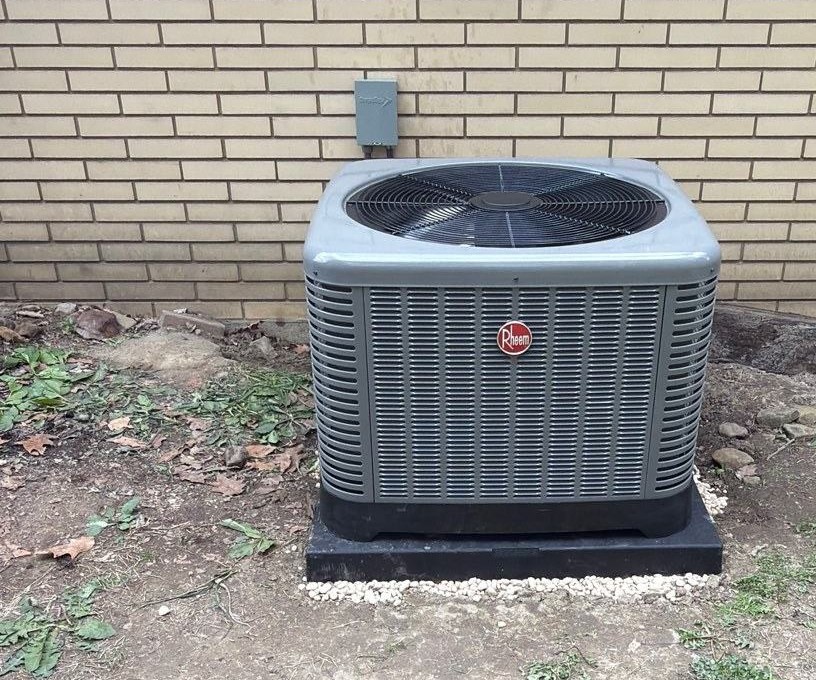

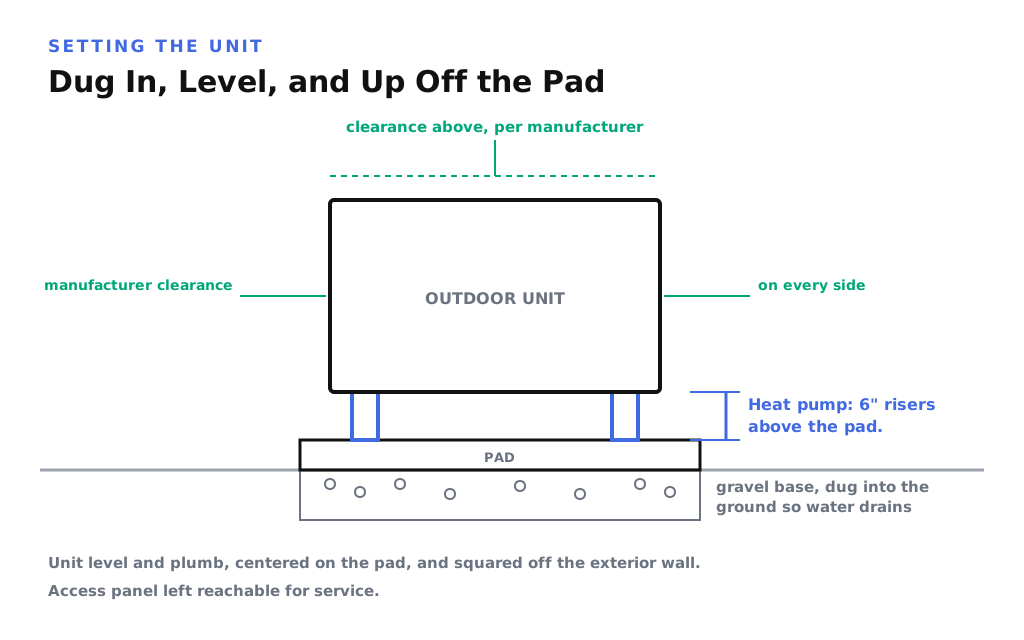
The pad sits on a gravel base dug into the ground so it drains and does not settle, with the unit level, centered, and squared to the house.
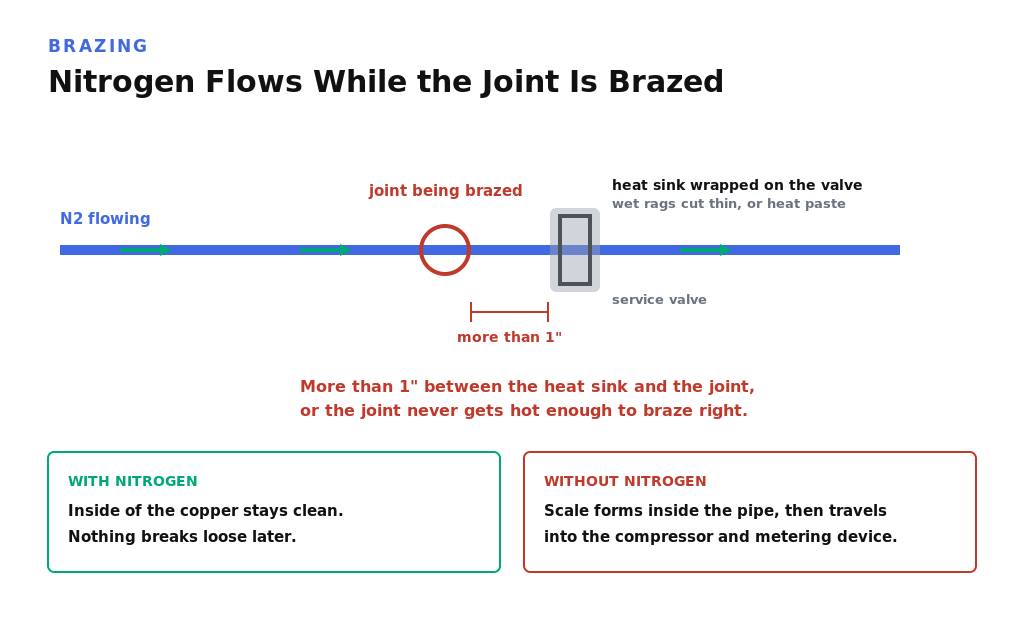
Nitrogen through the line while brazing prevents the copper from scaling on the inside, because that scale breaks loose later and travels through the compressor.
Most contractors run a triple evacuation only where the manufacturer demands one. We run three vacuum passes on every install, because each pass carries out moisture the last one loosened, and moisture left in a system turns into acid.
The pad sits on a gravel base dug into the ground so water drains under it and the ground does not settle out from under the unit. Where the ground genuinely will not take one, the base is built to drain another way and the reason is written on your paperwork rather than left for you to find. The unit sits level and plumb, centered on the pad, and squared off the exterior wall, with the manufacturer's clearances held on every side and above, and the access panel left reachable for service. A heat pump gets feet or risers: six inches of rise above the pad. A heat pump makes water all winter when it defrosts, and that water has to have somewhere to go.
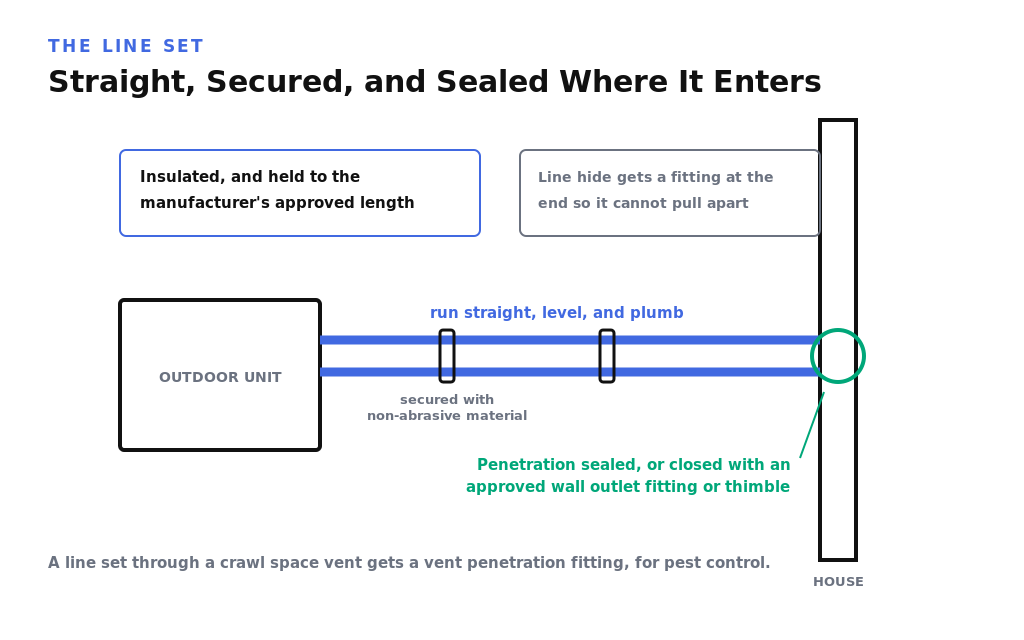
Line sets are run straight, level, and plumb, secured with non-abrasive material so they cannot rub or shift, held to the manufacturer's approved length, and insulated. Where the line set enters the house, the penetration is sealed, or closed with an approved wall outlet fitting or thimble, so nothing weather or rodent related follows it in. A line set through a crawl space vent gets a vent penetration fitting. Where line hide is used it runs plumb and level with proper fittings, including a fitting at the end of the run so it cannot pull apart later. The slit in the insulation is turned away and hidden wherever it can be, because you are going to look at this every time you walk past it.
Every brazed joint is made with nitrogen flowing through the line. Brazing without it scales and oxidizes the inside of the copper, and that debris does not stay put: it breaks loose and travels into the compressor and the metering device. At the outdoor unit the service valve seals are protected with a heat sink, either wet rags cut thin and wrapped around the valve or heat absorbing paste, and the heat sink stays more than an inch from the joint so the joint still gets hot enough to braze correctly. Where flare fittings are used, flares are made and torqued to specification with oil on the threads.
Before any vacuum is pulled, the line set is pressure tested with nitrogen to the manufacturer's recommended pressure, never above 150 PSI, and every joint is bubble tested while the system is holding that pressure. A leak shows itself at the joint, in front of you, which is something you can stand there and watch. Only then does the vacuum start. Company policy is to pull below 500 microns, isolate the pump, and confirm the system stays under 700 microns for no less than seven minutes, or to whatever tighter number the equipment manufacturer specifies. The vacuum is broken properly with nitrogen, not with refrigerant and not with air.
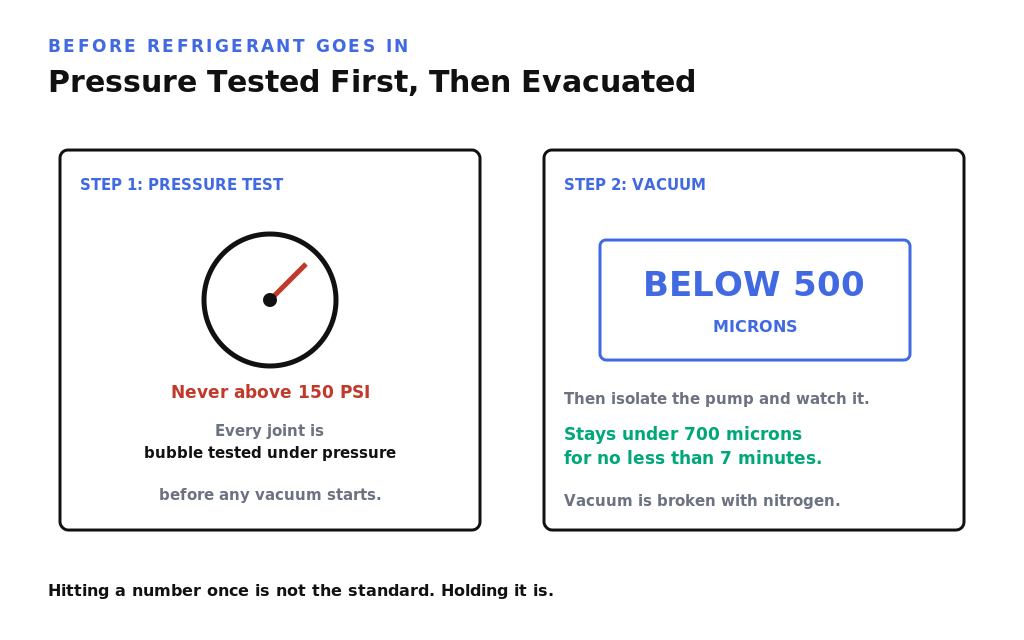
Most contractors run a triple evacuation only where the equipment manufacturer demands one. Honest Fix runs it on every install. We vacuum to 1,500 microns, break with 3 to 5 PSI of nitrogen, and release. Vacuum to 1,000 microns, break with nitrogen again, and release. Then vacuum to 500 microns, or whatever tighter number that manufacturer specifies, isolate the pump, and watch that it holds under 700 for no less than seven minutes. Each pass picks up moisture the last one loosened. It is slower, nobody is making us do it, and it is the difference between a dry system and one that makes acid. Once the vacuum holds, the system is charged and verified on the commissioning record.

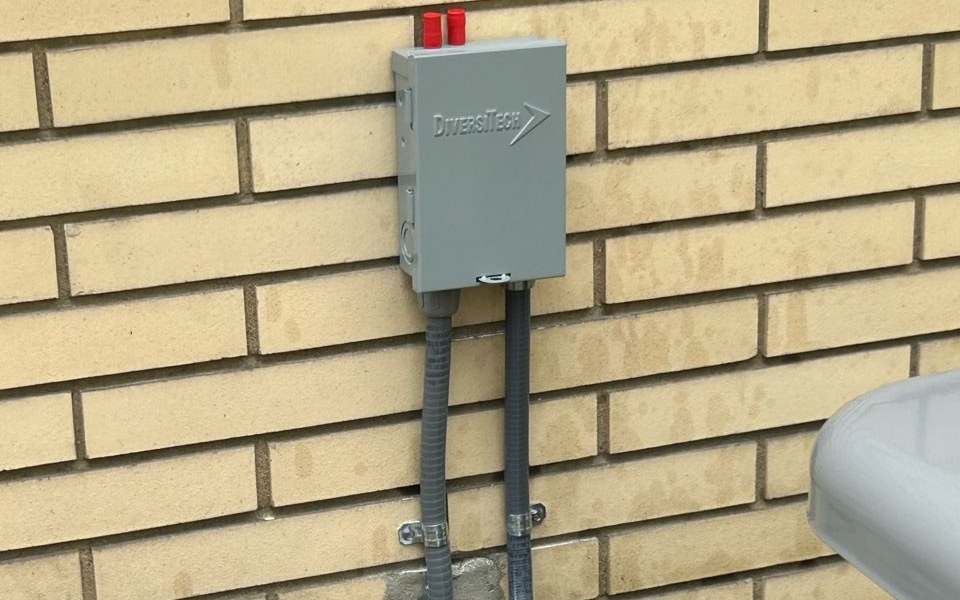
The disconnect gets replaced on every install, not reused because the old one still closes. Where the wire or the breaker feeding the unit is sized wrong and has to be fused down, a fused disconnect goes in instead, with the fuses facing forward so an inspector or a technician can read them without pulling anything apart, and sized between the minimum and maximum amp draw using the nameplate, the supplied breaker size, and the wire size together. A surge protector is an option you can choose, and where one is installed it lands on the line side of the disconnect. Wall-mounted units are bracketed into studs with proper hardware and set level and plumb. Thermostat wiring is routed neatly with the line set. The install closes with the outdoor unit wiped down so nothing is left sitting on it.

Now you know what a correct outdoor unit installation looks like. If yours does not look like this, or you would rather have someone else check, Honest Fix will come out and give you a straight answer. No upsells, no games.
AC installation · Heat pump installation · Where a drain line may terminate · Ductless mini-split standard · Gas meter clearance · The full Installation Standard
