0% for 25 months on a qualifying new Rheem® heating or cooling system. Installed by November 15.
A standard-efficiency furnace sends hot exhaust up a metal vent, and it relies on draft to carry that exhaust safely out of your house. Everything about the installation serves that: a vent cut clean and fastened at every joint, sloped to rise as it leaves the furnace, braced so it cannot shift, and a furnace set where water will not find it. This page is that standard, published in full, so you can hold any contractor to it. Ours included.
Published from our Installation Handbook · Reviewed by Alex Largent · 100% satisfaction, no exceptions
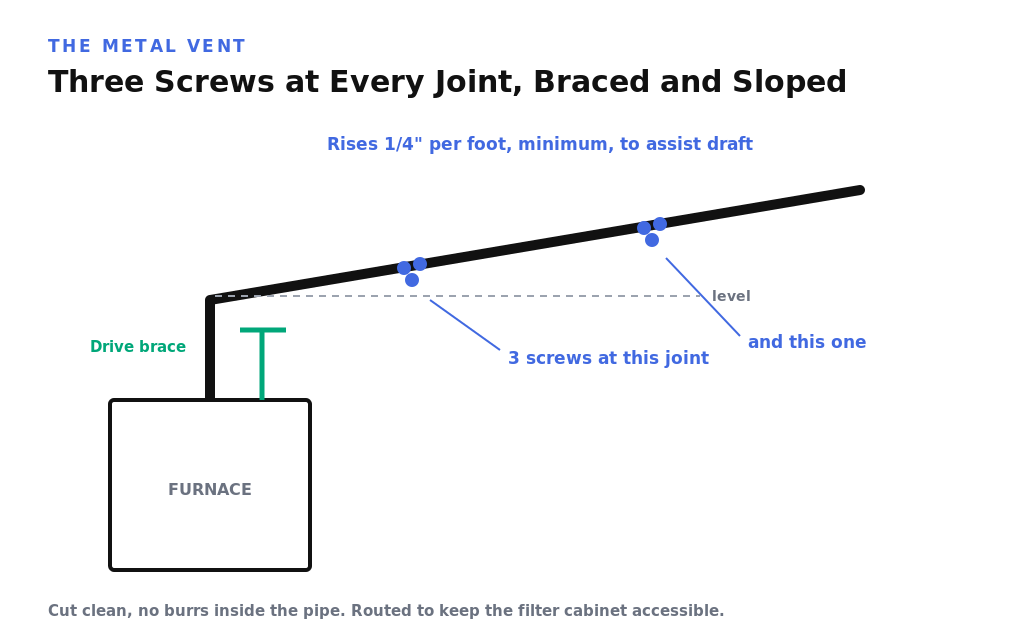
Vent sections are fastened with three screws per joint and braced back to the furnace, so the vent cannot loosen or shift over years of heating and cooling cycles.
A quarter inch of rise per foot, minimum, so draft pulls exhaust up and out instead of fighting a low spot in the pipe.
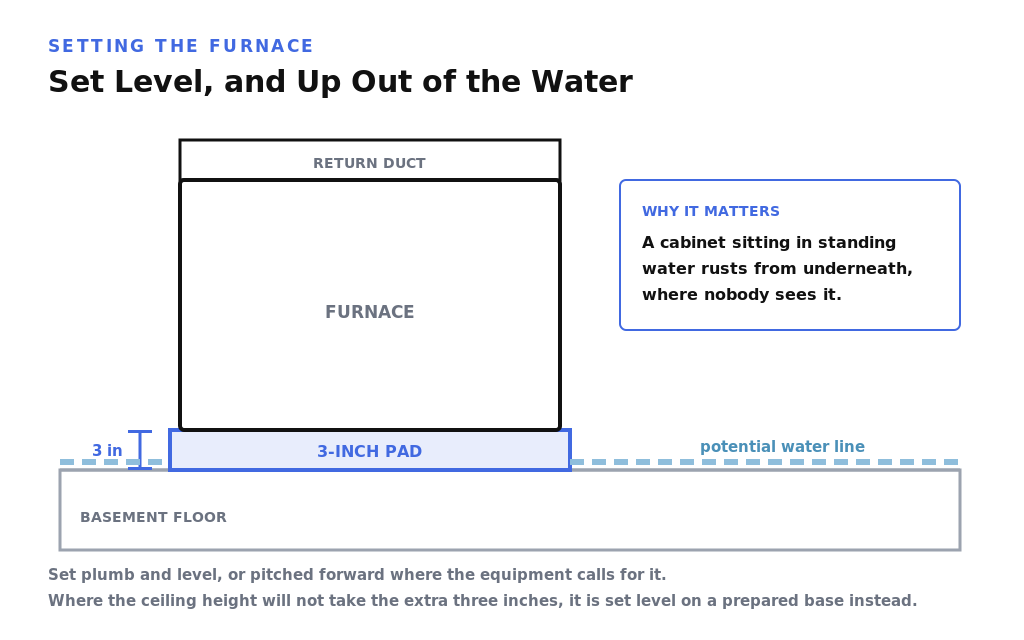
Where a basement has any history of water, the furnace and the return duct are set up on a three inch pad rather than left sitting on the floor. Where the ceiling height will not take the extra three inches, the furnace is set level on a prepared base instead.
A standard-efficiency furnace, rated at about 80 percent, does not cool its exhaust enough to turn it into water. The combustion gases leave hot, and they leave through metal. That means the whole installation rests on the vent doing its job: carrying hot exhaust up and out, reliably, for as long as the furnace lasts. On a full-system replacement, sizing comes first: Honest Fix runs a Manual J load calculation before any equipment is chosen, as the installation standard lays out. Here is what Honest Fix requires on every one. You are welcome to check yours against it.
The furnace is set plumb and level, or pitched forward where the equipment's own specifications call for it, and the manufacturer's clearances are met. A horizontal installation rides on anti-vibration pads so the cabinet is not humming into the framing of the house. In a basement with any history of water, the furnace and the return duct are set up on a three inch pad, because a furnace sitting on a floor that floods is a furnace rusting from the bottom up. Where the ceiling height will not take the extra three inches, the furnace is set level on a prepared base instead, and the reason is written on your paperwork rather than left for you to find.
This is the heart of the job. The vent is rated for the gauge the equipment manufacturer and local and national codes call for, cut to clean lengths with no sharp burrs or exposed edges left inside the pipe, and fastened with three screws at every joint. It is braced back to the furnace so it cannot move, and it rises at least a quarter inch per foot as it leaves the furnace to assist draft. It is routed to keep the filter cabinet accessible, and it terminates to the manufacturer's specification and to code. Full standard: venting.
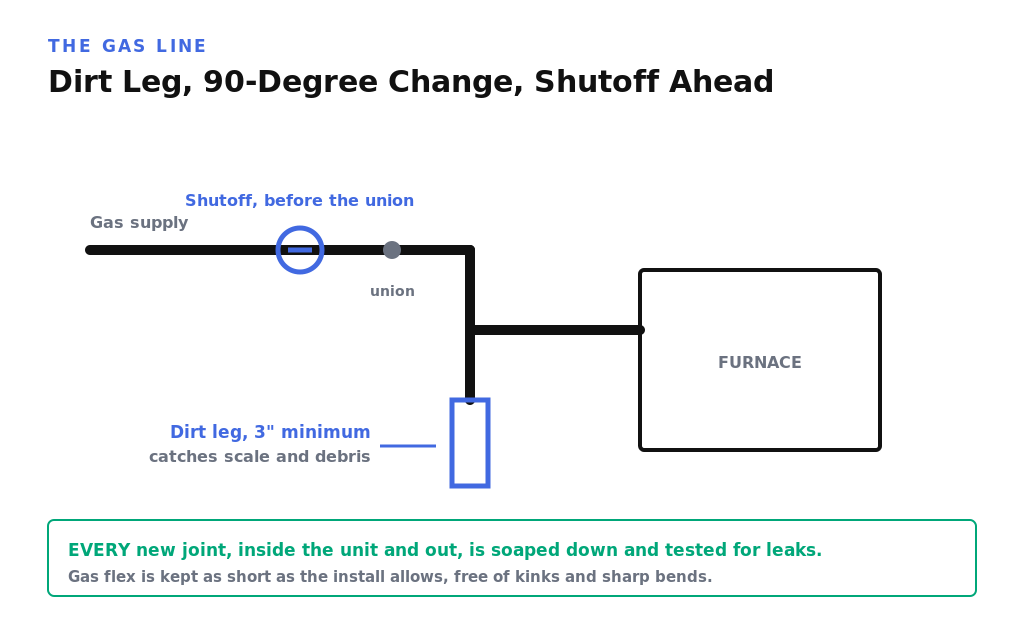
Gas piping runs level and plumb into the furnace with a minimum three inch dirt leg and a 90-degree direction change, so debris in the line drops out before it can reach the gas valve. Any gas flex is free of kinks and sharp bends. No new gas piping goes into service untested. Every new joint, inside the unit and outside it, is soaped down and given a careful look before the furnace is ever fired. The gas line is one of two services landing at the cabinet. The other one, the wiring, is the same standard on both furnaces and it is published on the high-efficiency furnace page.
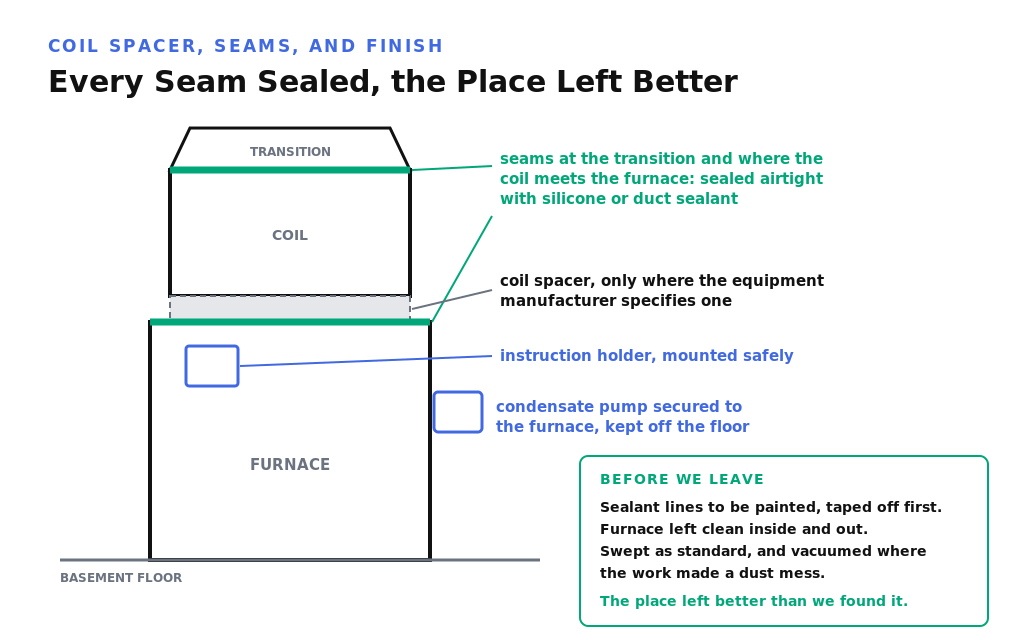
Where a furnace and a coil of different make or width are paired and the equipment manufacturer specifies a coil spacer between them, one is built and fitted so the coil sits where it is meant to sit. Where the manufacturer requires a coil spacer and there is not enough height for one, Honest Fix tells you so and does not do the job. Where the coil meets the furnace and where transitions meet the cabinet, those seams are sealed airtight with silicone or duct sealant, because an open seam at the equipment dumps the air you paid to heat straight into the basement. Any sealant line that will be painted is taped off first, for a clean finished edge. Where a condensate pump serves the coil in a damp basement, it is secured to the furnace and kept off the floor. The install closes with the instruction holder mounted safely, the furnace left clean inside and out, and the place left better than we found it: we sweep as standard, and where the work made a dust mess it gets vacuumed.
A lot of the housing stock here predates the furnace sitting in it, which means vents get adapted to chimneys and framing that were never designed around them. Add basements that take on water in the spring, and the two things most likely to go wrong on an 80 percent furnace are the vent and the floor it sits on.
Screws at every joint are what keeps a vent mechanically together. Friction fit alone loosens with years of expansion and contraction.
Exhaust needs to rise. A run that dips creates a low point where draft stalls, and stalled draft is combustion gas looking for another way out.
What the pipe looks like on the inside matters more than what it looks like on the outside, and nobody sees the inside after the day it goes in.
The damage starts underneath, where you cannot see it, and by the time it shows, the cabinet is already going.
When a furnace and a coil are different brands or different widths, the fit is not something to improvise. Forcing two cabinets together pinches the airflow path, and where the manufacturer calls for a coil spacer between them, leaving it out puts the coil somewhere it was never meant to sit.
Field conditions. Final installation details may vary based on manufacturer requirements, local code, home conditions, equipment model, safety constraints, and the written scope of work. Where the manufacturer's instructions and this standard disagree, the manufacturer's instructions win, and your technician follows them.
How much heat they pull out of the exhaust before it leaves. A standard-efficiency furnace, rated at about 80 percent, sends exhaust out hot through a metal vent. A high-efficiency furnace pulls out enough additional heat that the exhaust condenses into water, which is why it vents in PVC and needs a drain. Neither is a better installation. They are different installations.
Because its exhaust is still hot when it leaves. Metal vent pipe is built to carry hot, dry combustion gases, and it is the correct material for an 80 percent furnace. Plastic is for the cooler, wet exhaust a condensing furnace produces.
Draft. Hot exhaust rises on its own, and the vent is pitched to work with that instead of against it, at least a quarter inch of rise per foot. A vent that dips somewhere along the run creates a spot where draft can stall.
To hold the joints together mechanically. Honest Fix uses three screws at every joint and braces the vent back to the furnace. A vent that is only pressed together can work loose over years of heating cycles, and a loose vent joint leaks exhaust into the room it runs through.
Because the basement it sits in has taken on water at some point, or could. Setting the furnace and the return duct up on a three inch pad keeps the cabinet and the duct out of standing water. Where the ceiling height will not take the extra three inches, the furnace is set level on a prepared base instead. It costs very little on the day of an installation and it is one of the most annoying things to put right afterward.
Often, yes, and it depends on the two cabinets. Where the furnace and the coil are different brands or different widths, the fit is built rather than forced, and where the equipment manufacturer specifies a coil spacer between them, one is fitted so the coil sits where it is meant to and the airflow is not pinched. If the manufacturer requires a coil spacer and your basement has no height for one, Honest Fix will not install that pairing. What is not acceptable is forcing two mismatched cabinets together.
Read this page and go look. You are checking for a vent that rises steadily away from the furnace, screws at the joints, a brace back to the unit, a dirt leg on the gas line, and a furnace that is level and dry underneath. If you would rather have someone look with you, that is what a free exact quote visit is for.
Now you know what a correct standard-efficiency furnace installation looks like. If yours does not look like this, or you would rather have someone else check, Honest Fix will come out and give you a straight answer. No upsells, no games.
Furnace installation · High-efficiency furnace standards · Furnace installation pricing · How your system is commissioned · The full Installation Standard