Why Is My AC Making Strange Noises Like Banging or Squealing in New Cumberland, WV?
January 29th, 2026
4 min read
Quick Answer
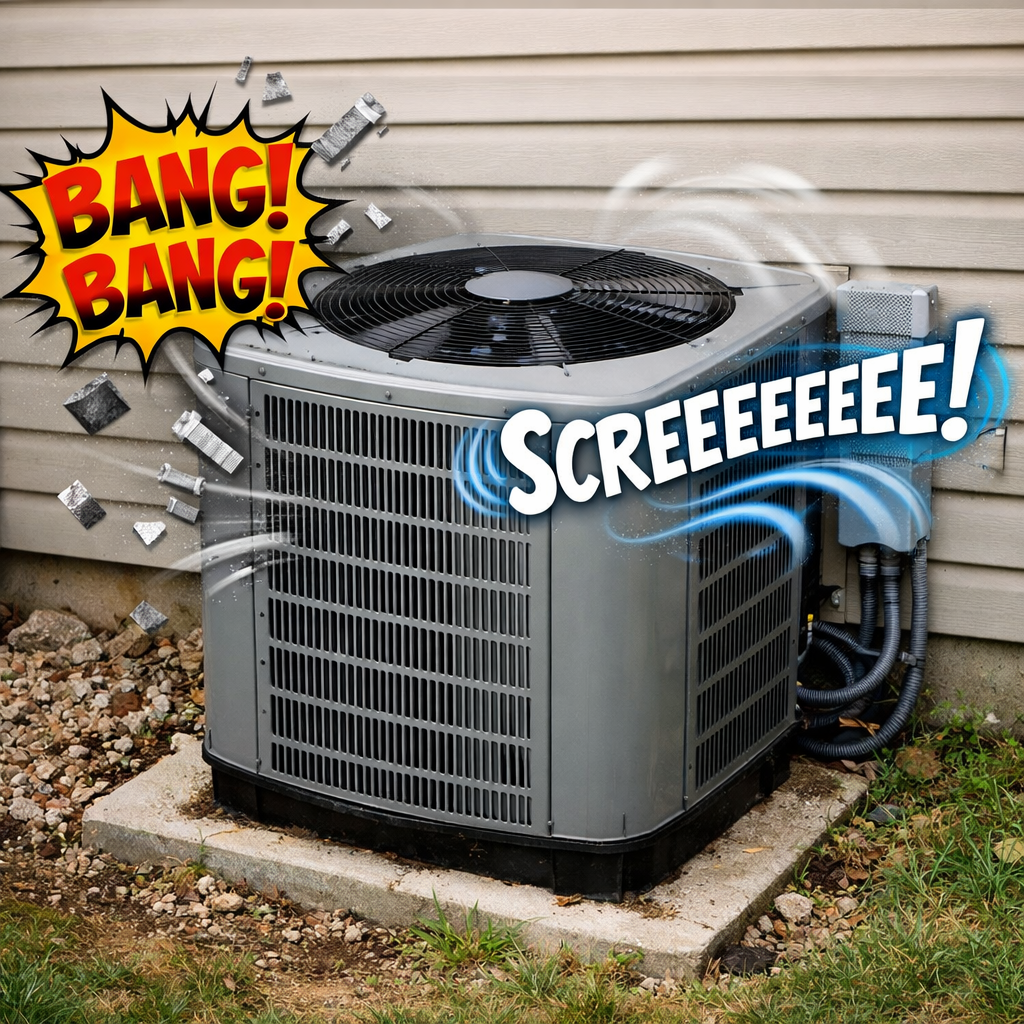
If your AC is making strange noises like banging, squealing, grinding, buzzing, or rattling in New Cumberland, it usually means a mechanical or electrical component is loose, worn, failing, or under abnormal stress. Closely spaced homes, tight basements, retrofitted duct systems, and aging electrical infrastructure common in New Cumberland cause these noises to appear sooner. Any new or changing noise is a warning sign and should be addressed promptly.
If You Hear a New or Loud Noise, Do This First
If the noise is sudden, loud, metal-on-metal, or getting worse, turn the system OFF.
Continuing to run a noisy AC often turns a manageable repair into a major component failure.
Do not:
- Assume the sound is “normal for a small house”
- Let banging or squealing continue through full cycles
- Try to quiet the noise without diagnosing the cause
Noise is information. Ignoring it removes your early warning.
Why You Can Trust This Explanation
I’m Scott Merritt, and I’ve worked in residential HVAC since 1994.
Over the past 30+ years, I’ve diagnosed, repaired, and replaced thousands of AC systems and trained technicians across Ohio and throughout the Upper Ohio Valley, including dense river communities like New Cumberland.
Everything below reflects repeat noise-related failures we consistently see in real New Cumberland homes, not generic HVAC advice.
First: Is the Noise Coming From Inside or Outside?
In tightly built neighborhoods, sound location matters.
Indoor Unit Noises (Basement or Utility Closet)
Often tied to:
- Blower motors and bearings
- Restricted airflow in tight spaces
- Loose cabinets or mounts
- Belt or pulley wear on older systems
Outdoor Unit Noises (Condenser)
Often tied to:
- Fan motor imbalance
- Compressor operation
- Electrical components
- Loose or vibrating panels
Tight construction amplifies vibration through floors and walls.
What Different AC Noises Usually Mean
Banging or Clanking
Risk Level: High — Shut the system off
Often caused by:
- Loose or broken internal components
- Fan blades striking the housing
- Compressor mounting or internal damage
Banging means something heavy is moving that should not be.
Squealing or Screeching
Risk Level: Medium to High — Limit run time
Common causes:
- Failing blower motor bearings
- Belt or pulley wear (older equipment)
- Motor shaft imbalance
Squealing usually indicates metal-on-metal wear, which accelerates quickly.
Grinding
Risk Level: High — Shut the system off
Often indicates:
- Motor bearing failure
- Severe mechanical wear
Grinding means parts are actively damaging each other.
Rattling or Vibrating
Risk Level: Medium — Schedule service
Often caused by:
- Loose panels or fasteners
- Ductwork vibration in retrofitted systems
- Aging mounts or supports
In dense homes, even small looseness becomes loud.
Buzzing or Loud Humming
Risk Level: Medium to High — Electrical concern
Often caused by:
- Failing contactors
- Weak capacitors
- Loose wiring
- Electrical load stress
Electrical noises should never be ignored.
Mechanical vs Electrical Noises (Why This Matters)
Mechanical noises involve:
- Movement
- Friction
- Wear
- Vibration
They usually worsen gradually.
Electrical noises involve:
- Power delivery
- Heat buildup
- Switching components
They can escalate suddenly and cause rapid failure.
A Critical Safety Note
If you hear:
- Grinding
- Loud electrical buzzing
- Sharp metal-on-metal sounds
Turn the system off immediately.
Continuing to run the AC under these conditions can damage motors, wiring, or the compressor.
Does System Age Affect Noise Risk?
Yes — but noise alone doesn’t determine replacement.
- Newer systems + noise: Often installation or early component issues
- Older systems + noise: Usually wear, fatigue, or imbalance
The source of the noise matters more than system age.
Compressor Noises: What New Cumberland Homeowners Should Know
Not all compressor noises mean failure.
- Some noises come from external mounts, panels, or fan components
- Others indicate internal compressor damage
Tight installations make professional diagnosis especially important.
A New Cumberland–Specific Risk: Tight Mechanical Clearances
Many homes in New Cumberland have:
- Air handlers in very tight basements or closets
- Ductwork routed through finished walls and ceilings
- Limited clearance around motors and blowers
This increases vibration and makes small problems louder.
A Simple Diagnostic Question That Matters
Did this noise start suddenly, or has it changed recently?
Sudden or changing noises usually signal active failure progression, not harmless operation.
Why Ignoring AC Noises Gets Expensive
Noise is often the first warning sign.
A common progression looks like this:
Loose or worn part → vibration → secondary damage → major system failure
Early attention almost always costs less.
A Real New Cumberland Home Example
We serviced a New Cumberland home with a basement-installed AC tucked between finished walls that developed loud rattling and buzzing noises.
The causes:
- A failing blower motor bearing
- Loose cabinet panels amplified by tight clearances
- Electrical components operating near capacity
Early repair prevented motor failure and avoided full system replacement.
Common Sounds That Aren’t Always Serious
Some sounds can be normal:
- Brief duct expansion noises
- Light cabinet vibration during high airflow
- Short startup sounds that don’t repeat
If a noise is new, louder, or recurring, it should be checked.
The Most Common Mistake New Cumberland Homeowners Make
Ignoring noise because the system “still cools.”
Cooling can continue even while damage is occurring.
What Guarantees Apply If Your AC Needs Repair
Honest Fix Service Trust Guardian (Repairs & Diagnostics)
AC noise-related repairs are protected by our Service Trust Guardian, which includes:
- A 5-year labor warranty on covered repairs
- A 60-day satisfaction guarantee
- No overtime or after-hours charges
- On-time arrival and clean-work commitments
Guarantees remain active with documented yearly maintenance.
If Noise Leads to Replacement
Honest Fix Lifetime Trust Shield (New Installations)
If replacement becomes the right decision, new systems are protected by our Lifetime Trust Shield, which includes:
- 15-year labor warranty
- Manufacturer parts coverage
- No-lemon replacement protection
- Satisfaction guarantee
- Energy performance accountability
- Apples-to-apples price protection
These protections are written for homeowners in the Upper Ohio Valley.
Other Ohio Valley Communities With Similar AC Noise Issues
We see AC noise problems throughout the region, including:
- Steubenville, OH
- Wintersville, OH
- Toronto, OH
- Mingo Junction, OH
- Brilliant, OH
- Weirton, WV
- Follansbee, WV
- Wellsburg, WV
- Colliers, WV
- Hooverson Heights, WV
Frequently Asked Questions
Is it safe to run my AC if it’s making noise?
Only if the noise is minor and unchanged. Loud or worsening noises require shutdown.
Can a noisy AC still cool properly?
Yes, but internal damage may already be occurring.
What guarantees do you offer?
Repairs are covered by the Service Trust Guardian.
New installations are covered by the Lifetime Trust Shield with 15-year labor coverage.
What To Do Next
Strange AC noises are early warning signs of mechanical or electrical failure. Addressing them early protects your system and your budget.
Call Honest Fix today for a free exact quote.
You can also learn about our guarantees before you decide.
::contentReference[oaicite:0]{index=0}Scott Merritt is a co-founder of Honest Fix Heating, Cooling and Plumbing and brings more than 30 years of experience across HVAC, leadership, and industry education. He serves in a senior leadership and oversight role, providing licensed guidance, reviewing HVAC educational content, and supporting technician training and documentation standards. Prior to co-founding Honest Fix, Scott founded and owned Fire & Ice Heating & Air Conditioning in Columbus, Ohio, which he operated for more than two decades before selling the company in 2025. During that time, he led programs and partnerships including Carrier Factory Authorized Dealer, Trane Comfort Specialist, and Rheem Pro Partner, helping establish high technical and training standards. Scott is the Ohio State HVAC license holder for Honest Fix and provides licensed oversight to help ensure work meets applicable codes and manufacturer requirements. Learn more about Scott’s background and role at Honest Fix by viewing his full leadership bio.