Why Is Ice Forming on My AC Unit in Hooverson Heights, WV?
February 3rd, 2026
4 min read
Quick Answer
Ice forms on AC units in Hooverson Heights most often because airflow has been reduced by past renovations or duct changes, or because refrigerant pressure is too low. Ice is not the failure—it is a warning sign that heat and moisture are not moving through the system correctly. The AC should be shut off and the underlying cause corrected before damage occurs.
Why Frozen AC Units Are Common in Hooverson Heights
Frozen air conditioners are common in Hooverson Heights because many homes have been remodeled or expanded over time without updating the HVAC system design.
Many Hooverson Heights homes:
- Combine older construction with newer additions
- Have HVAC equipment relocated during renovations
- Use ductwork that was extended or modified in stages
- Rely on one system to cool uneven layouts
Each modification can slightly reduce airflow. Over time, those small losses add up and create conditions where coil temperatures drop below freezing.
Ice forms when airflow, pressure, and layout changes are no longer aligned.
What Changes Before Ice Appears
Freeze-ups rarely happen without warning.
Homeowners often notice:
- Certain rooms cooling well while others lag
- Weak airflow after renovations
- Longer run cycles than in previous summers
- Indoor humidity increasing
By the time ice is visible, the system has usually been struggling for some time.
Where the Ice Is Tells You What’s Wrong
Ice location often points to the likely cause.
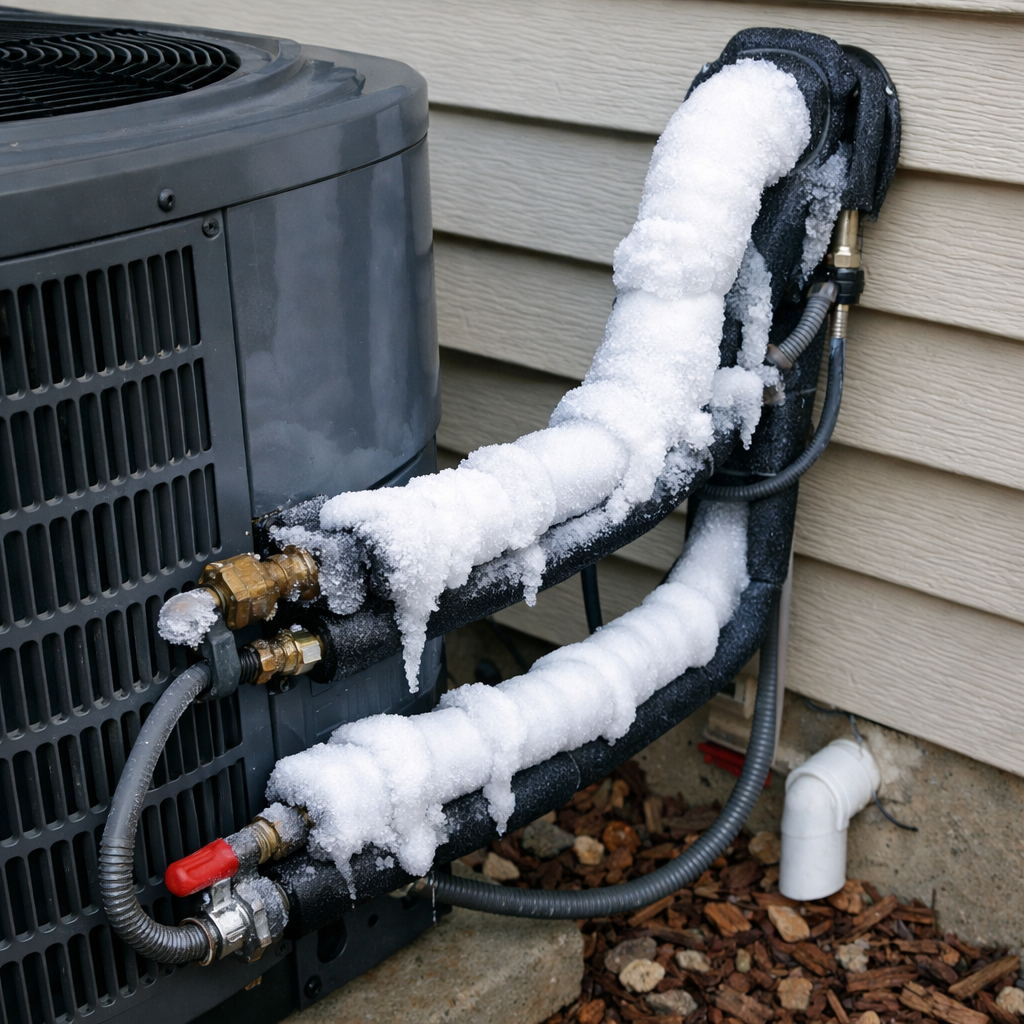
- Ice on the indoor evaporator coil
Usually caused by restricted airflow from duct changes or dirty components. - Ice on the refrigerant line
Commonly linked to airflow loss or low refrigerant pressure. - Ice on the outdoor unit
Often the result of prolonged internal freezing during extended run cycles.
Ice location narrows the issue, but it does not replace a full evaluation.
The Most Common Reasons Ice Forms on AC Units in Hooverson Heights Homes
Restricted Airflow From Renovation Changes
Airflow loss after renovations is the leading cause of freeze-ups in Hooverson Heights.
This often comes from:
- Ducts extended without resizing
- Added rooms sharing existing supply lines
- Returns blocked or never added to new spaces
When warm air cannot move across the coil fast enough, coil temperature drops below freezing and condensation turns to ice.
Long Run Times After Layout Changes
In many Hooverson Heights homes:
- Original spaces cool quickly
- Additions lag behind
- The thermostat remains unsatisfied
Extended runtime lowers coil temperature and increases freeze-up risk.
Low Refrigerant Pressure
Low refrigerant lowers system pressure and coil temperature.
This causes:
- Rapid ice formation
- Weak cooling
- Increased mechanical stress
Refrigerant does not get used up. Ice caused by low refrigerant always means a leak, not routine maintenance.
Dirty Evaporator Coils
Dust buildup on coils restricts heat absorption.
This leads to:
- Colder coil surfaces
- Reduced efficiency
- Ice formation even when airflow appears adequate
Coil issues are common when systems run longer after renovations.
Elevated Indoor Humidity
Humidity accelerates freezing.
When moisture levels are high:
- More condensation forms on the coil
- That moisture freezes more easily
- Ice builds faster
Humidity problems often overlap with airflow imbalance created by layout changes.
Why AC Units Often Freeze Overnight in Hooverson Heights
A common Hooverson Heights complaint is:
“It was fine yesterday, but frozen this morning.”
This usually happens because:
- Outdoor temperatures drop overnight
- Cooling demand decreases
- Renovation-related airflow restrictions remain
- Coil temperatures fall below freezing
Overnight freezing almost always points to airflow or pressure issues—not nighttime weather alone.
Temporary Fix vs the Real Fix
Turning the AC off and letting the ice melt is necessary, but it does not solve the problem.
- Temporary action: Shutting the system off prevents compressor damage.
- Permanent fix: Correcting airflow design, duct sizing, refrigerant pressure, or layout imbalance prevents repeat freeze-ups.
If the cause is not corrected, the ice will return.
Is Ice on an AC Unit Dangerous?
Ice itself is not the danger—the damage it causes is.
Repeated freeze-ups can lead to:
- Compressor damage
- Refrigerant floodback
- Blower motor strain
- Complete system shutdown
Running an AC while frozen can turn a manageable issue into a major repair.
Which Ice-Related Problems Cost the Most?
Not all freeze-ups carry the same risk.
Lower-severity causes often include:
- Dirty filters
- Minor airflow restrictions
Moderate-severity causes include:
- Duct imbalance after renovations
- Dirty coils
High-risk causes if ignored include:
- Refrigerant leaks
- Repeated freeze-ups
- Compressor failure
Ice is usually an early warning, not the final failure.
A Real Hooverson Heights Home Example
A homeowner in Hooverson Heights remodeled their home in stages, adding a rear room and relocating ductwork.
The AC began running longer each summer, and ice formed on the refrigerant line overnight. Duct extensions reduced airflow enough to freeze the coil.
The issue was not equipment age—it was airflow loss caused by renovation changes.
A Unique Hooverson Heights Risk Factor
Incremental renovations magnify airflow loss.
Each change may seem minor, but combined they often create enough restriction to cause freezing.
A Common Homeowner Mistake
A common mistake is assuming:
“The system just needs more refrigerant.”
In many Hooverson Heights homes, airflow—not refrigerant—is the real issue.
Honest Fix Perspective on Frozen AC Units
Ice usually points to airflow or layout problems—not automatic system failure. Many freeze-ups in renovated homes can be corrected without replacement when the real cause is identified early.
How Ice Problems Are Prevented
Preventing freeze-ups requires understanding why the coil is getting too cold.
Proper evaluation often includes:
- Airflow testing across modified ducts
- Filter, coil, and duct inspection
- Refrigerant pressure checks
- Layout and renovation review
When airflow and pressure are corrected, freezing stops.
Guarantees That Matter When AC Problems Are Found
Service Trust Guardian (Repairs and Maintenance)
When freezing issues are tied to service-related problems:
- 5-year labor coverage on qualifying repairs
- Clear accountability if the issue returns
- No surprise charges
Lifetime Trust Shield (New Installations)
If freeze-ups reveal deeper system problems:
- 15-year labor coverage
- Protection against workmanship-related failures
- Long-term accountability in the Upper Ohio Valley
Cities Where This Same Issue Is Common
Frozen AC units affect homeowners throughout the Upper Ohio Valley, including:
- Steubenville, OH
- Wintersville, OH
- Toronto, OH
- Mingo Junction, OH
- Brilliant, OH
- Weirton, WV
- Follansbee, WV
- Wellsburg, WV
- New Cumberland, WV
- Colliers, WV
Airflow and layout matter more than AC brand.
Frequently Asked Questions
Can renovations cause AC freeze-ups?
Yes. Duct changes and added rooms often reduce airflow.
Can I run my AC if it has ice on it?
No. Running a frozen system can cause serious damage.
Does low refrigerant always mean a leak?
Yes. Refrigerant does not get used up.
Why does ice keep coming back?
Because airflow or refrigerant issues were not corrected.
What guarantees do you offer?
- 5-year labor coverage through the Service Trust Guardian
- 15-year labor coverage through the Lifetime Trust Shield
Final Thoughts
Ice forming on an AC unit in Hooverson Heights is almost always a symptom of airflow loss, layout changes, or pressure imbalance—not a random failure. Addressing the cause early prevents costly damage and restores dependable cooling.
If you are looking for the cheapest temporary fix without addressing why the system froze, this approach likely is not the right fit.
Call Honest Fix today for a free exact quote.
Optional next step: Learn about our guarantees before you decide.
Scott Merritt is a co-founder of Honest Fix Heating, Cooling and Plumbing and brings more than 30 years of experience across HVAC, leadership, and industry education. He serves in a senior leadership and oversight role, providing licensed guidance, reviewing HVAC educational content, and supporting technician training and documentation standards. Prior to co-founding Honest Fix, Scott founded and owned Fire & Ice Heating & Air Conditioning in Columbus, Ohio, which he operated for more than two decades before selling the company in 2025. During that time, he led programs and partnerships including Carrier Factory Authorized Dealer, Trane Comfort Specialist, and Rheem Pro Partner, helping establish high technical and training standards. Scott is the Ohio State HVAC license holder for Honest Fix and provides licensed oversight to help ensure work meets applicable codes and manufacturer requirements. Learn more about Scott’s background and role at Honest Fix by viewing his full leadership bio.