High-Efficiency vs Standard Heat Pumps: Energy Savings in Steubenville, OH & Weirton, WV
March 14th, 2026
4 min read
Quick Answer
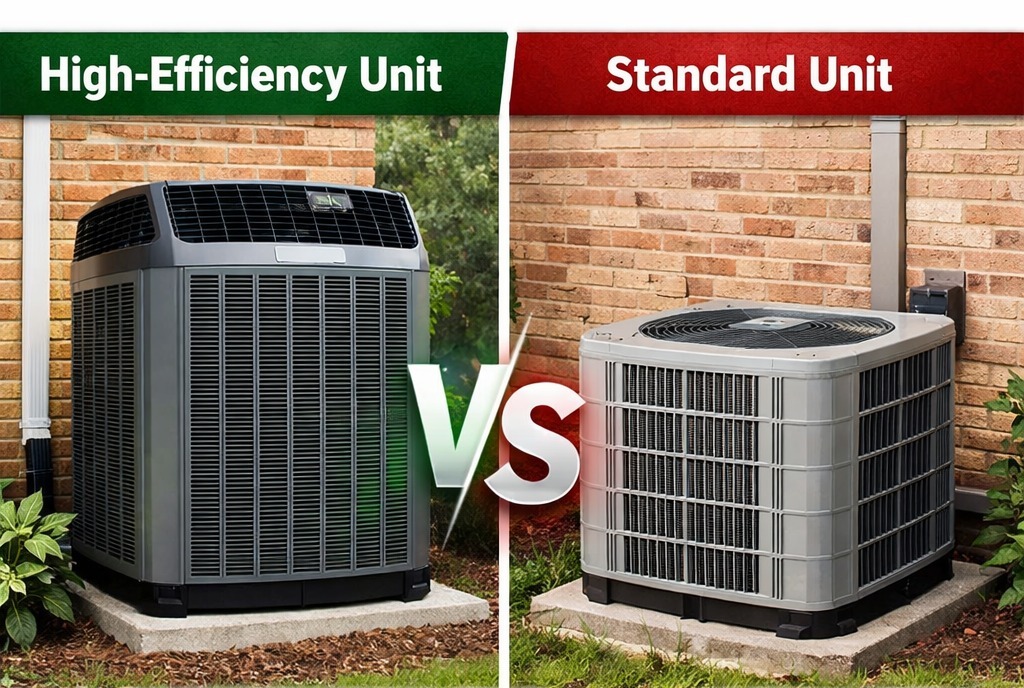
High-efficiency heat pumps use less electricity than basic models because they produce more heating and cooling per unit of energy. Standard systems typically rate around 14–15 SEER2 and 7–8 HSPF2, while high-efficiency models often reach 18–22 SEER2 and 9–10+ HSPF2, reducing HVAC electricity use by roughly 15–30% in many Steubenville and Weirton homes.
Homes in Steubenville and Weirton operate in a mixed climate shaped by the Ohio River valley. Humid summers, winter lows near 22°F, and many houses built before modern insulation standards all influence HVAC performance. Aging basement duct systems and uneven airflow between floors are also common. Because heat pumps run during both heating and cooling seasons here, system efficiency can noticeably affect yearly energy use.
What Is Considered a High-Efficiency Heat Pump?
Quick Answer
Most heat pumps with 18 SEER2 or higher cooling efficiency and 9+ HSPF2 heating efficiency are considered high-efficiency systems.
High-efficiency heat pumps usually include:
- two-stage or variable-speed compressors
- variable indoor fan speeds
- improved coil designs for better heat transfer
- electronic controls that adjust output automatically
Instead of cycling fully on and off, these systems often run longer at lower speeds. Longer run times help maintain steadier indoor temperatures and improve humidity control during cooling.
What Is a Standard or Basic Heat Pump?
Quick Answer
A standard heat pump typically uses a single-stage compressor that runs at 100% capacity whenever it turns on, providing basic heating and cooling performance.
Typical entry-level efficiency ratings include:
- 14–15 SEER2 cooling efficiency
- 7–8 HSPF2 heating efficiency
Basic systems remain common because they offer:
- lower installation cost
- simpler mechanical design
- easier repairs and maintenance
Many homes in Steubenville and Weirton still use single-stage heat pumps installed more than 10–15 years ago.
High-Efficiency vs Standard Heat Pumps: Energy Savings
Quick Answer
High-efficiency heat pumps typically reduce electricity use by 15–30% compared with basic systems, depending on insulation, duct performance, and system sizing.
Energy savings come from:
- higher SEER2 cooling efficiency
- improved HSPF2 heating performance
- longer run cycles at lower capacity
- reduced on-off cycling
Example Energy Savings Comparison
| System | Estimated Annual Electricity Use |
|---|---|
| 14 SEER2 heat pump | ~100% baseline |
| 18 SEER2 heat pump | ~15–20% lower |
| 20+ SEER2 heat pump | ~20–30% lower |
Actual savings vary depending on the home's insulation and HVAC design.
Are High-Efficiency Heat Pumps Worth It in Steubenville and Weirton?
Quick Answer
High-efficiency heat pumps are often worth the upgrade because heating and cooling systems run across multiple seasons in the Ohio River valley climate.
Local conditions include:
- humid summers requiring extended cooling
- winter temperatures near 22°F
- long heating seasons
Because systems operate for much of the year, improved efficiency can reduce electricity use while maintaining more stable indoor temperatures.
Which System Saves More Energy in the Ohio River Valley?
Quick Answer
High-efficiency heat pumps usually save more energy in Steubenville and Weirton because they run efficiently during moderate outdoor temperatures.
Spring and fall temperatures often range between 35–60°F. During these conditions, high-efficiency systems operate at lower capacity instead of cycling on and off repeatedly.
This type of operation helps:
- reduce electricity consumption
- stabilize indoor temperatures
- improve humidity control
HVAC technicians servicing Steubenville and Weirton frequently see the largest savings in homes where heating and cooling systems run through long seasonal transitions.
When High-Efficiency Heat Pumps May Not Provide Large Savings
Quick Answer
Energy savings may be smaller in homes with poor insulation, leaking ductwork, or systems that run only occasionally.
Efficiency gains can be limited when:
- attic insulation is inadequate
- ductwork leaks air in basements or crawlspaces
- airflow restrictions reduce system capacity
- oversized systems cycle too frequently
Improving insulation and sealing ducts often increases the benefits of higher-efficiency equipment.
How High-Efficiency Heat Pumps Improve Comfort
High-efficiency heat pumps can improve indoor comfort as well as reduce electricity use.
These systems often provide:
- longer run cycles with steadier temperatures
- quieter operation
- better humidity removal during summer
- improved airflow through duct systems
Homes in Steubenville and Weirton with multiple floors or uneven airflow often experience more stable temperatures when using staged or variable-speed heat pumps.
Real-World Efficiency Factors HVAC Technicians See
Quick Answer
Actual heat pump efficiency depends on installation quality, duct condition, and insulation levels as much as equipment ratings.
HVAC technicians servicing homes across Steubenville and Weirton frequently find that:
- duct leakage reduces efficiency
- restricted airflow lowers heating performance
- poor attic insulation increases energy demand
- oversized systems cycle too frequently
Proper system design using a Manual J load calculation helps ensure equipment matches the heating and cooling needs of the home.
Quick Efficiency Comparison
| Feature | Standard Heat Pump | High-Efficiency Heat Pump |
|---|---|---|
| Compressor type | Single-stage | Two-stage or variable |
| Typical SEER2 | 14–15 | 18–22+ |
| Typical HSPF2 | 7–8 | 9–10+ |
| Energy use | Higher | Lower |
| Indoor comfort | Basic | More stable |
How to Get the Best Energy Savings From a Heat Pump
Several factors influence how efficiently a heat pump operates in Ohio River valley homes.
Helpful steps include:
- maintaining airflow around 350–450 CFM per ton
- sealing duct leaks in older basement duct systems
- replacing air filters regularly
- scheduling annual HVAC inspections
- improving attic insulation
Cold air pooling along the Ohio River valley can create overnight temperature swings. Systems that run longer cycles often maintain stable indoor comfort during these changes.
Key Differences Between High-Efficiency and Standard Heat Pumps
- high-efficiency systems use advanced compressors and controls
- higher SEER2 and HSPF2 ratings reduce electricity consumption
- basic systems cost less upfront but use more energy
- longer run cycles improve comfort and humidity control
- installation quality strongly affects real-world efficiency
FAQs
Do high-efficiency heat pumps always save money?
Often yes, but savings depend on electricity costs, insulation levels, and how frequently the system operates.
Are high-efficiency heat pumps more expensive?
Yes. Higher-efficiency systems usually cost more upfront due to advanced compressors and control systems.
How much energy can a high-efficiency heat pump save?
In many homes, high-efficiency systems can reduce HVAC electricity use by 15–30% compared with entry-level equipment.
Are efficiency ratings the most important factor when choosing a heat pump?
Efficiency ratings matter, but system sizing, duct condition, and insulation often influence comfort and energy use just as much.
Exact HVAC replacement quotes available at (740) 825-9408 or HonestFix.com/schedule-service.
Scott Merritt is a co-founder of Honest Fix Heating, Cooling and Plumbing and brings more than 30 years of experience across HVAC, leadership, and industry education. He serves in a senior leadership and oversight role, providing licensed guidance, reviewing HVAC educational content, and supporting technician training and documentation standards. Prior to co-founding Honest Fix, Scott founded and owned Fire & Ice Heating & Air Conditioning in Columbus, Ohio, which he operated for more than two decades before selling the company in 2025. During that time, he led programs and partnerships including Carrier Factory Authorized Dealer, Trane Comfort Specialist, and Rheem Pro Partner, helping establish high technical and training standards. Scott is the Ohio State HVAC license holder for Honest Fix and provides licensed oversight to help ensure work meets applicable codes and manufacturer requirements. Learn more about Scott’s background and role at Honest Fix by viewing his full leadership bio.