What Are the Signs of a Failing Heat Pump Compressor in Steubenville, OH and Weirton, WV?
March 10th, 2026
4 min read
What Are the Signs of a Failing Heat Pump Compressor?
Quick Answer: Common signs of a failing heat pump compressor include loud humming or grinding noises, the outdoor unit running without heating or cooling, breaker trips when the system starts, and longer run times. Compressors operate under 100–300 PSI and normally last 10–15 years, but overheating, restricted airflow, or low refrigerant can shorten their lifespan.
Many homes in Steubenville’s historic neighborhoods and Weirton’s hillside communities rely on heat pumps for year-round comfort. Winter temperatures along the Ohio River valley often fall into the 20–30°F range, forcing systems to run longer heating cycles. Older homes with aging duct systems, seasonal river-valley humidity, and extended cold-weather run times can place additional strain on compressors if airflow or refrigerant levels are not maintained.
Quick Diagnostic Summary
| Symptom | Likely Cause | What to Check |
|---|---|---|
| Outdoor unit humming but not starting | Electrical compressor issue | Capacitor or contactor |
| Breaker trips when heat pump starts | Compressor motor overload | Electrical inspection |
| Heat pump running but not heating | Refrigerant circulation problem | System pressure test |
| Loud grinding or rattling | Mechanical compressor damage | Technician inspection |
| System short cycling | Compressor overheating | Airflow and refrigerant check |
| Rising energy bills | Compressor efficiency loss | HVAC evaluation |
| Clicking sound but compressor won’t start | Failed capacitor or hard-start issue | Electrical inspection |
| Outdoor fan running but no heating | Compressor not compressing refrigerant | Professional service |
What Does the Compressor Do in a Heat Pump?
Quick Answer: The compressor circulates refrigerant through the heat pump system so heat can be transferred between indoor and outdoor coils.
The compressor is the core component of the refrigeration cycle. It compresses refrigerant vapor and moves it through the system under pressure.
This allows the heat pump to:
- Absorb heat from outdoor air
- Transfer heat indoors during heating
- Release heat outside during cooling
If the compressor fails, refrigerant cannot circulate and the heat pump cannot heat or cool effectively.
What Are the Most Common Signs of Compressor Failure?
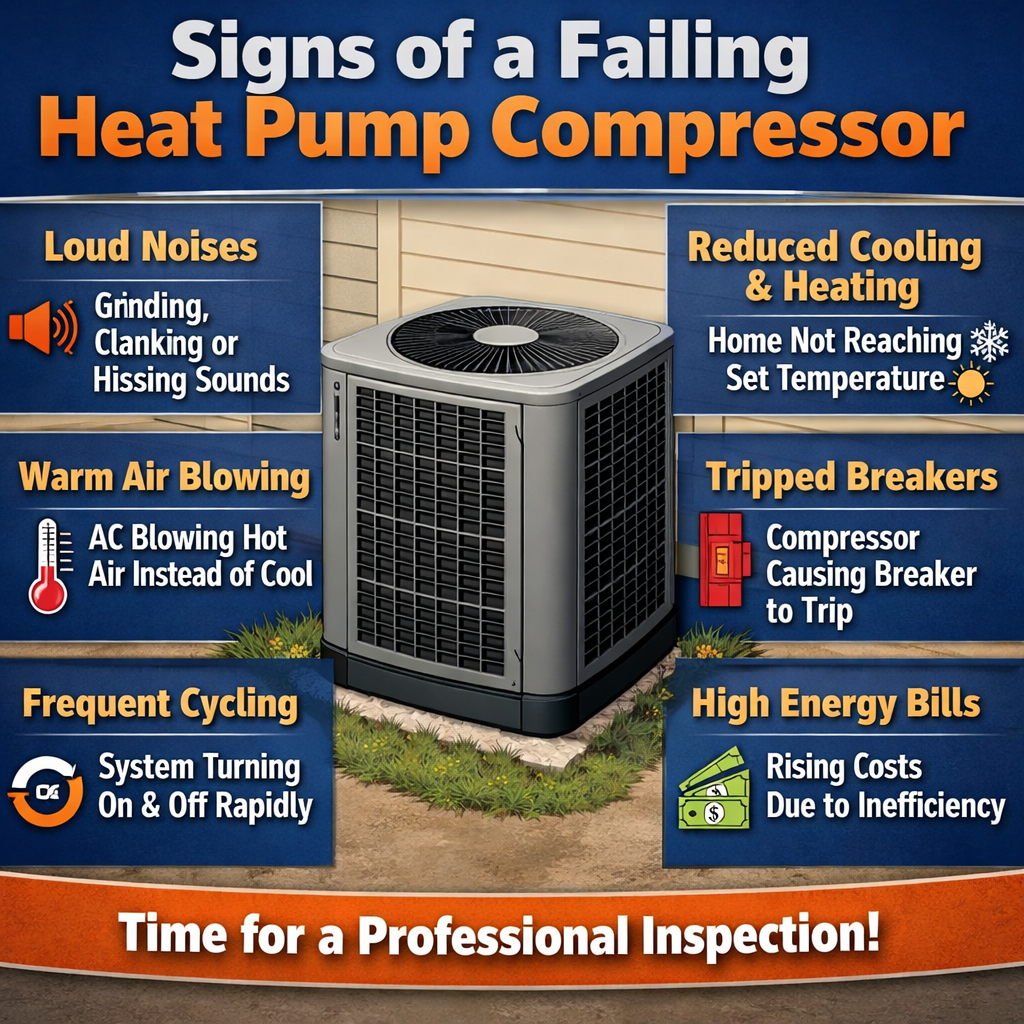
Quick Answer: The most common signs of compressor failure include loud noises, breaker trips, weak heating or cooling, and the outdoor unit running without producing temperature change.
Homeowners may notice:
- Loud humming or buzzing sounds
- Outdoor unit running but no heating or cooling
- Breaker trips when the system starts
- Longer system run times
- Rising electricity bills
A struggling compressor often causes the system to run longer cycles while delivering reduced heating performance.
Why Does My Heat Pump Click but Not Start?
Quick Answer: A clicking sound without the compressor starting often indicates a failed capacitor, contactor, or compressor hard-start problem.
The capacitor provides the electrical boost needed to start the compressor motor. When the capacitor fails, the compressor may attempt to start repeatedly but never fully engage.
This often results in:
- Clicking noises from the outdoor unit
- Compressor humming without starting
- System failing to begin a heating cycle
Electrical component testing is usually required to diagnose the issue.
What Is a Locked Compressor?
Quick Answer: A locked compressor occurs when the internal motor cannot rotate, preventing the compressor from starting.
This condition may cause:
- Loud humming sounds
- Breaker trips when the system starts
- The outdoor unit attempting to start repeatedly
Locked compressors usually occur due to internal mechanical damage or severe electrical failure.
Can Low Refrigerant Damage a Heat Pump Compressor?
Quick Answer: Yes. Low refrigerant levels can cause the compressor to overheat and operate outside normal pressure ranges.
Refrigerant carries heat away from the compressor during operation. When levels drop too low, internal temperatures rise and mechanical strain increases.
Refrigerant contamination or acid buildup inside the system can also damage compressor components.
Signs may include:
- Reduced heating performance
- Ice buildup on system components
- Longer heating cycles
Can Airflow Problems Lead to Compressor Damage?
Quick Answer: Yes. Restricted airflow can increase system pressure and force the compressor to work harder than designed.
Common airflow restrictions include:
- Dirty air filters
- Blocked supply or return vents
- Dust buildup on coils
- Duct airflow restrictions
Most heat pump systems require approximately 350–450 cubic feet per minute (CFM) per ton of airflow. Reduced airflow can significantly increase compressor strain.
How Can Homeowners Prevent Compressor Damage?
Quick Answer: Regular maintenance, proper airflow, and maintaining correct refrigerant levels help reduce compressor strain.
Helpful steps include:
- Replace air filters every 1–3 months
- Keep 2–3 feet of clearance around the outdoor unit
- Schedule annual HVAC maintenance
- Address refrigerant leaks promptly
These steps help protect the compressor and maintain system efficiency.
Quick Troubleshooting Checklist
Quick Answer: Homeowners can check several basic conditions before scheduling HVAC service if compressor problems are suspected.
Basic checks include:
- Replace a dirty air filter
- Confirm thermostat settings
- Check the HVAC breaker panel
- Inspect vents for obstructions
- Listen for unusual noises from the outdoor unit
If the system still fails to heat or cool properly, professional service is recommended.
When Should You Call an HVAC Technician?
Quick Answer: If the heat pump stops heating or cooling, repeatedly trips the breaker, or produces loud mechanical noises, the compressor or related components should be inspected by a technician.
HVAC technicians in the Steubenville and Weirton area frequently diagnose compressor problems in systems that have operated for more than a decade without major component replacement.
Professional inspection may include:
- Refrigerant pressure testing
- Electrical component testing
- Compressor performance evaluation
- System efficiency inspection
Key Takeaways
Quick Answer: A failing compressor can prevent a heat pump from heating or cooling properly.
Common warning signs include:
- Loud noises from the outdoor unit
- Breaker trips when the system starts
- Weak or no heating or cooling
- Longer system run times
- Rising electricity bills
Early inspection can help prevent further damage to the HVAC system.
FAQs
How long should a heat pump compressor last?
Quick Answer: Most heat pump compressors last 10–15 years, depending on system maintenance, operating conditions, and seasonal workload.
What are the first signs of compressor failure?
Quick Answer: Early warning signs often include humming noises, weak heating or cooling output, and the outdoor unit running without producing temperature change.
Can a compressor be repaired?
Quick Answer: Electrical components connected to the compressor can sometimes be repaired, but internal compressor damage usually requires replacement.
Does compressor failure mean replacing the entire heat pump?
Quick Answer: Not always. However, if the system is older, replacing the entire heat pump may be more cost-effective than installing a new compressor.
Exact HVAC replacement quotes available at (740) 825-9408 or HonestFix.com/schedule-service.
Scott Merritt is a co-founder of Honest Fix Heating, Cooling and Plumbing and brings more than 30 years of experience across HVAC, leadership, and industry education. He serves in a senior leadership and oversight role, providing licensed guidance, reviewing HVAC educational content, and supporting technician training and documentation standards. Prior to co-founding Honest Fix, Scott founded and owned Fire & Ice Heating & Air Conditioning in Columbus, Ohio, which he operated for more than two decades before selling the company in 2025. During that time, he led programs and partnerships including Carrier Factory Authorized Dealer, Trane Comfort Specialist, and Rheem Pro Partner, helping establish high technical and training standards. Scott is the Ohio State HVAC license holder for Honest Fix and provides licensed oversight to help ensure work meets applicable codes and manufacturer requirements. Learn more about Scott’s background and role at Honest Fix by viewing his full leadership bio.